Weird Medical History · Biology
The Surgeon Who Planted a Human Tooth in a Rooster's Comb
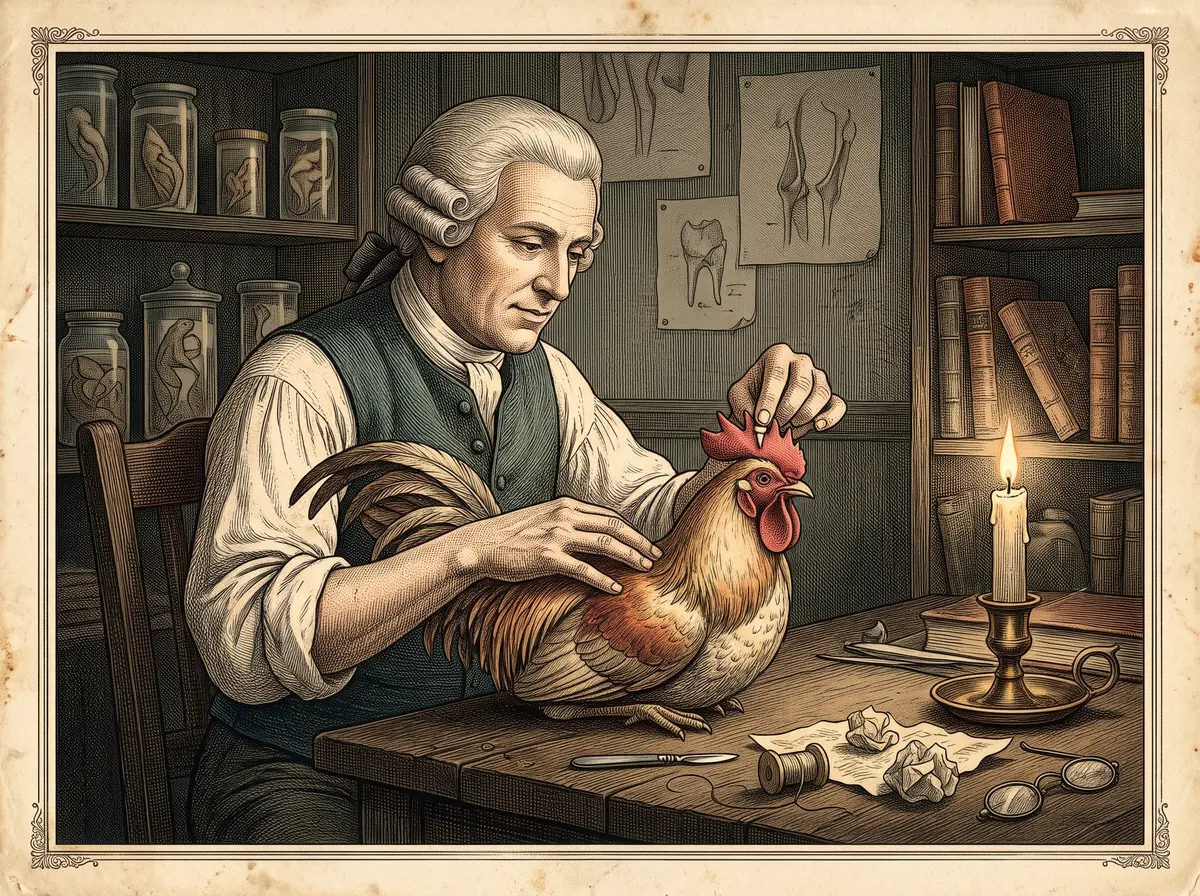
In 18th-century London, the surgeon John Hunter took a healthy human tooth, cut a deep slit in the red, fleshy comb on top of a rooster's head, and pressed the tooth's root into the wound. He tied it in place with thread and let the bird go about its life. A few months later, the rooster was strutting around with a human tooth sticking out of its head. You can still see it today, preserved in a London museum.
By the Curiosities Desk · · 5 min read · Filed under Biology · Today’s round
What happened: The Surgeon Who Planted a Human Tooth in a Rooster's Comb
John Hunter (1728–1793) was one of the most restlessly experimental surgeons of 18th-century Britain. He dissected animals and people constantly, built a collection of thousands of anatomical specimens, and tested almost every idea he had on something alive. Teeth were one of his big subjects. His book The Natural History of the Human Teeth came out in 1771, and a second part on dental diseases and treatments followed in 1778.
One of the treatments Hunter championed was tooth transplantation. The idea was simple, if alarming: pull a healthy tooth from one person’s mouth and push it into the empty socket of another. According to the Royal College of Surgeons of England, the new tooth was then tied to its neighbors with silk or seaweed until it settled in. Hunter even borrowed a gardener’s word for the donor tooth, calling it the “scion,” the same term used for a twig grafted onto a fruit tree.
But a big question nagged at him. Was a transplanted tooth just a peg wedged into a hole, or could it actually become living tissue in its new home, connected to the host’s blood supply? To find out, he needed a test bed that was soft, warm, and full of blood vessels. A rooster’s comb fit the bill.
Hunter described the experiment in his writing on teeth. He took a sound tooth, made a deep wound in the thick part of the comb, pressed the root in, and fastened it with threads. “The cock was killed some months after,” he wrote, “and I injected the head with a very minute injection.” Injection here meant filling the blood vessels with a colored wax or liquid so they would show up clearly. After softening the comb in weak acid and slicing both comb and tooth lengthwise, he reported that he “found the vessels of the tooth well injected,” and that the tooth’s outer surface was joined to the comb by vessels, much like a tooth joins to the gum and socket.
He was candid that this was not a reliable result. “I succeeded but once out of a great number of trials,” he admitted, as quoted by Londonist from his treatise.
That specimen, a rooster’s head with a human tooth poking up from its comb, is catalogued as RCSHC/P 56 and is held by the Hunterian Museum at the Royal College of Surgeons in London.
Why it was strange: The Surgeon Who Planted a Human Tooth in a Rooster's Comb
Moving body parts between species sounds like something out of a gothic novel, and in the 1770s there was no theory of immunity, no anesthetic, and no germ theory. He wasn’t trying to give roosters better smiles. He was using a bird’s comb as a living test tube to ask a serious biological question: are teeth alive, and can living tissue knit itself to a foreign part?
It’s also worth noting what the experiment didn’t prove. Historian Thomas Morris points out there’s no record of Hunter ever using an animal tooth in a human patient. And modern writers, including at IFLScience, have doubted whether the “vessels” Hunter saw really meant the tooth had become living tissue. With one success out of many tries, and an 18th-century microscope, it’s hard to know exactly what he was looking at.
For another bird that ended up at the center of medical history, see The Rooster Diagnosed by Mail With Malaria, Diabetes, Cancer, and Syphilis.
What scientists learned: The Surgeon Who Planted a Human Tooth in a Rooster's Comb
Hunter’s real lesson came from his human patients. Transplanted teeth could hold on for a while, but the Royal College of Surgeons notes that “long-term success was rare”: the teeth tended to loosen and fail over time. Today we know a big reason why. The body’s immune system recognizes tissue from another person as foreign and slowly attacks it, a process called rejection. Hunter had no word for it, but his loosening teeth were showing it to him.
There was a darker problem too. The same source calls “the danger of cross infection from donor to recipient” more serious still. Teeth pulled from one mouth and pushed into another could carry disease with them, and transplanted teeth were blamed for passing on syphilis.
The trade also rested on inequality. Donors were often poor, sometimes children, selling healthy front teeth to wealthy patients for little reward. Thomas Rowlandson’s 1787 etching Transplanting of Teeth skewered the practice, showing a young chimney sweep having his teeth pulled for a fashionable client.
For the myth that grew up around another famous set of 18th-century teeth, see George Washington’s Wooden Teeth — Which Were Never Made of Wood.
How it reaches us today: The Surgeon Who Planted a Human Tooth in a Rooster's Comb
Tooth transplants between people faded out in the early 19th century, when realistic false teeth made them unnecessary, according to Londonist’s account of the Hunterian specimen. But Hunter’s core question, whether living tissue will accept a part from elsewhere, sits at the heart of every modern transplant, from kidneys to corneas.
Dentistry still uses a version of his idea, with the risky parts removed. Dentists can sometimes move a patient’s own tooth, such as an unneeded wisdom tooth, into a gap elsewhere in the same mouth. Because the tooth comes from the same body, rejection isn’t the problem it was for Hunter’s donors. And when an adult tooth gets knocked out, the standard advice is to get to a dentist fast so it can be put back in its own socket, a reminder that a tooth really is living tissue, just as Hunter suspected.
For an even stranger chicken in science, see The Chicken That Lived 18 Months After Losing His Head.
If you’ve lost or damaged a tooth, a dentist can tell you what your options are, and acting quickly often gives you more of them.
Fun fact: The Surgeon Who Planted a Human Tooth in a Rooster's Comb
The tooth wasn’t the only thing Hunter grafted onto a rooster’s comb. He also moved a spur from a bird’s foot up to its comb, where it kept growing into a spiral horn about six inches long. A watercolor of that horned head survives in the Wellcome Collection.
Sources: The Surgeon Who Planted a Human Tooth in a Rooster's Comb
- Thomas Morris, “Reeking from the jaw of the living animal” — quotes Hunter’s own description of the cock’s comb experiment (2016)
- Royal College of Surgeons of England Library, “Transplanting of Teeth” — on Hunter’s method, its failures, cross-infection, and Rowlandson’s 1787 etching
- Londonist, “From The Hunterian: The Cockerel’s Tooth” — on Hunterian Museum specimen RCSHC/P 56 (2009)
- Wellcome Collection, “Head of a Maltese cock” — Thomas Godart’s watercolor of Hunter’s spur-to-comb graft
- John Hunter, The Natural History and Diseases of the Human Teeth, in The Complete Works of John Hunter, Vol. II (1841 edition) — primary source, National Library of Medicine