Impossible Inventions · Archaeology
The Tomb Lamps Said to Have Burned for 1,500 Years — and Went Out the Moment Anyone Looked
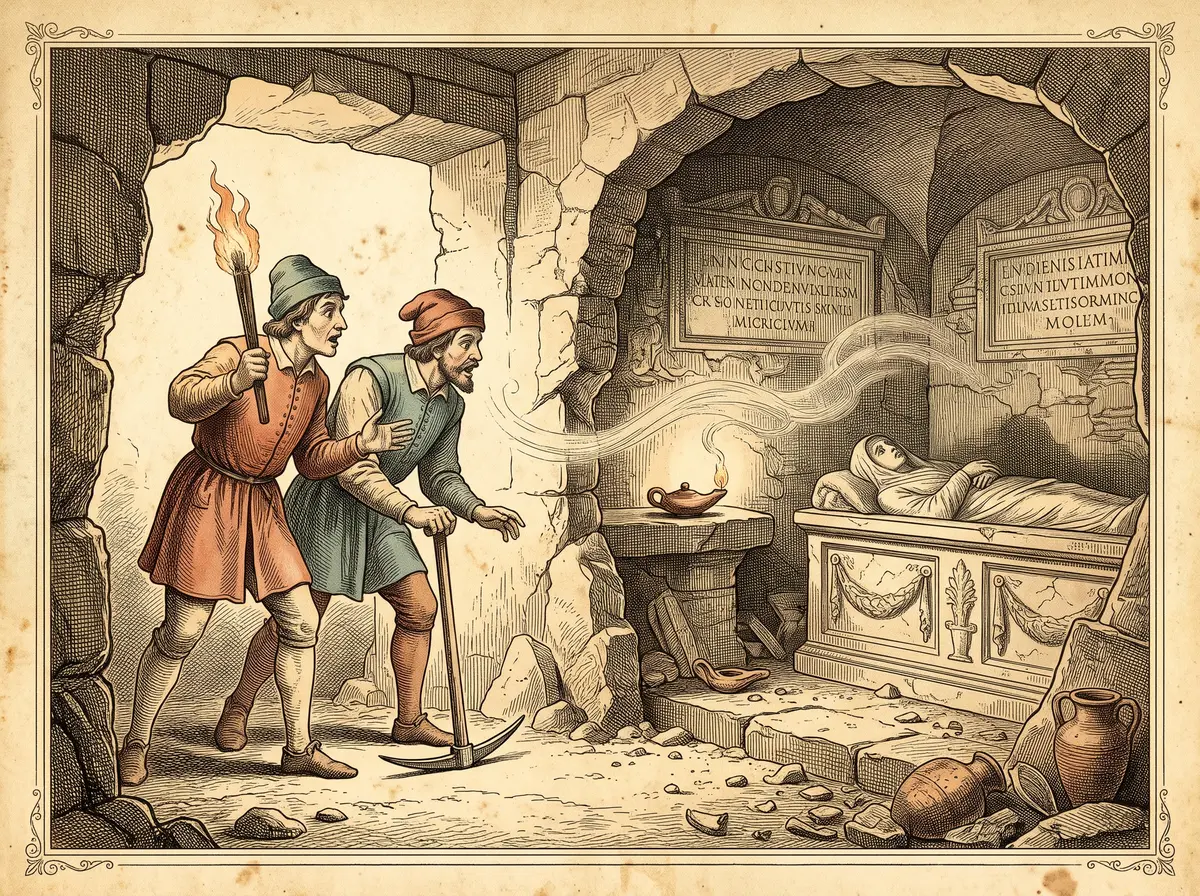
In the late 16th century, Guido Panciroli told of workmen breaking into a sealed Roman tomb on the Appian Way. Inside lies a young woman whose body looks as if she was buried that morning. Beside her, a small lamp is still burning, supposedly lit some 1,500 years earlier. Then the fresh air rushes in. The flame flickers and dies. In some tellings, the body crumbles to dust as well. The lamp has kept going for fifteen centuries, and it lasts exactly until someone arrives to see it.
By the Curiosities Desk · · 5 min read · Filed under Archaeology · Today’s round
Part of Built to Do the Impossible
What happened: The Ever-Burning Lamps
The story begins with something that really did happen. In April 1485, workmen digging for marble along the Via Appia, about six miles outside Rome, broke open a marble sarcophagus. Inside, under a layer of fragrant bark, was the body of a Roman girl, remarkably well preserved. Bartolomeo Fonzio, a literature professor in Florence, described her in a letter to a friend, and another witness, Daniele da San Sebastiano, wrote that the coating held myrrh, frankincense, and aloe, and that she looked as though she had been buried that day. Crowds came to see her. According to some reports, Pope Innocent VIII, uneasy at the attention, had her quietly reburied outside the city walls.
Rumor soon named her Tulliola, the beloved daughter of the orator Cicero, who died in February 45 BC. Nobody could prove that. And none of the early eyewitness accounts mentions a lamp.
The lamp arrived later. In the late 16th century, the Italian legal scholar Guido Panciroli (1523–1599) was reporting that Tullia’s tomb had held a lamp that had burned for more than 1,550 years. Retellings moved the discovery around, some placing it in the time of Pope Paul III in the 1540s, and added the detail that the flame went out the moment the tomb was opened.
Tullia’s lamp had company. A second famous lamp was said to have been found around 1500 near Padua: an urn inside an urn, with a lamp still burning between two little flasks, one of gold and one of silver, full of liquid. It came with Latin inscriptions dedicating it to Pluto and naming a man called Olybius, and it too went out once it met the air. In 12th-century England, the historian William of Malmesbury told of a giant’s tomb near Rome whose lamp, “constructed by magical art,” vanished when someone pierced it with an iron stylus.
These stories became serious scholarship. In 1621 Fortunio Liceti, a philosophy professor at Padua, published De lucernis antiquorum reconditis (“On the Hidden Lamps of the Ancients”), a long treatise arguing that a perpetual flame was plausible and could have natural causes, with no demons required. He proposed fuels that might never run out, or lamps in which the smoke somehow turned back into oil. The German Jesuit Athanasius Kircher suggested a wick made of asbestos, the fibrous mineral that does not burn. Debate ran for decades. In 1670 the scholar Ottavio Ferrari published a dissertation on ancient tomb lamps that rejected the perpetual flame outright.
Why it was strange: The Ever-Burning Lamps
Look at the pattern. Every ever-burning lamp is discovered burning and then goes out within moments, usually at the exact instant a witness gets a good look. That makes the claim almost impossible to check. A lamp that has burned for 1,500 years and is found already dark is just an old lamp. The legend had an escape hatch built in.
The physics was against it, too. A flame is a chemical reaction that consumes fuel and oxygen. In a sealed stone box, a lamp would use up the oxygen and go out in minutes, not centuries. A wick that never burns, like asbestos, does nothing about fuel that does.
The evidence was shakier than the legend’s popularity suggested. In the 19th century, the great German classicist Theodor Mommsen judged both Olybius inscriptions to be forgeries.
For another machine that was supposed to run forever, see The Perpetual Motion Machine Secretly Powered by an Old Man Upstairs Eating Bread.
What scientists learned: The Ever-Burning Lamps
The lamp debate pushed scholars to ask a sharper question: what does a flame actually need? Liceti’s fuels and Kircher’s wicks were attempts to explain the legend with nature rather than magic, and their rivals answered with the same tools. Once 17th- and 18th-century chemists showed that burning depends on something in the air, now known to be oxygen, a sealed lamp burning for centuries was no longer a mystery to solve. It was a story that could not be true.
Some of the inspiration was real, though. The Greek travel writer Pausanias, in the second century AD, described a lamp made by the sculptor Callimachus for Athena on the Athenian Acropolis. Attendants filled it with oil once a year, and it burned day and night until the next filling, using a wick of “Carpasian flax,” which his translator identifies as probably asbestos. St. Augustine, writing in the 420s, mentioned a lamp in a temple of Venus that no wind or rain could put out, and he guessed it might be fitted with asbestos. Asbestos wicks really can last a long time. The oil is what runs out.
For another temple gadget built to amaze worshippers, see The Coin-Operated Holy Water Machine That Beat the Vending Machine by 1,800 Years.
How it reaches us today: The Ever-Burning Lamps
The ever-burning lamp never existed, but the impulse behind it is easy to recognize. Romans did honor their dead with lamps, and scenes of lamps on tall stands beside a funeral bier appear in Roman tomb reliefs. Today, eternal flames burn at memorials around the world. The difference is a gas line and a maintenance crew.
The legend also shows how a story grows. A real, well-documented 1485 discovery gained a famous name through rumor, then a magic lamp, then a dramatic ending in which it vanished. Historians now treat each added detail as a clue to when, and why, people wanted the story to be more wonderful than it was.
Whether it ever flickered or not, the tomb lamp belongs with the machines in Built to Do the Impossible.
Fun fact: The Ever-Burning Lamps
The idea that a lamp would keep a secret only until the air reached it caught on in English literature: the physician Sir Thomas Browne compared a well-kept secret to “the Lamp in Olybius his Urn,” alive and burning but invisible.
Sources: The Ever-Burning Lamps
- Augustine, The City of God, Book 21, chapter 6 — trans. Marcus Dods (primary source)
- Pausanias, Description of Greece 1.26.6–7 — Perseus/Perseids (primary source)
- Edward Bensly, notes on “Olybius’s Lamp” — in Sir Thomas Browne’s Christian Morals, hosted by the University of Chicago
- Alessandro Ottaviani, “Salamandre e lucerne: erudizione e storia naturale fra due accademie” — Scientia 1(1), 2023
- “The Discovery of a Roman Girl in the 15th Century” — Medievalists.net (on Bartolomeo Fonzio’s 1485 letter)