The Toys NASA Flew Into Orbit — Where the Slinky Wouldn't Slink and the Wind-Up Mouse Never Landed
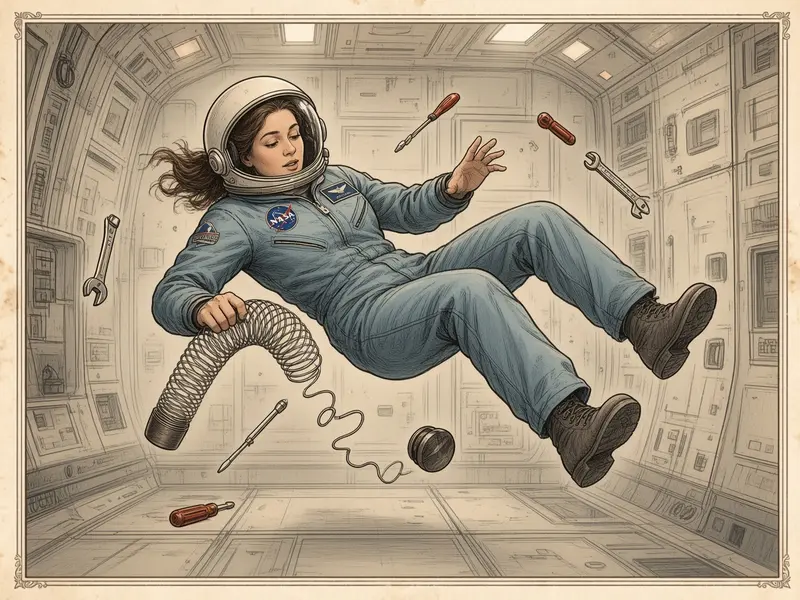
In April 1985, a space shuttle crew that had just launched two satellites set aside time for a different job. Mission specialist Rhea Seddon floated on Discovery's middeck, stretched out a Slinky, and waited for it to do its famous walk. It didn't. "It really won't slink at all," she reported. "It sort of droops over."
By the Curiosities Desk · · 5 min read · Filed under Space · Today’s round
What happened: The Slinky in Orbit
The mission was STS-51-D, the fourth flight of the space shuttle Discovery. It launched from Kennedy Space Center on April 12, 1985, and landed there on April 19. Its seven-person crew, commanded by Karol Bobko, had serious work to do: deploy a Canadian communications satellite and one leased to the U.S. Navy, run medical and materials experiments, and, after the Navy’s satellite failed to start its engine, stage an unplanned spacewalk. The crew also included Senator Jake Garn of Utah, who was busy becoming a legend of a different kind.
Tucked into the cargo list, NASA’s own mission summary records something unusual: “an informal study of the behavior of simple toys” in weightlessness, with results to be shared with schoolchildren once the shuttle came home.
The idea came from Carolyn Sumners, an educator at the Houston Museum of Natural Science. She reasoned that kids already knew exactly how a yo-yo or a toy car behaved. Show them the same toy in orbit, and the strange new behavior would teach physics better than a lecture. According to a later NASA teaching guide, Discovery carried the first 11 toys into orbit. Contemporary accounts list a yo-yo, a Slinky, a paddleball, a paper airplane, jacks, magnetic marbles, a gyroscope, a toy car, a Wheel-O (a magnetic wheel that rolls along metal rails), and a spring-loaded wind-up mouse nicknamed “Rat Stuff.”
The crew filmed themselves playing. UPI, reporting on the videotape on April 15, captured the results.
Seddon’s Slinky drooped. Her game of jacks went no better: the rubber ball bounced as expected, but when it hit the jacks, they tumbled off in every direction. “The biggest problem,” she said, “is to keep your jacks from floating all over the cabin while you’re chasing the ball.”
Pilot Donald Williams, a part-time juggler, released Rat Stuff. On Earth, the little mouse leaps, does a backflip, and lands on its feet. In orbit, it flipped and simply kept drifting across the cabin, with no floor to come back to. “It’s a good thing Rat Stuff doesn’t get dizzy,” Williams said.
Mission specialist David Griggs took the yo-yo, flinging it out at angles that are nearly impossible on Earth. He introduced the segment as “the first and probably the last yo-yo show in space.” Jeffrey Hoffman demonstrated the Wheel-O. And Senator Garn launched a paper airplane, which, he said, “flies very much as it does on Earth except much more slowly and much easier.”
Why it was strange: The Slinky in Orbit
Every pound of shuttle cargo was argued over, yet NASA found room for a bag of toy-store toys.
The deeper surprise was what the toys revealed. Most of us never notice how much of an ordinary toy’s “personality” is really gravity. A Slinky doesn’t walk because of some clever spring; it walks because gravity pulls the top coils down over the step. A yo-yo “sleeps,” spinning at the bottom of its string, because gravity keeps it there. Rat Stuff lands on its feet because there is a floor and something pulling him toward it. Take gravity away, and these familiar objects stop doing the thing they’re famous for.
The flight also gave Senator Garn the reputation that lives on in The Senator Who Went to Space and Came Back as a Unit of Nausea.
What scientists learned: The Slinky in Orbit
None of this was new physics; Isaac Newton could have predicted every result. The toys made the laws visible.
The first lesson is inertia: an object keeps doing what it’s doing unless a force changes it. Seddon’s jacks, knocked by the ball, kept going until they hit a wall. Rat Stuff, once flipped, kept rotating and drifting.
The second is what microgravity really means. Astronauts in orbit are not beyond Earth’s gravity; it is still roughly 90 percent as strong at shuttle altitude. They feel weightless because they and their spacecraft are falling around Earth together, so nothing presses against anything else. That’s why a toy that depends on “down” loses its bearings.
The third is what doesn’t change. Spin still matters. A NASA guide to later toy flights on the International Space Station reported that a top stayed remarkably stable for as long as it spun, a vivid demonstration of gyroscopic stability (a spinning object’s tendency to hold its orientation). The same guide explained the yo-yo: “there is no force in space to hold the yo-yo in the loop at the bottom of the string,” so instead of sleeping, it bounces back. Garn’s paper plane, meanwhile, still had air to fly through. The cabin was full of it, so the wings still worked.
The original Slinky story, by the way, is its own accident: The Slinky: The Walking Spring That Fell Off a Navy Workbench.
How it reaches us today: The Slinky in Orbit
The experiment kept coming back. In January 1993, the STS-54 crew flew a second set of toys (including a flipping mouse, a swimming frog, a Slinky, and a basketball hoop) selected by Sumners and a group of educators. A 1996 shuttle flight returned toys that hadn’t yet been tested. In 2002, the Expedition 5 crew aboard the International Space Station tested 16 toys and sports from around the world, including a top, a yo-yo, a jump rope, and a kendama, a Japanese cup-and-ball game.
The videotapes went to schools, and a NASA guide later reported they had been used as a teaching tool in thousands of schools. The approach stuck, too: astronauts still bring small familiar objects into orbit to show how physics behaves without a “down.” A Buzz Lightyear action figure spent about 15 months on the space station starting in 2008, and it now belongs to the Smithsonian’s National Air and Space Museum.
The idea itself is the legacy. To explain something huge, start with something a child already knows by heart. The toys belong on The Ordinary Object With the Strange Origin.
Fun fact: The Slinky in Orbit
David Griggs called his 1985 performance “the first and probably the last yo-yo show in space.” He was wrong in the best way: yo-yos kept flying, and in 2002 cosmonaut Sergei Treschev was doing yo-yo demonstrations aboard the International Space Station.
Sources: The Slinky in Orbit
- NASA, STS-51D mission summary: https://www.nasa.gov/mission/sts-51D
- NASA, International Toys in Space: Science on the Station video resource guide (ED-2004-06-001-JSC): https://www.nasa.gov/stem-content/international-toys-in-space-video-resource-guide
- UPI Archives, “Toys in space” (April 15, 1985): https://www.upi.com/Archives/1985/04/15/Toys-in-space/6791482389200/
- The Christian Science Monitor, “Shuttle’s first ‘fun-and-games’ flight” (April 11, 1985): https://csmonitor.com/1985/0411/agarn-f.html
- Smithsonian National Air and Space Museum, “Toys in Space” (Google Arts & Culture): https://artsandculture.google.com/story/toys-in-space-smithsonian-national-air-and-space-museum/cgXxkg5p2YrIKA