The Walking Stick That Whistled at Lions — and Became the Dog Whistle
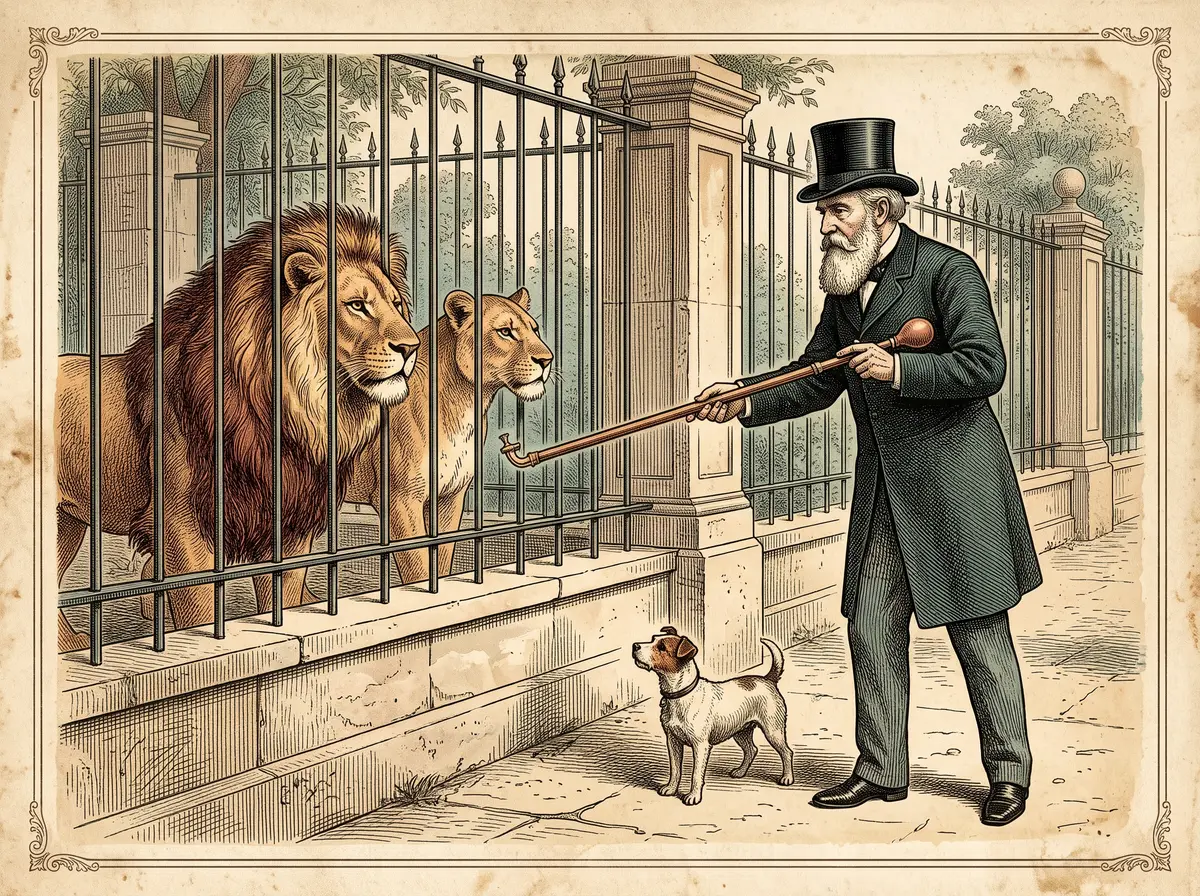
Around 1876, Francis Galton strolled from cage to cage at the Zoological Gardens in London carrying what looked like an ordinary walking stick. It wasn't. The cane was hollow, a tiny brass whistle was fitted into its tip, and a rubber tube was tucked under the handle. Whenever he squeezed it, the stick let out a note too shrill for most adults to hear. Most of the animals ignored him. The lions, he reported, did not. They turned away and rubbed themselves irritably, as if something invisible were bothering them.
By the Curiosities Desk · · 5 min read · Filed under Biology · Today’s round
What happened: The Dog Whistle
The man with the cane was Francis Galton, an English scientist and Charles Darwin’s half-cousin. Galton was famously obsessed with measuring things: fingerprints, weather, the speed of people’s reactions. Around 1876 he turned that habit to hearing. He wanted to know the highest note a person could hear, and whether that limit changed from one person to the next.
He had no instrument for it, so he made one. The Galton whistle was a small brass tube with a narrow slit at one end. Air forced through the tube escaped at the slit and made a tone. A plug inside the tube could be screwed in or out to shorten or lengthen the air chamber. A shorter chamber gave a higher note, and markings on the plug let him record exactly which setting someone could no longer hear.
Testing people turned up a pattern right away. Young people heard notes that older people could not. In his 1883 book Inquiries into Human Faculty and Its Development, Galton remarked that people who were deaf to the shrillest notes were often unhappy to find out. In his 1908 memoir, he added that schoolboys could signal each other with a whistle their elderly teacher couldn’t hear.
Then he got curious about animals. He couldn’t ask a cat which notes it heard, but he could watch its ears. From an upstairs bedroom window overlooking a garden that cats liked to visit, Galton waited until a cat was relaxed and absorbed, then blew a note that most older people couldn’t hear. “The cat was round in a minute,” he wrote in his memoir.
To take the test on the road, he built the walking stick. The whistle sat at the bottom end, and squeezing the rubber tube under the handle pushed air down the hollow cane to sound it. He could hold the whistle near an animal’s ear without looking like he was doing anything at all. He walked through town streets with it and found that it “made nearly all the little dogs turn round, but not the large ones.” He spent hours sounding it near big dogs and couldn’t get a reaction. Once, he startled a pony in the middle of a large field.
At the Zoological Gardens he tried the stick at nearly every cage. Most of it, he admitted in his memoir, was uneventful. Galton was also careful about what a non-response meant. An animal that ignored the whistle might hear it perfectly well and simply not care. Insects, which he also tried, gave him no useful results.
Why it was strange: The Dog Whistle
Galton was measuring something nobody could perceive, including, past a certain age, himself. The whole experiment depended on a silent signal and a twitching ear. It was one of the first systematic attempts to compare what different species can hear, and it was carried out with a disguised walking stick in a public park.
His results also overturned a common assumption: bigger animals did not have “better” hearing. In his tests the small creatures, cats and small dogs, responded to the highest notes, while the lions only seemed bothered. Galton suggested that the lions might feel the sound as discomfort without hearing it as a note, a feeling he said he had sometimes experienced himself. That’s his guess, not a measured result. More stories like this one are collected in The Ordinary Object With the Strange Origin.
What scientists learned: The Dog Whistle
Pitch is set by frequency, the number of sound-wave vibrations per second, measured in hertz (Hz). Galton estimated that the normal upper limit of human hearing was around 18,000 Hz. That is close to modern figures: children can often hear up to about 20,000 Hz, and the limit usually falls with age, a change audiologists call presbycusis, or age-related hearing loss.
Galton’s explanation for the cats was evolutionary. Cats, he argued, had been shaped by natural selection to hear the high squeaks of mice. Modern measurements back up the broad pattern. Cats hear up to roughly 64,000 Hz and dogs up to about 45,000 Hz, both far beyond any human ear. Galton’s method was crude, but the idea of comparing species by their upper limit held up. After him, researchers used refined Galton whistles to test the hearing of reptiles, insects, hedgehogs, bats, and rats. Another early experimenter tested fish hearing with a whistle too, in The Opera Singer Who Serenaded a Catfish — and the Whistle That Proved Fish Can Hear.
How it reaches us today: The Dog Whistle
For decades, the Galton whistle was standard equipment in psychology and physiology labs. Manufacturers sold versions with printed frequency tables, and one maker added a diaphragm to stop users from “over-blowing” it. Today its best-known descendant is the dog whistle. Most dog whistles sound somewhere between about 23,000 and 54,000 Hz, so the dog hears a clear call and the owner hears little more than a hiss.
Galton’s discovery that younger people hear higher notes returned in the 2000s. Howard Stapleton’s “Mosquito” device used a high-pitched tone, audible mainly to teenagers and young adults, to discourage them from gathering outside shops. It won the 2006 Ig Nobel Peace Prize. Galton’s legacy is mixed in other ways: the same 1883 book introduced the word “eugenics,” the movement he championed that later caused enormous harm. The whistle is one of his more harmless inventions. Another everyday object that started with a curious man and a dog is The Burrs Stuck to a Dog That Became Velcro.
Fun fact: The Dog Whistle
The Science Museum Group in London holds an early Galton whistle in a rough wooden case with two glass panels: one labeled, in French, “Sifflet de Galton,” the other printed with a table of numbers.
Sources: The Dog Whistle
- Francis Galton, Inquiries into Human Faculty and Its Development (1883), “Whistles for Audibility of Shrill Notes,” via galton.org: https://galton.org/books/human-faculty/text/html/galton-1883-human-faculty49.html
- Francis Galton, Memories of My Life (1908), via galton.org: https://galton.org/cgi-bin/searchImages/search/books/memories/pages/memories_0256.htm
- Nick Joyce and David B. Baker, “The Galton Whistle,” APS Observer (Association for Psychological Science): https://www.psychologicalscience.org/observer/the-galton-whistle
- Science Museum Group Collection, “Galton’s whistle, in case with two glass panels” (object 1996-277/2): https://collection.sciencemuseumgroup.org.uk/objects/co432708/galtons-whistle-in-case-with-two-glass-panels
- George M. Strain, “How Well Do Dogs and Other Animals Hear?” Louisiana State University School of Veterinary Medicine: https://lsu.edu/deafness/HearingRange.html