Strange Animals Scientists Studied · Physics
The Water Bears Scientists Froze, Loaded Into a Gun, and Fired Into Sand
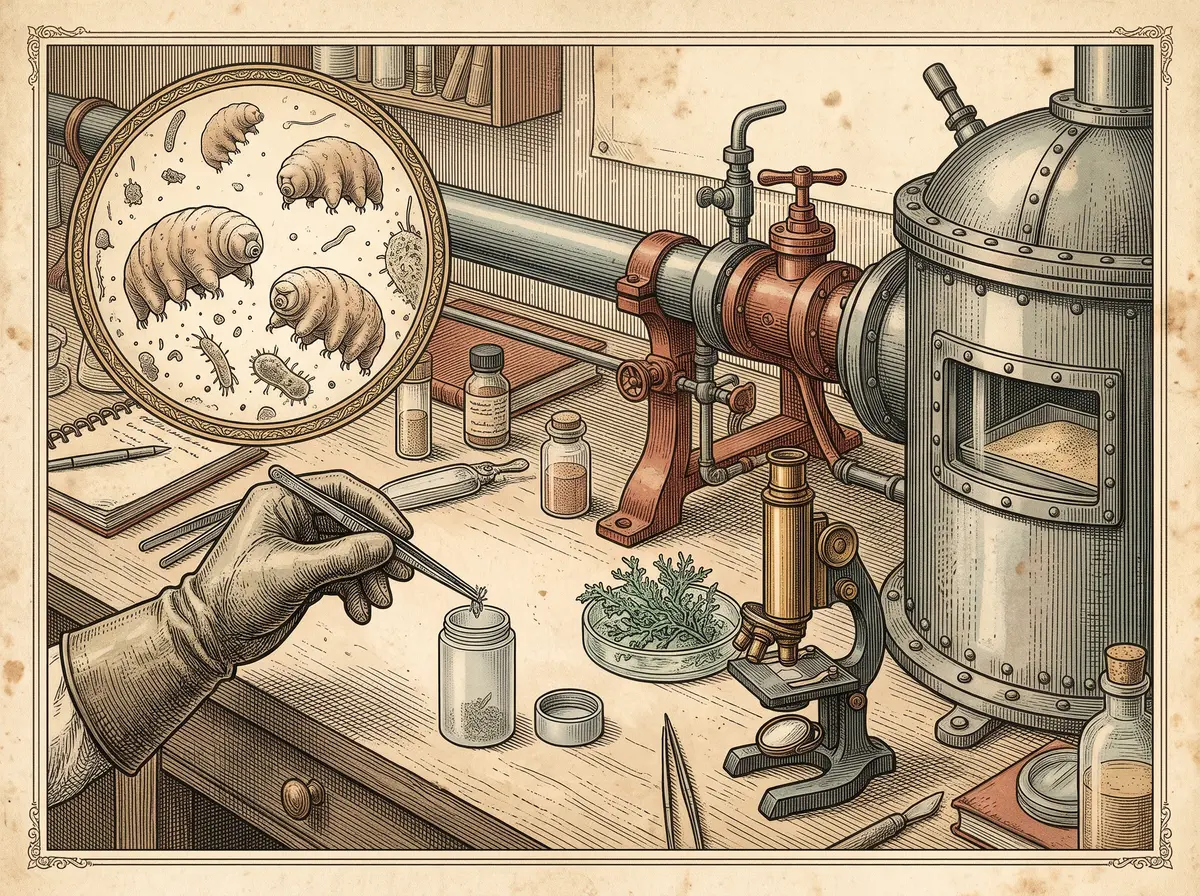
In 2021, at the University of Kent in England, Alejandra Traspas fed a few tiny animals a last meal of moss and mineral water, froze them solid inside a nylon capsule, and loaded the capsule into a gun. The gun was fired into a vacuum chamber at a target of sand. Then someone sifted through the sand, found the animals, and waited to see whether they would start walking again. Some of them did.
By the Curiosities Desk · · 5 min read · Filed under Physics · Today’s round
Part of Creatures That Changed Science
What happened: The Frozen Water Bears
The animals were tardigrades, nicknamed water bears: plump, eight-legged creatures that the Kent team measured at roughly 0.15 to 0.85 millimeters long. Tardigrades are famous for surviving things that would kill almost anything else. When they dry out or freeze, they pull in their legs and shrivel into a dormant state called a “tun,” in which their metabolism drops to a tiny fraction of normal. In that state they have survived deep cold, radiation, and even exposure to open space.
In 2021, astrochemist Alejandra Traspas and space scientist Mark Burchell set out to test something those earlier experiments hadn’t: a sudden, violent blow. Traspas did the work for her master’s degree at Kent, where Burchell runs a two-stage light gas gun. Gunpowder drives a piston that squeezes hydrogen gas, and the compressed hydrogen then shoves the projectile down the barrel. Guns like this can reach speeds of several kilometers per second. Planetary scientists use them to imitate meteorite and space-debris impacts.
The species was Hypsibius dujardini, a freshwater tardigrade. After feeding, two or three animals at a time were sealed in a water-filled hollow in a nylon “sabot,” a carrier shell that holds a small payload inside a gun barrel. Each sabot was frozen for 48 hours so the animals would be in their tun state. Then the team fired six shots at a sand target sitting in a vacuum chamber, at speeds from 556 to 1,000 meters per second, measured as the sabot passed through laser beams.
After each shot, the sand was poured into water so the tardigrades could be found under a microscope. A control group of 20 frozen tardigrades that were never fired all revived, typically within eight to nine hours.
The results drew a sharp line. Tardigrades that hit the sand at up to 825 meters per second, roughly 1,850 miles per hour, could recover and move again, though they took noticeably longer than the controls. By 901 meters per second, none survived. In the fastest shots, the team recovered only fragments. In their paper, published in the journal Astrobiology, the authors wrote that just after the onset of lethality, the tardigrades “were also physically broken apart” as speeds rose.
Why it was strange: The Frozen Water Bears
The obvious puzzle is why anyone would shoot an animal that small out of a gun on purpose. The answer is a very old and very large question: can life ride from one world to another?
The idea is called panspermia, more specifically lithopanspermia. When a large asteroid hits a planet, it blasts out rock, called impact ejecta, and some of that rock escapes into space. Pieces of Mars have landed on Earth this way. If a hardy organism were tucked inside such a rock, could it survive the trip and the landing? Tardigrades are a natural test case because they are complex animals, not microbes, and are already known to take extreme punishment. Firing them at sand was a controlled way to recreate the landing.
There was also a more recent reason the question felt real. In April 2019, the Israeli lunar lander Beresheet crashed on the Moon. It was carrying a small archive from the Arch Mission Foundation, and thousands of dehydrated tardigrades had been added to it at the last minute. People began to wonder whether Earth had accidentally put live animals on the Moon. You can read about tardigrades’ earlier space trip in The Water Bears That Survived Naked in Open Space.
What scientists learned: The Frozen Water Bears
The key number isn’t really the speed. It’s the shock pressure, the sudden squeeze delivered by an impact. Pressure is measured in pascals; a gigapascal (GPa) is a billion pascals, roughly 10,000 times the air pressure around you. The team calculated that the fatal shot at 901 meters per second hit the tardigrades with about 1.14 GPa, while the survivable 825-meter-per-second shot delivered about 1.01 GPa.
That limit is well below the pressures tardigrades can tolerate when they are squeezed slowly. A sudden shock is far more destructive than a steady squeeze. The survivors’ slow recovery suggested, in the authors’ words, that “a degree of internal damage has to be overcome.”
For panspermia, the news was mixed. Typical meteorite arrivals on Earth would produce shock pressures above that limit, so a tardigrade inside one would likely die. The researchers estimated that only a minority of Earth rocks striking the Moon, around 40 percent, would arrive slowly enough for survival. They called transfer of life this way “difficult but not impossible.” Another small animal that made big physics headlines is The Inch-Long Shrimp That Drowned Out the Navy’s Underwater Microphones — With a Bubble.
As for Beresheet, the lander was still moving fast when it hit. Its final telemetry recorded a vertical speed of about 134 meters per second, but it was also moving sideways at roughly 950 meters per second. Most researchers who have weighed in think the crash pressures were probably too high for the lunar tardigrades to survive.
How it reaches us today: The Frozen Water Bears
The one-gigapascal limit is useful for planning future missions. Both Saturn’s moon Enceladus and Jupiter’s moon Europa have oceans hidden under ice, and Enceladus sprays some of that water into space in plumes. A spacecraft flying through a plume could collect samples, but whatever it scoops up hits the collector at high speed. Traspas and Burchell calculated that at Europa, every type of metal collector they modeled would subject captured organisms to pressures above the tardigrade limit. They suggested a softer catcher such as aerogel, an ultralight foam-like solid. At Enceladus, some collection methods looked gentle enough for small animals to survive.
The work also feeds into planetary protection, the effort to avoid contaminating other worlds with Earth life. Knowing what survives a crash helps judge the risk when a spacecraft carrying living material doesn’t land as planned. For a much earlier attempt to manage this risk, see The Airstream Trailer That Was Supposed to Save Earth From Moon Germs. The gun test belongs with the other creatures that changed science, in Creatures That Changed Science.
Fun fact: The Frozen Water Bears
The tardigrades’ survival limit, around 825 to 900 meters per second, is in the same range as the muzzle velocity of many rifle bullets. That’s why some headlines described the water bears as surviving being shot.
Sources: The Frozen Water Bears
- Alejandra Traspas and Mark J. Burchell, “Tardigrade Survival Limits in High-Speed Impacts—Implications for Panspermia and Collection of Samples from Plumes Emitted by Ice Worlds,” Astrobiology (2021), doi:10.1089/ast.2020.2405 — https://www.liebertpub.com/doi/full/10.1089/ast.2020.2405 (open-access copy: https://kar.kent.ac.uk/88087)
- University of Kent News Centre, “Hardiness of tardigrades tested to simulate transmission of life through space,” 21 May 2021 — https://www.kent.ac.uk/news/science/28775/hardiness-of-tardigrades-tested-to-simulate-transmission-of-life-through-space
- Jonathan O’Callaghan, “Hardy water bears survive bullet impacts—up to a point,” Science, May 2021 — https://www.science.org/content/article/hardy-water-bears-survive-bullet-impacts-point
- “Tardigrades Can Survive High-Velocity Impacts After Being Fired From a Gun,” ScienceAlert, May 2021 — https://www.sciencealert.com/tardigrades-can-survive-high-velocity-impacts-after-being-fired-from-a-gun
- Sam Sokol, “Crashed Israeli lander may have seeded moon with ‘water bears’,” The Times of Israel, 6 August 2019 — https://www.timesofisrael.com/crashed-israeli-lander-may-have-seeded-moon-with-water-bears/
Related stories: The Frozen Water Bears
- The Water Bears That Survived Naked in Open Space — Tardigrades that endured a trip outside a satellite
- The Inch-Long Shrimp That Drowned Out the Navy’s Underwater Microphones — With a Bubble — A shrimp whose snapping claw makes a collapsing bubble
- From a Thunderstone Chained in a Church to a Meteorite That Dented a Chevy: A Short History of Meteorites — How people learned rocks really do fall from the sky