Science Through Time · Physics
From a Looted Sundial Rome Read Wrong for 99 Years to a Sundial on Mars: A Short History of the Sundial
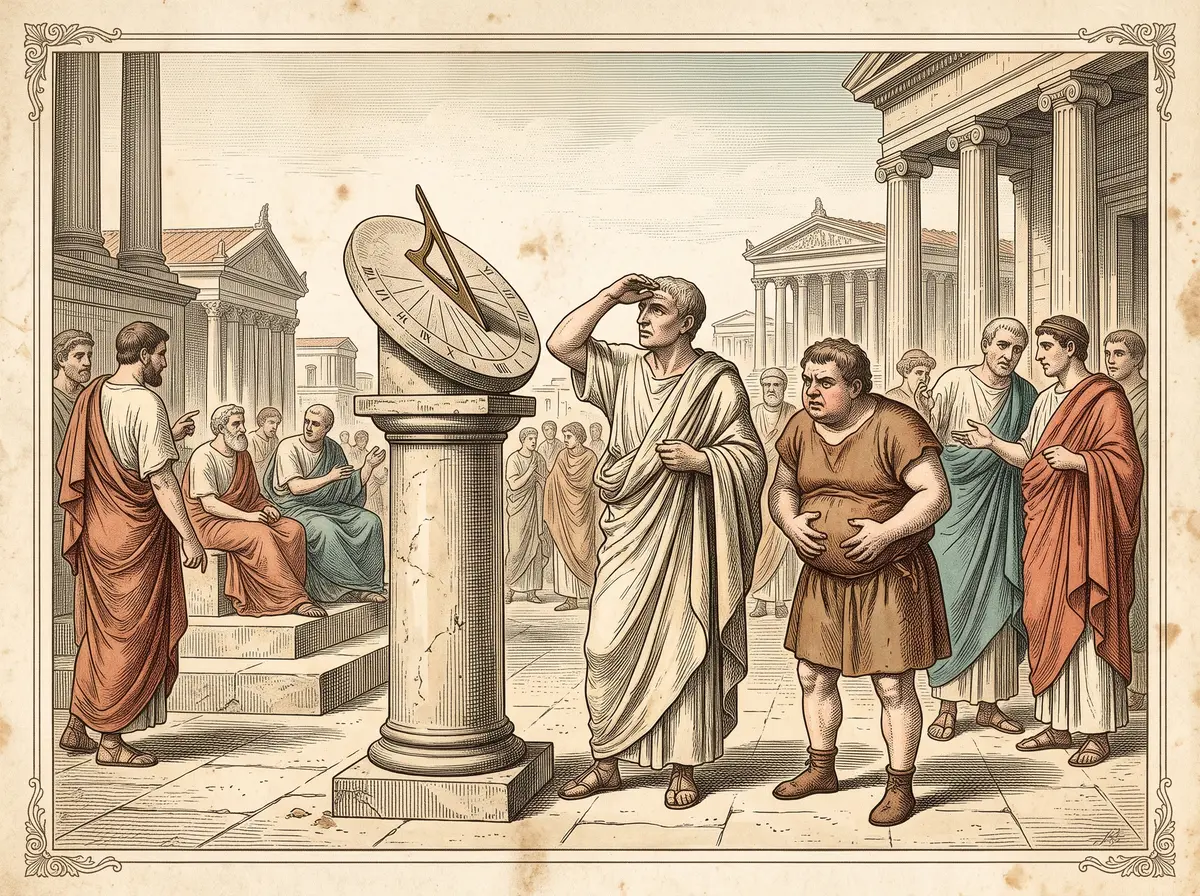
In 263 BC, a Roman consul came home from war in Sicily with a souvenir: a sundial taken from the city of Catania. Rome set it up on a column in the Forum and ran its days by it. There was one small problem. It had been built for Catania, not Rome, and according to Pliny the Elder its hour lines never matched the real hours. Romans followed it anyway, for 99 years.
By the Curiosities Desk · · 5 min read · Filed under Physics · Today’s round
What happened: Rome's Stolen Sundial
A sundial is one of the simplest scientific instruments ever made. A pointer, called a gnomon, casts a shadow. As the sun crosses the sky, the shadow moves across a set of marked lines, and each line stands for an hour.
The oldest known examples come from Egypt. In 2013, archaeologists from the University of Basel working in the Valley of the Kings found a flat piece of limestone among the stone huts of the workmen who built the royal tombs. It dates to the 13th century BC. Someone had painted a black semicircle on it, divided into twelve sections. A peg pushed into the center would have cast the shadow. The team suspects the workers used it to track their hours on the job.
Rome came to sundials late. The Roman writer Pliny the Elder, drawing on the earlier scholar Varro, says the first public sundial worth the name arrived in 263 BC, during the First Punic War. The consul Manius Valerius Maximus Messalla had captured Catania, on the east coast of Sicily, and brought its sundial back as war booty. It went up on a column beside the Rostra, the speakers’ platform in the Forum.
Then, as Pliny tells it, the Romans simply lived with it. Its lines did not agree with the hours, but they followed it for 99 years. Only in 164 BC did the censor Quintus Marcius Philippus set up a more carefully designed dial beside the old one. Pliny counts it among the most welcome things a censor ever did.
Even the new dial had a weakness. On cloudy days it told you nothing. So about five years later, around 159 BC, Scipio Nasica set up a water clock, which kept time by the steady drip of water and worked at night too.
Not everyone was pleased with all this precision. A fragment of a Roman comedy, preserved by the writer Aulus Gellius, gives the complaint of a hungry parasite, a stock comic character who lives off other people’s dinners. As a boy, he grumbles, his stomach told him when to eat. Now the town is crowded with sundials and he must wait for the sun’s permission. “The gods confound the man who first found out how to distinguish hours!” he cries, in one older English translation. Gellius thought the play was by Plautus, though ancient critics argued about its authorship.
Why it was strange: Rome's Stolen Sundial
It is tempting to imagine Rome’s citizens squinting at a broken clock for a century. The truth is stranger: the clock was not broken. It was working perfectly, for a place more than 300 miles to the south.
A sundial is tuned to a latitude, meaning how far north or south of the equator it sits. Catania lies about four and a half degrees farther south than Rome. That changes how high the sun climbs and the path a shadow traces across the day. Hour lines drawn for Sicily will drift out of step in Rome.
The error probably mattered less than it sounds, because Roman hours were slippery anyway. Romans split the daylight into twelve equal hours, whatever the season, so a summer hour in Rome ran roughly 75 minutes and a winter hour about 45. A dial a little off was measuring a unit that already stretched and shrank. Still, it took a century for someone to fix it, and the fix was simply to build a new dial next to the old one.
The Romans also carried time in their pockets, sometimes in unusual shapes: The Roman Pocket Sundial Shaped Like a Ham.
What scientists learned: Rome's Stolen Sundial
The Catania dial is an accidental lesson in geometry. A shadow clock is really a model of how Earth sits under the sun. Point the gnomon correctly and draw the right lines, and the dial is a small map of the sky for one spot on the planet. Carry it somewhere else and the map is wrong.
Ancient astronomers worked this out in detail. The Roman architect Vitruvius, writing in the first century BC, listed more than a dozen sundial designs, from flat plates to carved hollow bowls, each needing lines worked out for its own latitude. Later makers tilted the gnomon so it pointed at the celestial pole, which lets the same hour lines work all year. Over the centuries, sundials became the reference that mechanical clocks were checked against, until the clocks finally beat them.
Mechanical clocks raised new puzzles of their own, as in The Two Clocks That Fell Into Step While Huygens Was Stuck in His Room.
How it reaches us today: Rome's Stolen Sundial
Sundials are mostly garden ornaments now, but the oldest idea in timekeeping has found a new job on another planet.
When NASA’s Spirit and Opportunity rovers landed on Mars in January 2004, each carried a sundial about three inches square on its rear solar panel. The “MarsDial” was designed by a team that included Bill Nye and astronomer Woody Sullivan. It carried the motto “Two Worlds, One Sun” and the word “Mars” in 17 languages. Its real work was calibration: colored blocks helped the rovers’ cameras get colors right, and the gnomon’s shadow helped set brightness. Perseverance, which landed in 2021, carries a descendant with a new motto, “Two Worlds, One Beginning,” and an outer inscription that begins “Are we alone?”
The Catania dial taught Rome that a sundial belongs to one place. The Mars dials take that seriously: they are built for a whole different world.
For the long road from Martian sunrises to actual schedules, see From a Watch Weighed Down With Lead to Breakfast at 3 P.M.: A Short History of Living on Mars Time, and for more everyday tools with deep roots, From the First Spark to the Thing You Still Use.
Fun fact: Rome's Stolen Sundial
The sundials on Spirit and Opportunity have no hour marks. Because a rover keeps driving and turning, fixed lines would be wrong almost immediately, so the science team added the hour lines digitally to each photo afterward.
Sources: Rome's Stolen Sundial
- Pliny the Elder on Rome’s first sundials — excerpt from Natural History, Book 7, via Lapham’s Quarterly
- Aulus Gellius, Attic Nights 3.3 — the parasite’s complaint from the comedy The Boeotian Woman, Perseus Digital Library
- Early Egyptian Sundial Discovered — Archaeology magazine, on the University of Basel find in the Valley of the Kings
- Bill Nye’s interplanetary sundial heads for Mars — Cornell Chronicle, December 2003
- 5 Hidden Gems Are Riding Aboard NASA’s Perseverance Rover — NASA Jet Propulsion Laboratory