Weird Medical History · Physics
The 1,200 Pounds of Grapes That Convinced America to Sit Under Blue Windowpanes
In the spring of 1877, after Augustus J. Pleasonton's grape claims spread, you could walk down an American street and see blue windowpanes glinting in parlor windows, blue glass set into baby carriages, blue-tinted parasols, and invalids arranged in sunbeams the color of a swimming pool. One Massachusetts factory was turning out three thousand square feet of blue glass a day. The whole thing had started with a retired general, a greenhouse, and a very good year for grapes.
By the Curiosities Desk · · 5 min read · Filed under Physics · Today’s round
Part of Medicine, Before It Was Sure
What happened: The Blue Glass Craze
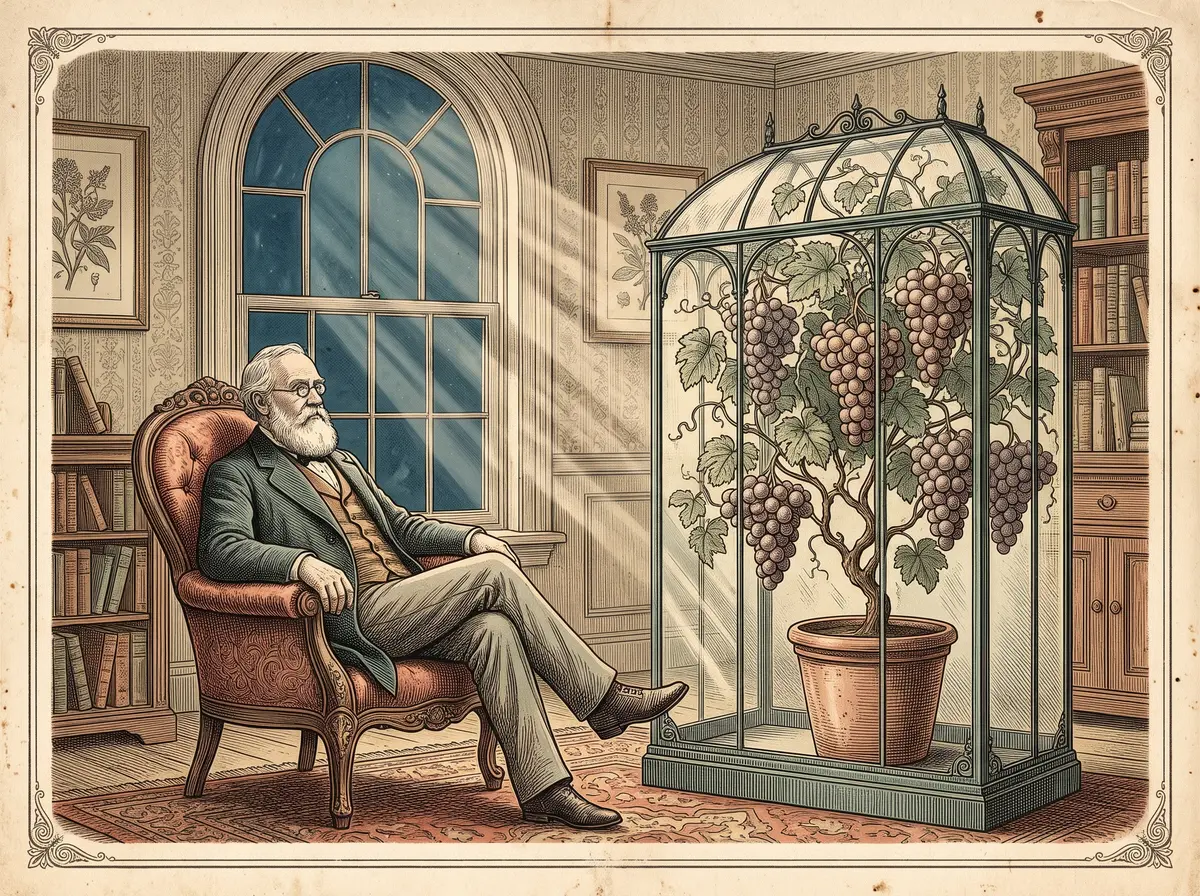
Augustus J. Pleasonton was a Philadelphia lawyer and a retired general with no scientific or medical training, but with a keen amateur interest in optics and photography. Sometime in the 1860s he built himself a grapery — a glass-roofed greenhouse for grapevines — in which, by his account, every eighth pane was blue glass instead of clear.
The grapes did extremely well. Pleasonton reported that twenty vines in their second year under the glass produced 1,200 pounds of fruit. He liked to recount the reaction of Robert Buist Sr., the Philadelphia seedsman who had supplied the vines: “General! Do you know that you have 1200 pounds of grapes in this grapery?”
From there the idea grew. Pleasonton reasoned that plants bloom in spring because the sky is blue, and concluded that the blue and violet end of sunlight carried some special growth-giving force. He ran a version of the experiment on animals: pigs from the same litter, half raised under violet-tinted light and half in ordinary sunlight. After six months, he reported, the violet-light pigs were heavier. “By these comparisons,” his pamphlet concluded, “it seems obvious that the influence of the violet-colored glass was very marked.”
In 1871 he read a paper on all this to the Philadelphia Society for Promoting Agriculture and patented a greenhouse glazed with blue-filtered glass. In 1877 the argument appeared as a book with a title that left nothing out: The Influence of the Blue Ray of the Sunlight and of the Blue Color of the Sky, in Developing Animal and Vegetable Life; in Arresting Disease, and in Restoring Health in Acute and Chronic Disorders to Human and Domestic Animals. It was printed on blue-tinted paper — Pleasonton had decided blue ink on blue stock was easier on the eyes under gaslight.
Then the newspapers found it. A Chicago article, written by a friend of Pleasonton’s brother, was reprinted and rewritten across the country, and “blue glass mania” was on. Readers were told that sitting behind blue glass could ease all manner of complaints, even restore hair. One 1877 Oregon paper, reprinting a New York Evening Mail piece, reported hopefully that “under the blue glass treatment, however, the hair did begin to grow,” and helpfully noted that the right glass “is a dark purplish blue, and can be obtained almost anywhere.”
The craze was loud and brief. Blue glass went into homes, hospitals, consumer goods, and spectacles worn in the street to ward off disease. The New York Daily Graphic floated the idea of a blue glass statue of Pleasonton in the Boston Public Garden. Then, almost as quickly, it was over.
Why it was strange: The Blue Glass Craze
The strangest part is how little of it was salesmanship. Pleasonton’s patent covered a greenhouse, not a windowpane, and the glass that sold by the ton was sold by other people. What the country had actually bought was a story with a number in it. Twelve hundred pounds of grapes is a wonderfully concrete fact, and it was probably true. It simply could not carry the weight that was piled on it, because nothing in the grapery had been arranged to tell one explanation from another. Something similar happened to a set of pointed metal rods that cured all manner of complaints until somebody made a wooden copy: The Fake Metal Rods That Accidentally Invented the Placebo-Controlled Trial.
What scientists learned: The Blue Glass Craze
Scientific American published “The Blue Glass Deception” in its issue of February 24, 1877, and the dismantling is a small masterpiece of plain reasoning. Pleasonton’s electrical speculations it refused to engage with at all: “their absurdity is so complete that we shall waste no time over them.” The claim that blue rays specially drove plant chemistry, it said, had been “totally disproved” by existing research, and strong violet light could actually set plants back. As for the grapes and the pigs, the magazine’s verdict was deflating and almost certainly right: “the violet glass acts purely as a shade for decreasing the intensity of the solar light.”
In other words, Pleasonton had not added a magic ray. He had taken some light away. A greenhouse that is slightly dimmer and slightly cooler may well grow better grapes, and nothing about the color is doing the work. His comparisons also lacked the machinery that makes a comparison mean something: no randomizing, no blinding, no accounting for the fact that people with aching joints who spend afternoons resting in a warm patch of sunlight tend to report feeling better. The Boston Medical and Surgical Journal made the point with more comedy, comparing the fad to an eighteenth-century enthusiasm for the color green and suggesting that hypochondriacs try the humble “blue pill” before reglazing the house. For another cure whose glow was mistaken for its mechanism, see The Plug-In ‘Magic Horse Collar’ Sold by the Man Who Named Wilshire Boulevard.
How it reaches us today: The Blue Glass Craze
Blue light turned out to matter, in ways Pleasonton never guessed. Short-wavelength light is the strongest signal for setting the body’s daily clock. And blue light is a real treatment, just not for the things on his list: jaundiced newborns are placed under blue lamps that break down bilirubin in the skin, a therapy that traces back to someone noticing what sunlight did on a hospital ward. That story is The Blood Sample Left on a Sunny Windowsill — and Why Jaundiced Newborns Now Sleep Under Blue Lights.
The modern echo is on your face. Blue-light-filtering eyeglasses sell on reasoning that would have pleased the general — and when Cochrane reviewers pooled the randomized trials in 2023, they concluded the lenses “may not attenuate symptoms of eye strain with computer use,” probably make little or no difference to vision, and have unclear effects on sleep. Tinted glass between you and the sun remains an easy thing to believe in. The craze belongs with the other hopeful treatments in Medicine, Before It Was Sure.
Fun fact: The Blue Glass Craze
Pleasonton’s title gave a band its name 133 years later: OK Go’s 2010 album Of the Blue Colour of the Sky takes its title from a phrase in his book.
Sources: The Blue Glass Craze
- A. J. Pleasonton, The Influence of the Blue Ray of the Sunlight and of the Blue Color of the Sky… (Philadelphia: Claxton, Remsen & Haffelfinger, 1877) — the primary source, digitized by the Wellcome Collection
- “The Blue Glass Deception,” Scientific American XXXVI, no. 8 (February 24, 1877) — full text via Project Gutenberg
- Jill Carlson, “Reflecting upon the influence of the blue color of the sky,” Readex (quoting Pleasonton’s pamphlets and 1877 newspapers)
- Kat Long, “The 19th Century Manual That Claimed the Color Blue Could Cure All Ills,” Mental Floss (citing the 1877 Boston Medical and Surgical Journal and Druggist’s Circular)
- Singh et al., “Blue-light filtering spectacle lenses for visual performance, sleep, and macular health in adults,” Cochrane Database of Systematic Reviews (2023), CD013244
This article describes a nineteenth-century health fad. Light-based treatments that do work — phototherapy for newborn jaundice, for instance — are prescribed and monitored by clinicians, and a doctor is the right person to ask about any treatment you’re considering.