Everyday Objects · Archaeology
The 1,600-Year-Old Toothpaste Recipe a Dentist Tried on His Own Gums
In 2003, at a dental congress in Vienna, an Austrian dentist named Heinz Neuman did something most scholars of ancient texts would never think to do: he mixed up a recipe from a 1,600-year-old scrap of papyrus and brushed his teeth with it. His verdict was a very honest review. It was "not unpleasant," he said. It also made his gums bleed.
By the Curiosities Desk · · 5 min read · Filed under Archaeology · Today’s round
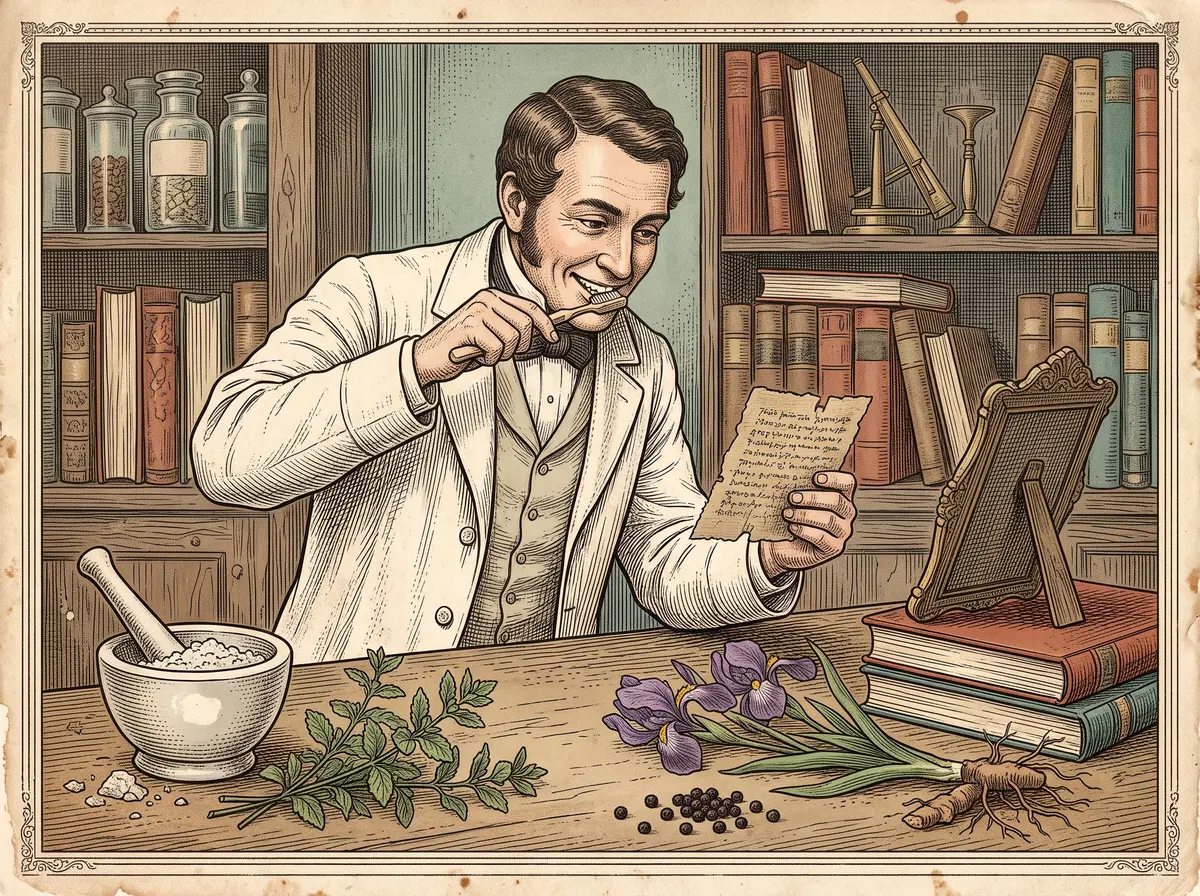
What happened: Ancient Egyptian Toothpaste
The recipe sits on a scrap of papyrus about the size of a playing card — 10.6 by 7.5 centimeters — in the Papyrus Collection of the Austrian National Library in Vienna. It was written in Greek, the language of government and learning in Egypt for centuries after Alexander the Great, and the handwriting dates it to the fourth century AD, when Egypt was a province of the Roman Empire.
The collection itself began with an unlikely shopping trip. In the late 1870s, huge numbers of papyri started turning up in Egypt’s Fayum oasis. A Vienna carpet dealer named Theodor Graf, who ran a branch in Cairo, shipped about 10,000 of them home in 1881 and 1882. Archduke Rainer of Austria bought the lot, and the “Papyrus Archduke Rainer” collection was founded in 1883. Later, he gave it to Emperor Franz Joseph I as a birthday present. Today it holds around 180,000 objects, and much of it has still never been closely studied.
Our scrap is a reused sheet. One side carries an everyday document from the city of Hermopolis. On the other side, someone jotted down a recipe headed, in the original Greek, “dry powder for white and abrōtos teeth.” The ingredients are brief and precise:
- one drachma (a weight of a few grams) of “Ammonian salt”
- two drachmas of glēchōn
- one drachma of iris
- twenty grains of pepper
In 2003 the recipe reached the newspapers. Hermann Harrauer, head of the papyrus collection, presented it at a dental congress in Vienna, and Britain’s Daily Telegraph ran the story that August. Press accounts translated the ingredients as rock salt, mint, dried iris flower, and pepper, crushed together and worked into a paste with saliva. Harrauer told reporters the writer clearly had medical training, because the text uses the abbreviations of medical writing. He also guessed the writer might have been a monk, since Egypt was turning Christian at the time — an educated guess, not something the papyrus states.
That’s where Neuman came in. He tried the mixture himself. “Nobody in the dental profession had any idea that such an advanced toothpaste formula of this antiquity existed,” he told the paper. It stung and drew blood from his gums, he reported, but afterward his mouth felt fresh and clean. He judged it a big improvement on some of the soap-based toothpastes people used much later.
Why it was strange: Ancient Egyptian Toothpaste
We usually imagine ancient hygiene as either nonexistent or charmingly gross. This recipe is neither. It reads like an ingredient list on the back of a modern tube: an abrasive to scrub, an herb for freshness, and measured doses rather than “a handful of whatever.”
There’s also a quiet twist in the word abrōtos. Newspapers rendered the title as a powder for “white and perfect teeth,” but the Greek literally means something like “not eaten away.” Scholars have debated what the writer meant: teeth protected from decay, or teeth not worn down by a harsh powder. The papyrologist Marie-Hélène Marganne argued for the second reading. If she’s right, the writer was already worrying about the problem dentists still warn about today: a cleaner that scratches the tooth it’s cleaning.
More ancient grooming advice turns up in From Crushed Oyster Shells to Nylon: A Short History of the Toothbrush.
What scientists learned: Ancient Egyptian Toothpaste
Each ingredient has a job. Salt crystals act as an abrasive, scraping off film and stains. “Ammonian salt” was named after the oracle of the god Ammon at the Siwa oasis in Egypt’s western desert; ancient writers described salt dug from the sands nearby. Pepper adds bite and a warming tingle. Iris root was a common perfume and medicinal ingredient in the ancient Mediterranean.
The herb is where the popular translation simplifies things. Glēchōn is the ancient Greek name for pennyroyal (Mentha pulegium), a strong-smelling member of the mint family. So “mint” is fair, but it wasn’t spearmint. Pennyroyal oil is toxic in concentrated amounts, which is one more good reason to admire this recipe rather than make it.
The recipe also wasn’t a one-off. Its editors noted close parallels in the writings of Oribasius, a fourth-century Greek physician who compiled medical knowledge for the emperor Julian. In other words, this was a recognizable formula circulating among trained healers, copied down by someone who knew the trade.
What it lacks is just as telling. Salt and herbs can scrub and freshen, but they can’t strengthen enamel. That breakthrough had to wait for fluoride.
The habit of jotting practical notes on scrap papyrus shows up in The Angry Customer Complaint That Survived 3,750 Years.
How it reaches us today: Ancient Egyptian Toothpaste
Modern toothpaste keeps the ancient structure and adds the chemistry. There’s still a mild abrasive, still a flavor (now usually spearmint or peppermint), and still a careful balance between cleaning teeth and wearing them away — toothpastes today are rated for how abrasive they are. The real leap came in the twentieth century, when Procter & Gamble funded research at Indiana University into a fluoride toothpaste. Crest launched in 1956, and in 1960 it won the American Dental Association’s endorsement as a cavity fighter — the boost that soon made it the market leader.
The papyrus also shows how much history is hiding in plain sight. A recipe that sounded brand-new in 2003 had been sitting in a library drawer in Vienna for more than a century.
Another story about teeth and the myths around them: George Washington’s Wooden Teeth — Which Were Never Made of Wood.
A powder jotted on scrap papyrus belongs with the other household things in The Ordinary Object With the Strange Origin.
Fun fact: Ancient Egyptian Toothpaste
The “world’s oldest toothpaste recipe” wasn’t really discovered in 2003. Harrauer and his colleague P. J. Sijpesteijn had already published it in 1981, in a scholarly volume of medical recipes from the Vienna papyri. It took 22 years, and one brave dentist, for the rest of the world to notice.
Sources: Ancient Egyptian Toothpaste
- “P. 7 MPER N.S. 13 = Trismegistos 64525”, Digital Corpus of Literary Papyri (Duke) — the Greek text, size, date, and edition (Harrauer & Sijpesteijn, Medizinische Rezepte und Verwandtes, 1981), with notes on abrōtos and the Oribasius parallels.
- “About the Department of Papyri”, Austrian National Library (archived) — history of the Archduke Rainer collection.
- “World’s oldest toothpaste formula found on papyrus scroll”, GMA News, reprinting the Daily Telegraph’s August 2003 report — Harrauer’s and Neuman’s quotes.
- “Making Toothpaste at Home, From Ancient Times to Today”, National Geographic.
- “How Toothpaste Got Scientific Cred”, JSTOR Daily — Crest, Indiana University, and the 1960 ADA endorsement.
A note: please don’t brush with home-made powders based on ancient recipes — salt can wear down enamel, and pennyroyal can be toxic. A fluoride toothpaste and a soft brush twice a day is the cheap, proven version. If cost keeps you from seeing a dentist, dental schools and community health centers often offer low-cost care.