The 47-Rocket Chair That Earned a Moon Crater for a Man Who May Never Have Existed
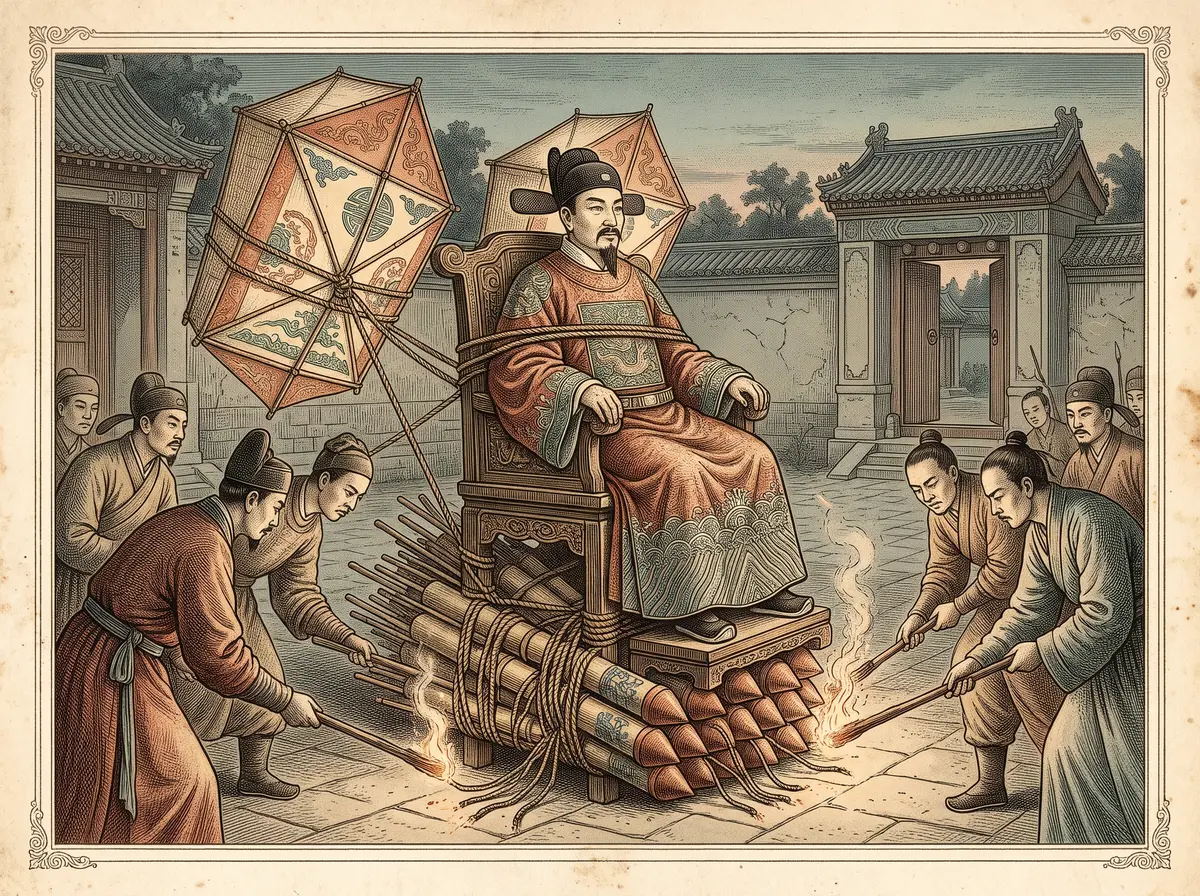
On the far side of the Moon, about 9.8 degrees south of the lunar equator, sits a 52-kilometer crater named Wan-Hoo. The International Astronomical Union gave it that name in 1970 to honor a Chinese official who, the story goes, strapped 47 rockets to a chair, had 47 servants light the fuses, and vanished in a cloud of smoke. It is a lovely tribute. The trouble is that historians have never found any proof that he lived, and the oldest known printed version of the story ends with him getting spanked.
By the Curiosities Desk · · 5 min read · Filed under Space · Today’s round
What happened: The 47-Rocket Chair That Earned a Moon Crater for a Man Who May Never Have
The earliest known telling turns up in an unlikely place: the October 2, 1909, issue of Scientific American. In a playful piece called “The Modern Icarus,” the writer John Elfreth Watkins rounded up tales of ancient would-be aviators. The first he credited to “tradition”: a Chinese mandarin named Wang Tu, said to have lived around 2000 BC. Wang Tu had two large kites built and lashed a chair between them. Forty-seven attendants, each holding a candle, lit 47 rockets placed under the contraption. The rocket under the chair blew up and burned the mandarin, and the emperor was so annoyed that he ordered Wang Tu given “a severe paddling.”
In that first version, then, the hero survived and got punished. The date was also a problem. 2000 BC is centuries before writing appears in China, and roughly 3,000 years before anyone there, or anywhere, was building gunpowder rockets.
Over the next few decades the story lost its spanking and gained a halo. By the mid-1940s, as rocketry moved from science fiction toward real engineering, popular science writers were retelling it with a new name, Wan-Hoo, and a new date, around AD 1500, in the middle of the Ming dynasty. Herbert S. Zim’s 1945 children’s book Rockets and Jets spread the tale widely, without citing any source, and called it the first attempt at rocket flight. The same year, the rocket pioneer G. Edward Pendray described it as an “oft repeated tale” of rocketry’s early days. In these versions, the official doesn’t get burned or scolded. When the smoke clears, Wan-Hoo and his chair are simply gone.
That ending was perfect for the space age. When the Soviet probe Zond 3 photographed the lunar far side in 1965, a wave of new craters needed names. According to the Armagh Observatory and Planetarium, Wan-Hoo appeared in a 1966 Soviet lunar atlas, and the IAU made it official in 1970. The approved description reads like an engineering spec: a manned rocket of “2 box-like kites and a seat, and 47 solid-propellant rockets.”
Historians were less convinced. The sinologist Joseph Needham, author of the monumental Science and Civilisation in China, called the story dubious and suggested it might have been invented in Europe during the craze for Chinese-themed art and design known as chinoiserie. In 1992, Frank Winter of the Smithsonian’s National Air and Space Museum went looking for Wan Hu in Ming dynasty histories and biographical guides and came up empty.
Then, in 2004, the TV show MythBusters actually built the chair. Their throne, fitted with 47 bamboo rockets, exploded on the launch pad and badly scorched the crash-test dummy, Buster. A version with 47 modern rockets lurched violently sideways instead of up. The verdict was “busted,” though the crew did note one eerie match with the legend: when the smoke cleared, the dummy and chair had disappeared from view. Both turned up nearby.
Why it was strange: The 47-Rocket Chair That Earned a Moon Crater for a Man Who May Never Have
Most myths grow out of a real event that gets exaggerated. This one seems to run the other way. It starts as a comic aside in an American magazine, attached to an impossible date, and only later becomes a serious origin story, complete with an honorable death and a crater.
It’s also unusual for a legend to be carved into the official map of another world. Lunar craters are generally named for real scientists and explorers. Wan-Hoo stands among them on the strength of a tale that, as far as anyone has shown, first appeared in print in 1909.
The legend has another modern cousin in The Truck Driver Who Flew a Lawn Chair to 16,000 Feet on 42 Weather Balloons, and it belongs on The Version Everyone Remembers.
What scientists learned: The 47-Rocket Chair That Earned a Moon Crater for a Man Who May Never Have
The physics explains why MythBusters never left the ground. A rocket works by throwing hot gas out one end, which pushes the rocket the other way. To rise at all, the total push, or thrust, has to be greater than the weight of everything being lifted. Small gunpowder rockets of the kind used in fireworks produce brief, modest thrust. Forty-seven of them would struggle to lift a heavy chair and a grown man, let alone reach the speed of roughly 7.8 kilometers per second needed to stay in orbit around Earth.
Worse, 47 rockets never light at exactly the same instant or burn at exactly the same rate. Uneven thrust twists a craft around, which is why the modern-rocket chair veered sideways. Real launch vehicles solve this with steering, guidance systems, and carefully controlled engines.
China’s real rocket history needs no embellishment. Gunpowder was a Chinese invention, and rocket-propelled weapons were in use there centuries before Europe had them. That genuine achievement is probably why the Wan Hu story felt so believable to Western readers.
Rocketry had to fight for credibility in print, too, as The Newspaper That Took 49 Years to Admit Rockets Work in Space shows.
How it reaches us today: The 47-Rocket Chair That Earned a Moon Crater for a Man Who May Never Have
The legend has found a home in China itself. Some Chinese accounts now give Wan Hu a real name, Tao Chengdao, and in 2023 the scholar Li Chengzhi argued the story might have reached the West through missionaries or a lost Chinese text. Others remain doubtful, since no such text has surfaced. When China launched its first astronaut, Yang Liwei, in 2003, news outlets including CNN retold the Wan Hu tale as the dream that came first. The Armagh Observatory and Planetarium reports that a statue of Wan Hu stands at the Xichang Satellite Launch Center.
Whether or not he lived, Wan Hu has become a kind of patron saint of bold, slightly reckless space dreams. His crater is still on every map of the lunar far side.
For another space tale that outran the facts, see The Newspaper Hoax That Put Bat-People on the Moon.
Fun fact: The 47-Rocket Chair That Earned a Moon Crater for a Man Who May Never Have
The scene in Kung Fu Panda (2008) in which Po straps fireworks to a chair to launch himself was inspired by the Wan Hu legend, according to the film’s director commentary.
Sources: The 47-Rocket Chair That Earned a Moon Crater for a Man Who May Never Have
- The Modern Icarus — John Elfreth Watkins, Scientific American, October 2, 1909 (primary source: earliest known version, “Wang Tu,” the 47 rockets, and the paddling)
- Wan-Hoo crater entry — The-Moon Wiki, lunar nomenclature reference (location, size, 1970 IAU approval and citation text from Menzel 1971)
- Wan Who? — Armagh Observatory and Planetarium (Zond 3, 1966 Soviet atlas, Chinese adoption, Xichang statue)
- In Search of the First Rocket Man — Centauri Dreams (Frank Winter’s search of Ming records)
- MythBusters Episode 24: Ming Dynasty Astronaut — MythResults episode guide (December 5, 2004 test results)