Everyday Objects · Archaeology
The 5,500-Year-Old Shoe That Was Saved by a Cave Floor of Sheep Dung
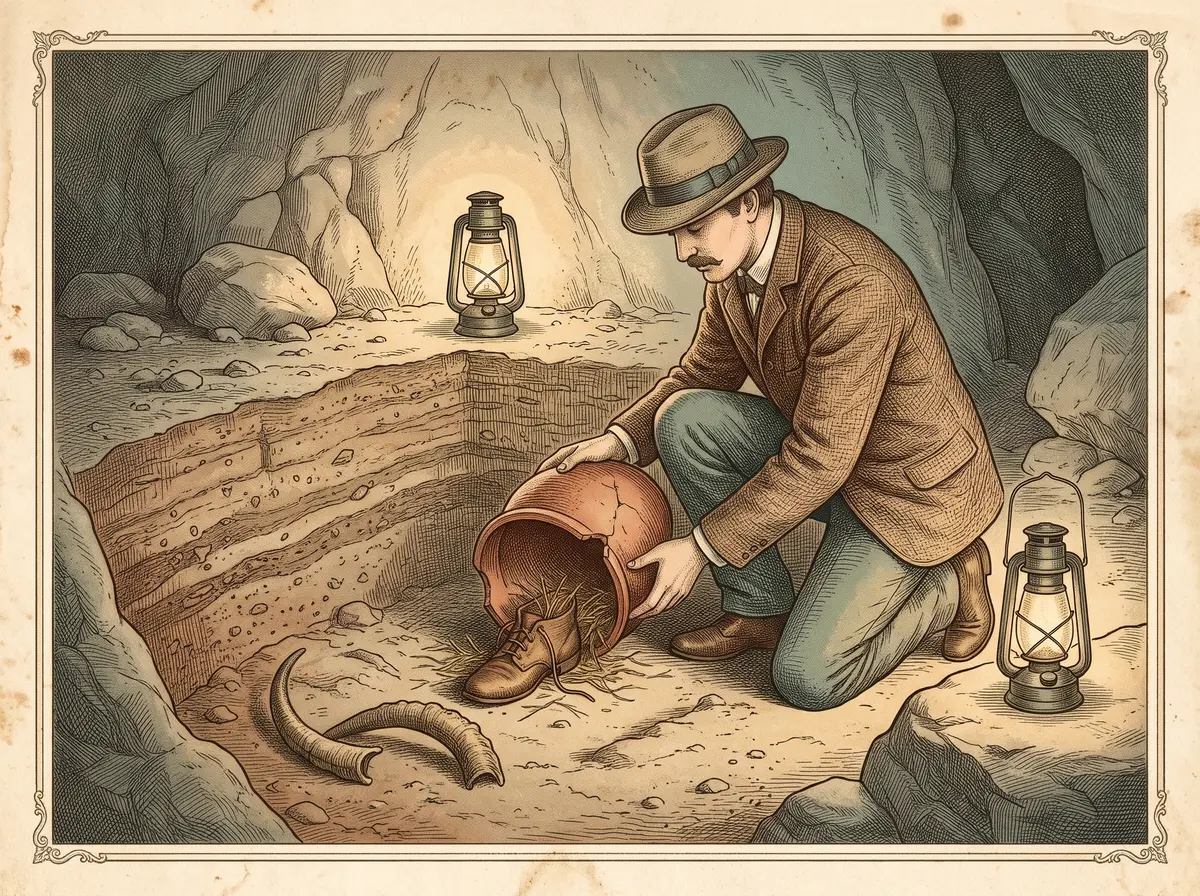
In 2008, an Armenian graduate student reached into a shallow pit in a mountain cave, lifted up an overturned broken pot, and found a leather shoe underneath it. It was laced, stuffed with grass, and about a women's US size 7. The team guessed it was a few centuries old. The lab results said it was older than the Great Pyramid by roughly a thousand years. They also had a guess about why it had lasted so long: the cave floor was covered in a thick layer of sheep dung.
By the Curiosities Desk · · 5 min read · Filed under Archaeology · Today’s round
What happened: The Areni-1 Shoe
The cave is called Areni-1, and it sits above a river gorge in Vayots Dzor province in southeastern Armenia, near the borders with Iran and Azerbaijan’s Nakhchivan exclave. Local archaeologists had known about it for years; it is visible from the highway below. An international team co-directed by Gregory Areshian of UCLA, Boris Gasparian of Armenia’s Institute of Archaeology and Ethnography, and Ron Pinhasi, then of University College Cork in Ireland, had been digging there.
The shoe turned up in 2008 in the hands of Diana Zardaryan, a PhD student at the Armenian institute. “I was amazed to find that even the shoe-laces were preserved,” she said afterward. The shoe lay upside down at the bottom of a small plastered pit, about 45 centimeters (18 inches) deep. A broken clay pot had been turned over on top of it. The same pit held two complete horns from a wild goat and the shoulder blade of a red deer, plus scraps of reeds and pottery. Nobody knows why those things were put together, and the researchers have been careful not to pretend otherwise. Pinhasi suggested the arrangement may have had some symbolic meaning, but said plainly that the team did not yet know what the shoe was doing there.
At first, the excavators assumed the shoe and its companions were medieval. “We thought initially that the shoe and other objects were about 600-700 years old,” Pinhasi said. To check, the team sent samples to two radiocarbon labs: two strips of the leather went to the University of Oxford and the University of California, Irvine, and a sample of the grass stuffing went to Oxford. Radiocarbon dating measures how much of a slowly decaying form of carbon is left in once-living material, which works like a clock that starts ticking when the cow or the grass died.
The three results agreed. The shoe dated to between about 3627 and 3377 BC. That made it roughly 5,500 years old, from the Chalcolithic, or Copper Age, when people were starting to work metal but still relied heavily on stone tools. The team published the find in the journal PLoS ONE in June 2010.
The shoe itself is simple and surprisingly familiar. It was cut from a single piece of leather, which appears to be cowhide, wrapped around the foot and closed with a leather cord threaded through slits: four sets of holes at the heel, fifteen across the top. It measures 24.5 centimeters long, a European size 37. The wear on the heel and big toe shows it had shaped itself to a right foot. Whether that foot belonged to a woman or a man is unknown; Pinhasi pointed out that it could well have fit a man of the period.
Why it was strange: The Areni-1 Shoe
Leather is food. Bacteria, fungi, and insects break it down, and in most places a shoe left in the ground for 5,500 years would simply be gone. What saved this one was the cave’s unglamorous housekeeping. Areni-1 was cool and dry, and, according to the excavators, its floor was covered by a thick layer of sheep dung that hardened over the pit. “The cave environment kept it cool and dry,” Pinhasi told National Geographic, “while the dung cemented the finds in.”
There is also the shock of how ordinary it looks. Shoe designer Manolo Blahnik called the resemblance to modern footwear “astonishing,” and curators compared it to the opanke shoes of the Balkans. The researchers noted it is very close to the pampooties, one-piece rawhide shoes worn on Ireland’s Aran Islands up to the 1950s. A design this basic, it turns out, barely needed updating for five thousand years.
Another ordinary thing with a long past: The 3,000-Year-Old Pants That Were Invented for Horseback Riding.
What scientists learned: The Areni-1 Shoe
The Areni-1 shoe is direct evidence that people in the highlands of the Near East were wearing closed leather shoes by about 3500 BC. It is a few hundred years older than the footwear of Ötzi the Iceman, the mummy found in the Alps in 1991, whose shoes had held the record for the oldest leather shoe from Europe or Asia. It is not the oldest footwear of any kind: plant-fiber sandals from Arnold Research Cave in Missouri are thousands of years older. But it is the oldest known leather shoe.
It also showed some real technical skill. Raw cattle hide is too thick to make a comfortable upper, so whoever made the shoe split the hide into thinner layers and tanned it, which Pinhasi described as probably a fairly new technology at the time. The grass inside remains a small puzzle. It may have been insulation for cold mountain winters, or an early shoe tree to hold the shape while the shoe was stored. The paper leans toward shape-keeping or storage but does not claim to know.
Ötzi’s own story, shoes included, is in The 5,300-Year-Old Iceman Whose Tattoos May Have Been Medicine.
How it reaches us today: The Areni-1 Shoe
The shoe is a reminder that “everyday” objects are among the hardest things for archaeology to recover. Stone tools and pottery survive; leather, cloth, and food almost never do. Finds like this one depend on rare conditions, such as dry caves, ice, or waterlogged mud. That is part of why archaeologists now sample old excavation layers so carefully, including the unappealing ones.
The find also tells us something about how people moved. The cave’s rocky terrain is full of sharp stones and thorny scrub, and temperatures there swing from about 45°C (113°F) in summer to below freezing in winter. Obsidian found in the cave came from at least 120 kilometers (75 miles) away. A sturdy shoe would have made that kind of travel much easier.
For another find that only survived because of where it was dropped, see The 5,700-Year-Old Chewing Gum That Held an Entire Human Genome. The shoe sits with the other everyday things that have a stranger past than they look, in The Ordinary Object With the Strange Origin.
Fun fact: The Areni-1 Shoe
The shoe was not the cave’s only record-breaker. In 2011, the same team reported a clay press basin, a fermentation vat, grape seeds, and drinking cups in Areni-1, dated to around 4000 BC. It is the oldest known complete wine-making facility.
Sources: The Areni-1 Shoe
- Pinhasi, R., Gasparian, B., Areshian, G., Zardaryan, D., Smith, A., Bar-Oz, G., & Higham, T. “First Direct Evidence of Chalcolithic Footwear from the Near Eastern Highlands.” PLoS ONE 5(6): e10984 (2010). https://doi.org/10.1371/journal.pone.0010984 (primary source)
- University College Cork, “World’s oldest leather shoe found in Armenia” (press release, June 2010). https://www.ucc.ie/en/news/archive/2014andbeyond/2010pressreleases/worlds-oldest-leather-shoe-found-in-armenia.html
- National Geographic, “World’s Oldest Leather Shoe Found in Armenia” (2010). https://www.nationalgeographic.com/culture/article/100609-worlds-oldest-leather-shoe-armenia-science
- Phys.org / UCLA, “Earliest known winery found in Armenian cave” (2011). https://phys.org/news/2011-01-earliest-winery-armenian-cave.pdf