Science Gone Wrong · Chemistry
The Bottled Water So Pure a Lab Used It as a Benchmark — Until It Found Benzene in It
In early 1990, every water sample run through a county health lab in Charlotte, North Carolina, seemed to come back slightly wrong. The technicians did what careful chemists do: they cleaned the lab, recalibrated the instruments, and ran the tests again. The problem didn't go away, because it wasn't in the samples. It was in the water they compared everything against: a supply of Perrier, the famously pure French mineral water, bought from a local store.
By the Curiosities Desk · · 5 min read · Filed under Chemistry · Today’s round
Part of When the Experiment Left the Lab
What happened: The Perrier Benzene Recall
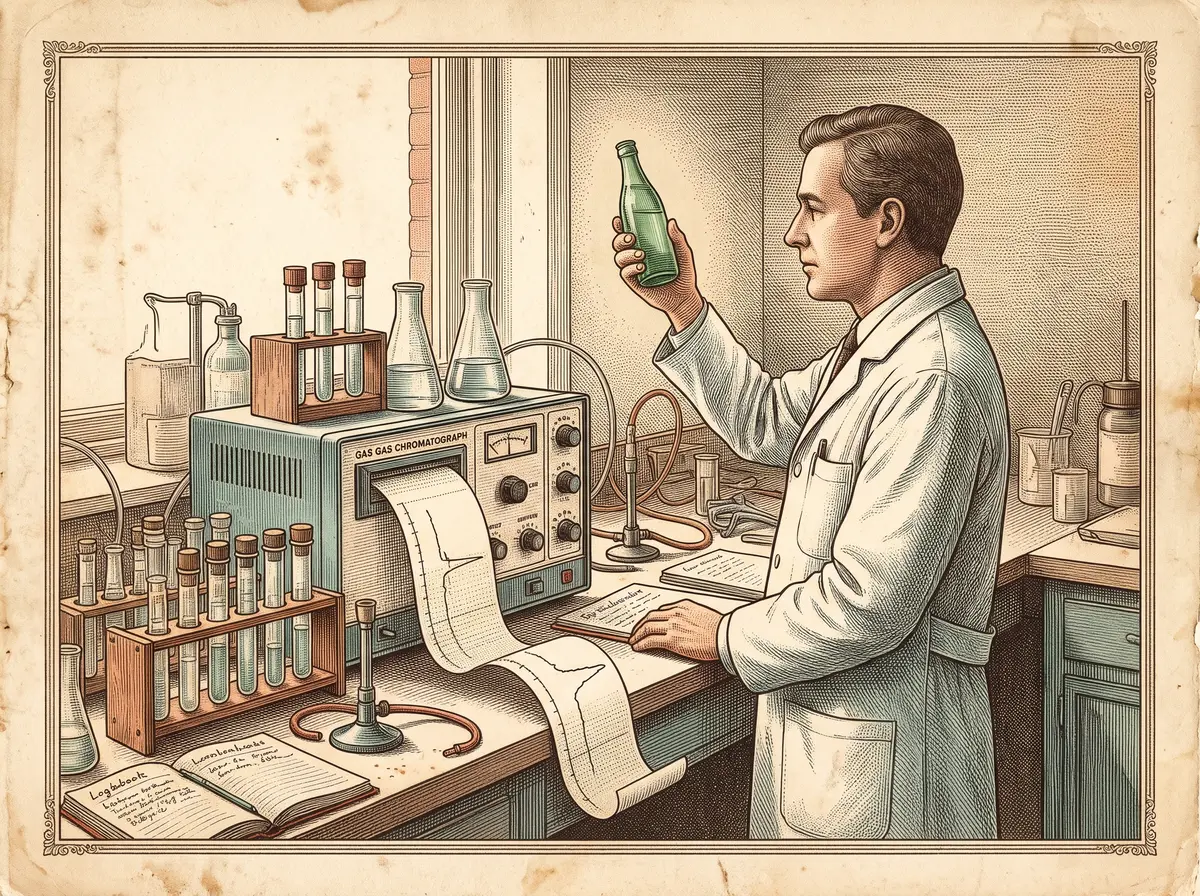
The Mecklenburg County Environmental Health Department tested groundwater, wells, and drinking water for contaminants. Analytical chemistry needs a reference point, and the lab used Perrier as its standard: a “clean” water to measure other samples against. If a well sample showed a chemical and the Perrier did not, the chemical belonged to the well.
According to water researcher Peter Gleick’s account of the episode, the trouble began when problems turned up across all of the lab’s water-quality tests. Only after the staff had ruled out their own equipment did they test the benchmark itself, and found benzene. Benzene is a colorless industrial chemical found in crude oil and gasoline, and it is a known human carcinogen (a substance that can cause cancer). The bottles held roughly 12 to 20 parts per billion of it. The U.S. federal limit for benzene in tap water is 5 parts per billion.
The county alerted the U.S. Food and Drug Administration. On February 9, 1990, the Perrier Group of America, based in Greenwich, Connecticut, began pulling every bottle of Perrier, regular and flavored, from stores across the United States and its territories. The FDA’s own enforcement report lists the recalled product with a single blunt line: “Product is contaminated with benzene.”
At first the company said the problem was limited to North America and played down the risk. Then more contaminated bottles turned up in Europe, including West Germany. On February 14, Perrier’s president, Gustave Leven, announced a worldwide withdrawal. “No half measures are possible,” he said. Roughly 160 million bottles in about 120 countries were pulled and destroyed, a loss reported at around $35 million, which the company said it was not insured for.
The explanation for how benzene got in went through a few versions. One early account blamed an employee who had supposedly used a benzene-based cleaner on equipment. The company then said the real cause was a filter on a gas line at its bottling plant in Vergèze, in southern France. The filter was supposed to be changed every six weeks. It had been left in place for up to three months.
Why it was strange: The Perrier Benzene Recall
The whole point of a reference standard is that you never have to wonder about it. The Charlotte lab chose Perrier precisely because it was the last thing anyone expected to be contaminated, and that is why the problem was so hard to spot. A good scientist’s first instinct, when every result looks off, is to doubt the instruments, not the benchmark.
There was a second surprise hiding behind the first. Perrier was sold as “naturally sparkling,” but the story of a filter on a gas line raised an awkward question: why was there a gas line at all? The answer was that the spring’s water and its carbon dioxide were collected separately and combined at the plant. In April 1990, the FDA ruled that the label claim was false. An FDA district director described the product as “fabricated from carbon dioxide and water,” and the company agreed to drop “naturally sparkling” from its U.S. labels.
For more on the strange ways water gets judged, see The 14-Year-Old Who Convinced 43 Classmates to Ban Water.
What scientists learned: The Perrier Benzene Recall
The episode is a clean lesson in how measurement works. Every chemical test compares a sample against something: a standard, a “blank” (a sample assumed to contain none of the target substance), or a calibration solution. If the reference is contaminated, the errors spread quietly through every result. That’s why labs certify their reference materials and test them regularly, rather than trusting a reputation.
It also showed how sensitive modern instruments had become. Twenty parts per billion is roughly one liter of a substance stirred into a large backyard swimming pool. Gas chromatography, a technique that separates a mixture into its components so each one can be identified and measured, could pick that out reliably. In 1990, the ability to detect a chemical had pulled far ahead of the public’s sense of what such tiny amounts meant.
Officials tried to put the risk in perspective. The acting FDA commissioner, James Benson, estimated that drinking about a pint a day for 70 years might raise a person’s lifetime cancer risk by about one in a million, and said he would drink a bottle from his own refrigerator. The risk being small doesn’t mean the contamination was acceptable. Federal limits are set well below harmful doses on purpose, and that cushion is what makes them useful.
Bubbly water has its own odd origin story: The Minister Who Lived Next to a Brewery and Invented Soda Water to Cure Scurvy.
How it reaches us today: The Perrier Benzene Recall
The Perrier recall became a standard case study in business schools on crisis management: a brand built entirely on purity, undone by one overdue filter change. Perrier returned to American shelves in the spring of 1990 with new labels, but by most accounts its market share never fully recovered, and Nestlé bought the company in 1992.
Benzene in drinks didn’t go away as a concern, either. In the 2000s, regulators found that some soft drinks could form small amounts of benzene when two common ingredients, the preservative sodium benzoate and vitamin C, react with each other, especially in heat and light. Manufacturers reformulated many of those products.
And labs still use the lesson every day: test your standard, not just your samples. More stories of science escaping into the real world sit on the shelf of When the Experiment Left the Lab.
Fun fact: The Perrier Benzene Recall
The contamination wasn’t caught by a regulator, a rival company, or a consumer complaint. It was caught because a county lab trusted Perrier so much that it used the water as its definition of “clean.”
Sources: The Perrier Benzene Recall
- U.S. Food and Drug Administration, “Enforcement Report: Perrier Sparkling Water, Recall #F-432/436-0” (February 1990), archived by the University of North Texas Libraries.
- Chemical & Engineering News, “Benzene in Perrier found by North Carolina lab,” vol. 68, no. 8, February 19, 1990.
- Associated Press, “Perrier Says Failure to Replace Filter Caused Benzene Contamination,” Deseret News, February 15, 1990.
- “Perrier Brought Down by Mecklenburg Health Lab,” North Carolina Miscellany, UNC Libraries (citing Peter H. Gleick, Bottled and Sold, 2010).
- U.S. EPA, “Consumer Factsheet on Benzene” (drinking-water limit of 5 parts per billion).