Science Gone Wrong · Chemistry
The Ten Tons of War Sodium the Army Rolled Off a Cliff Into a Frozen Lake — Then Shot at Until It Exploded
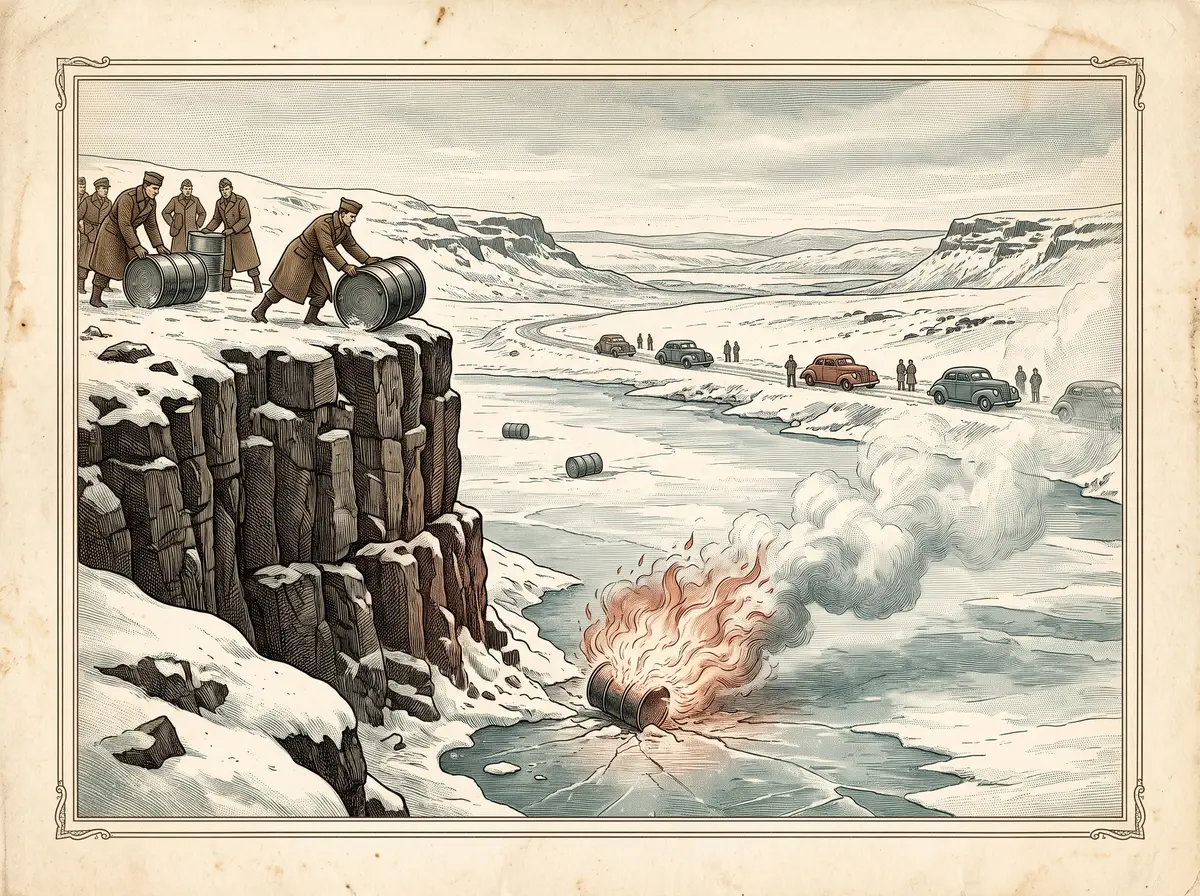
On a winter day in 1947, soldiers in eastern Washington rolled steel drums off a cliff onto a frozen lake, then opened fire on them with machine guns. They weren't fighting anyone. They were taking out the trash. Each bullet hole let lake water reach the metal inside, and each drum answered with a roar of flame that sent white mist drifting toward the road, where a few dozen drivers had pulled over to enjoy the show.
By the Curiosities Desk · · 5 min read · Filed under Chemistry · Today’s round
What happened: The Ten Tons of War Sodium the Army Rolled Off a Cliff Into a Frozen Lake
World War II left the United States with mountains of things it no longer needed: planes, trucks, boots, and chemicals. The job of selling or getting rid of them fell to a federal agency called the War Assets Administration. In its inventory was a stockpile of metallic sodium, left over from wartime munitions production, stored in drums that had started to deteriorate.
Metallic sodium is not the friendly sodium in table salt. In salt, sodium is already bonded to chlorine and perfectly calm. The pure metal is soft enough to cut with a knife, and it reacts violently with water. That made the old drums a shipping nightmare. According to the narrator of a government newsreel about the episode, no public carrier would agree to haul the sodium to a buyer. Chemical & Engineering News later summed up the problem the same way: no private carrier would touch the deteriorated containers.
So the sodium couldn’t go anywhere. The government decided to get rid of it close to where it sat, and chose Lake Lenore, a long, narrow lake in the lower Grand Coulee, north of the town of Soap Lake. The lake had been carved out by the Ice Age Missoula Floods, and its water was strongly alkaline, meaning chemically the opposite of acidic, like a mild solution of baking soda. The newsreel’s narrator described it as an alkali lake “devoid of fish” that made “an admirable disposal spot.”
Before anything happened, the War Assets Administration and the Washington State Department of Game looked at the plan. They concluded the sodium would have little effect on the lake or its wildlife. Their bigger worry was the safety of the workers.
In January 1947 (a newsreel of the event is dated January 13), soldiers drove the drums to the lake. In all, there was roughly 20,000 pounds of sodium, about 10 tons; C&EN put it at more than 9,000 kilograms. The drums were rolled off a cliff onto the ice. Then, so the water could get at the metal, the soldiers shot holes in them.
What followed was a chain of explosions. Fireballs bloomed off the frozen surface, and the newsreel’s narrator called it “a once-lethal war chemical” turned “peacetime pyrotechnic display.” According to a description accompanying an online copy of the film, the reaction released an estimated 162,000 cubic feet of hydrogen gas, which caught fire. The same description says several dozen passing motorists stopped to watch as a mist of sodium hydroxide, a caustic chemical better known as lye, drifted down, and that the Army paid to repaint their cars. That detail comes from a later retelling rather than an official record, so treat it as a good story that may be true rather than settled fact.
Why it was strange: The Ten Tons of War Sodium the Army Rolled Off a Cliff Into a Frozen Lake
The plan sounds like a cartoon: you have too many explosives, so you explode them in a lake. But it wasn’t careless in the way it first looks. The people in charge had a real chemical reason for picking this lake, they checked with the state’s wildlife agency, and they did it in the open where the blast could do little harm.
The strangeness is in the gap between the reasoning and the spectacle. A disposal method that looked on paper like quiet chemistry turned out to involve cliffs, frozen ice, machine guns, fireballs, and a crowd of spectators along the highway. The government even filmed it and narrated it like a fireworks show. It was hazardous-waste management performed as public entertainment, at a time before modern rules about how such waste must be handled. For another chemical too dangerous to handle politely, see The Chemical That Sets Fire to Sand — and the Rocket Chemist Who Recommended Running Shoes.
What scientists learned: The Ten Tons of War Sodium the Army Rolled Off a Cliff Into a Frozen Lake
The chemistry is the same reaction high-school teachers demonstrate with a pea-sized lump of sodium in a bowl of water, just scaled up enormously. Sodium hands an electron to water. That produces sodium hydroxide, hydrogen gas, and a burst of heat. The heat can be enough to ignite the hydrogen, which is where the fireballs come from.
The 162,000-cubic-foot figure checks out. Ten tons of sodium is close to 400,000 moles of sodium atoms, and every two sodium atoms release one molecule of hydrogen. At ordinary temperature and pressure, that’s on the order of 150,000 to 160,000 cubic feet of gas.
The bigger question was what all that lye would do to the lake. C&EN worked it out decades later. If the lake water had started out neutral, the sodium might have pushed its pH, the scale chemists use for acidity and alkalinity, up to about 9.2. But a 1958 study in the journal Limnology and Oceanography had found Lake Lenore’s natural average pH was already 9.9. On a lake that alkaline, the Army’s contribution barely registered. The officials’ reasoning held up: dissolving a base into water that was already more basic changed very little. Another lake that met an unexpected industrial accident: The Drilling Rig That Pulled the Plug on a Lake — and Then Got Sucked Down the Drain.
How it reaches us today: The Ten Tons of War Sodium the Army Rolled Off a Cliff Into a Frozen Lake
Nobody today would dispose of hazardous chemicals this way. Modern waste laws, starting with the Resource Conservation and Recovery Act in 1976, require dangerous materials to be tracked and treated rather than blown up in a scenic spot. Lake Lenore is a vivid reminder of how recently “find an empty place and get rid of it” counted as a plan.
The lake itself has had a happier second act. Since the mid-1980s, Washington has stocked it with Lahontan cutthroat trout, a fish that tolerates the alkaline water that would kill most others. The Washington Department of Fish and Wildlife says it’s the only species anglers can expect to catch there, and some fish push 30 inches. The lake once picked because nothing lived in it is now a destination for fly fishers. For another wartime explosion that got caught on film, see The Manhole Cover a Nuclear Test Fired Into the Sky — and the Single Camera Frame That Caught It.
Fun fact: The Ten Tons of War Sodium the Army Rolled Off a Cliff Into a Frozen Lake
The lake the Army chose because it was “devoid of fish” is now known for producing trout up to around 10 pounds.
Sources: The Ten Tons of War Sodium the Army Rolled Off a Cliff Into a Frozen Lake
- C&EN Newscripts, “Modeling Earth’s molten core” (includes Lake Lenore sodium disposal and pH analysis), Chemical & Engineering News, vol. 96, issue 49 (2018): https://cen.acs.org/environment/sustainability/tons-sodium/96/i49
- “The Disposal of Sodium, 1947 Washington State,” newsreel footage dated January 13, 1947: https://www.youtube.com/watch?v=HY7mTCMvpEM
- Jacob Wagner, “1947 Lake Lenore sodium explosions available to view online,” The Star (Grand Coulee, WA), November 28, 2018: https://grandcoulee.com/story/2018/11/28/community/1947-lake-lenore-sodium-explosions-available-to-view-online/11176.html
- UW–Madison Center for Limnology, “War Hazard Eliminated. Lake Effects Unknown?” (2012): https://blog.limnology.wisc.edu/2012/02/27/war-hazard-eliminated-lake-effects-unknown/
- Washington Department of Fish and Wildlife, “Lenore Lake” fishing location page: https://wdfw.wa.gov/fishing/locations/lowland-lakes/lake-lenore