Science Gone Wrong · Chemistry
The Stink Spray Built to Humiliate Nazi Officers — That Mostly Tagged the Person Holding It
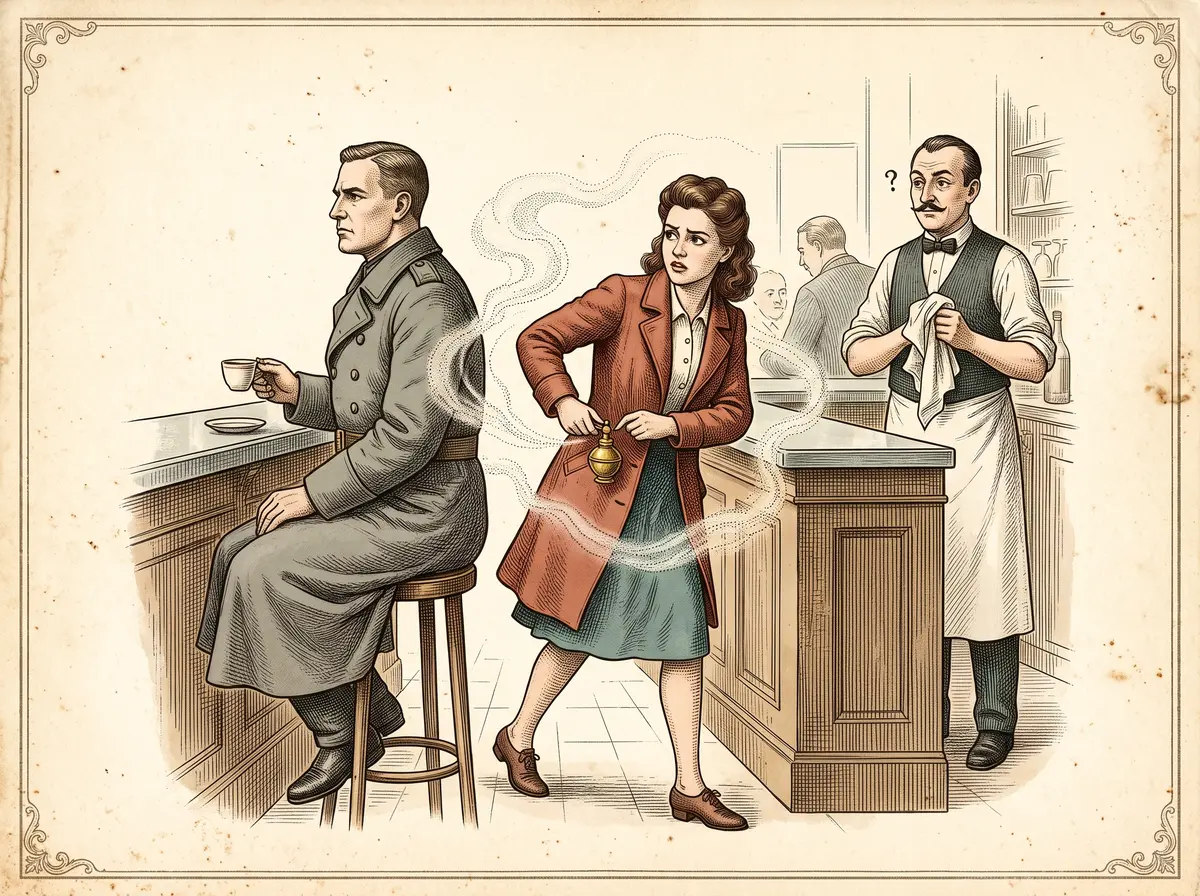
Picture a café in occupied France during World War II. A German officer stands at the counter. Someone brushes past him, thumbs a tiny atomizer, and walks on. Within moments the officer smells, unmistakably, like a sewer. That was the plan behind a secret American chemical called "Who Me?" The trouble, according to the scientist who later studied it, was that the person doing the spraying usually walked away smelling just as bad.
By the Curiosities Desk · · 5 min read · Filed under Chemistry · Today’s round
Part of When the Experiment Left the Lab
What happened: The Who Me Stink Bomb
In 1943 the Office of Strategic Services, the American wartime spy agency that came before the CIA, was in the business of strange ideas. Its Research and Development Branch was run by Stanley Lovell, an industrial chemist whom OSS chief William Donovan called “Professor Moriarty.” His shop included a small division devoted to what amounted to stench warfare.
The man given the stink job was Ernest Crocker, a chemical engineer from MIT’s class of 1914. Crocker was an unusual recruit: a flavor and fragrance scientist who, with his colleague Lloyd Henderson at the consulting firm Arthur D. Little in the 1920s, had worked out a system for classifying smells. If anyone in America could engineer a smell on purpose, it was him.
His brief was a smell nobody could stand. The idea was psychological, not physical. The target wasn’t supposed to be hurt. He was supposed to be laughed at. An occupying officer who reeked of excrement would become, in the project’s own framing, “a source of derision or contempt,” and his embarrassment would wear down the occupiers’ confidence. The code name explained the plan. When everyone turned to stare, the victim would be left asking the room: who, me?
According to an account in MIT Technology Review based on Crocker’s papers, the team settled on a formula in March 1944. It was a blend of skatole, the compound that gives feces much of its smell; amyl mercaptan, a sulfur compound in the rotten-egg family; and butyric, valeric, and caproic acids, which add notes of vomit, rancid butter, and sweaty feet. Testing took place at Maryland Research Laboratories, where technicians reportedly ended up coated in what was described as “unwashable stench.”
Here the story splits into two versions, and it is worth keeping them apart.
The version most people repeat comes from Pamela Dalton, a cognitive psychologist at the Monell Chemical Senses Center in Philadelphia, who recreated Who Me? decades later. In interviews around 2001 and 2002, she described the compound being issued to the French Resistance in pocket atomizers. Its sulfur compounds were so volatile, meaning they turned to vapor and spread so fast, that the sprayer could not avoid the cloud. More often than not, she said, the sprayer smelled as bad as the target. After about two weeks, in her telling, “the experiment was pretty much deemed a failure.”
The archival version is quieter. MIT Technology Review’s 2018 account, drawn from records of Crocker’s work, says 600 units were prepared after passing handling tests in the autumn of 1944 — and that the war ended before Who Me? was used on the battlefield. A second formula, aimed at the war with Japan, swapped out skatole for a chemical meant to add a smell of decay.
Both versions agree on the central problem: Who Me? was much better at smelling awful than at staying where it was put. Whether it failed in the streets of Paris or failed before it ever got there, the evidence available today doesn’t settle.
Why it was strange: The Who Me Stink Bomb
Most weapons are designed to work at a distance. A stink spray works only up close, and its active ingredient is a gas that goes wherever the air goes. That makes it a weapon that cannot tell friend from foe — and the closest friend is the person holding it.
There was a deeper flaw, too. As one newspaper account dryly noted, anyone close enough to spray an officer was close enough to do something far more serious. The weapon asked a resistance fighter to take a real risk for a prank.
For another story where a bad smell would not stay put, see The Molecule So Foul a Waitress Sprayed Deodorant at the Chemists Who Made It.
What scientists learned: The Who Me Stink Bomb
The real lesson came half a century later. In the late 1990s, the Pentagon’s nonlethal weapons program approached Monell about bad smells, and Dalton’s team began testing which odors people found worst. Who Me? did very well — it tied for the most unpleasant odor in her tests.
But the research turned up a stubborn fact: there is no truly universal stench. Smell is shaped by culture, experience, and expectation. In one of Dalton’s experiments, people sniffed butyric acid, a key note in the smell of vomit. When it was labeled as a body odor, they found it repulsive. When it was labeled as food, some thought of cheese. A smell that horrifies one group can barely register with another. Dalton has also said plainly that the rumored “stink bomb” never existed: “There is no bomb, and there has never been any bomb.”
The intelligence agencies weren’t done with odd ideas, either: Acoustic Kitty: The CIA Wired a Live Cat for Sound to Spy on the Soviets.
How it reaches us today: The Who Me Stink Bomb
The science of bad smells turned out to be more useful in peacetime. Monell’s malodor work feeds into products people actually want — better air fresheners, deodorizers, and ways to cut odor from places like hog farms. In one Monell study, adding copper chlorophyllin to pig feed cut the smell of hog slurry by about 90 percent.
And the core idea behind Who Me? — that odor triggers disgust, and disgust changes behavior — still guides research into the chemistry of smell, from the gas utilities that deliberately add a sulfur odor to natural gas so leaks are noticed, to studies of why the same smell means “dinner” to one person and “danger” to another.
Another wartime science scheme that came back to bite its makers: The Bomb Full of Sleeping Bats That Burned Down Its Own Air Base.
A humiliation spray that stuck to the sprayer sits with the other experiments that got out of the lab in When the Experiment Left the Lab.
Fun fact: The Who Me Stink Bomb
There is a reference smell called “U.S. Government Standard Bathroom Malodor,” used to test whether bathroom air fresheners work. In Pamela Dalton’s tests, it tied with Who Me? for the most unpleasant odor of all.
Sources: The Who Me Stink Bomb
- Christina Couch, “The stench of war,” MIT Technology Review, June 27, 2018 — archival account of Ernest Crocker’s formula, testing, and the 600 prepared units.
- “Aroma Therapy / In the military, it’s known as ‘nonlethal weapons development,’” San Francisco Chronicle (SFGate) — Pamela Dalton on the atomizers, the backfire, and the two-week failure.
- “By a nose,” The Baltimore Sun, January 30, 2002 — Monell Chemical Senses Center, Dalton’s labeling experiment, and the hog-farm study.
- Stephanie Pain, “Stench warfare,” New Scientist, July 7, 2001.
- Stanley P. Lovell, Of Spies and Stratagems (1964) — memoir by the head of the OSS Research and Development Branch.