Failed Experiments · Chemistry
The Charred Roman Scrolls Britain Tried to Open With Water — Then Chlorine Gas
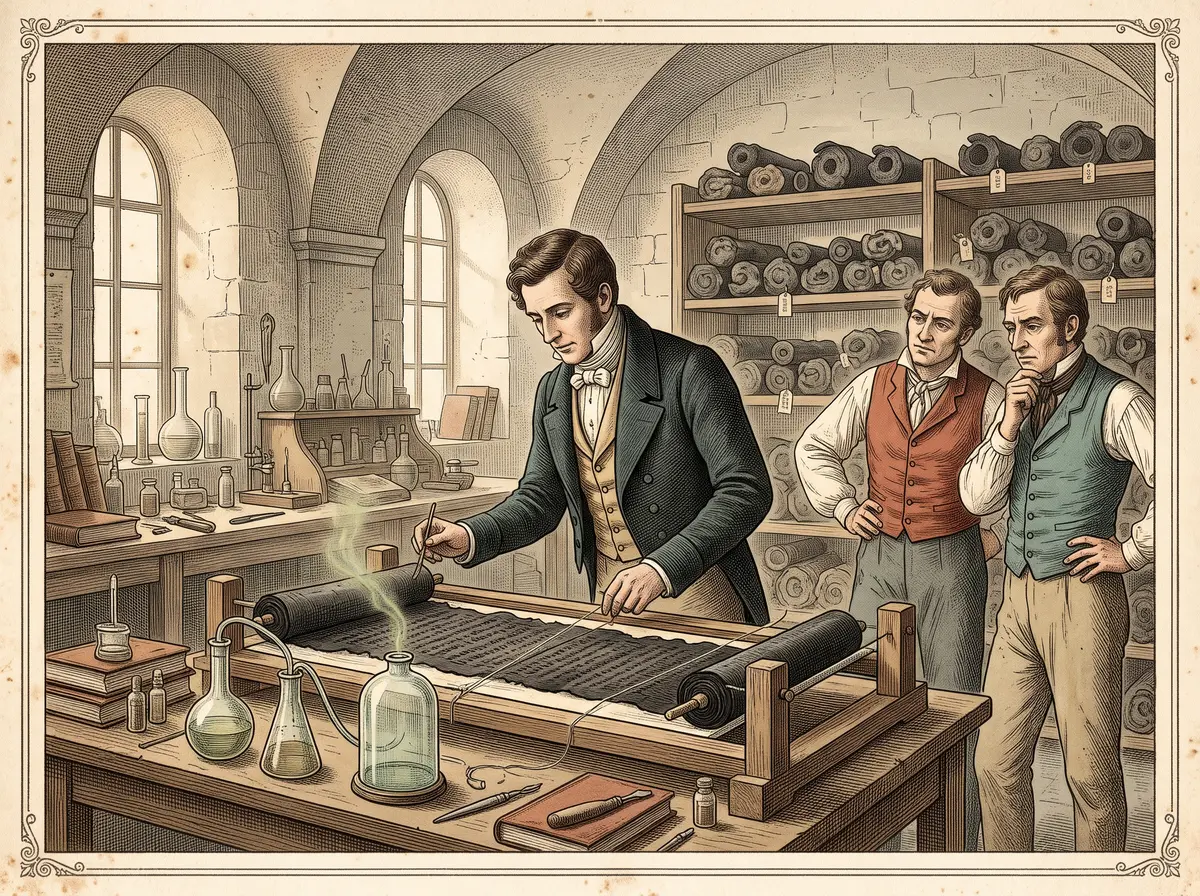
In the winter of 1819, Sir Humphry Davy, the most famous chemist in Britain, sat in a museum workroom in Naples treating a lump of charcoal with chlorine gas. The lump was a book. It had been a Greek scroll until Mount Vesuvius buried it in AD 79, and Davy had been sent by the Prince Regent to coax it open. His predecessor had already tried water. Seven scrolls had not survived the attempt.
By the Curiosities Desk · · 5 min read · Filed under Chemistry · Today’s round
What happened: Davy's Charred Scrolls
In 1752, workmen digging at Herculaneum for the Bourbon royal family broke into a lavish villa and found what looked like heaps of burnt logs. They turned out to be papyrus rolls, the private library of a Roman villa, now called the Villa of the Papyri. The official list eventually ran to more than 1,800 rolls and fragments, all of them blackened, brittle, and fused into lumps.
Opening them was the problem. In 1756 a priest named Antonio Piaggio built a frame that pulled a scroll open with silk threads, a few millimeters at a time; the first roll took about four years. It worked, slowly, on the better-preserved rolls. The worst ones stayed shut.
Britain got involved through a royal gift. In 1816 the King of the Two Sicilies presented twelve charred scrolls to the Prince Regent, the future George IV. A German scholar, Friedrich Sickler, was brought to England to open them. His method was to soak the rolls in water until the layers loosened. The water washed away the ink or made the papyrus crumble. Of the twelve scrolls, seven were destroyed. A Parliamentary committee looked into the affair in 1817, Sickler was paid off, and one of the committee members was handed the job. That member was Humphry Davy.
He had isolated sodium and potassium with electricity and had recently given coal miners a safety lamp. In 1818 he tested chlorine gas, iodine vapor, and heat on spare papyrus fragments in England, liked the results, and on May 26, 1818, set off from Dover for Naples with British government backing.
In Naples he worked with six assistants assigned by the museum and tried nearly everything in a chemist’s cabinet. He exposed rolls to chlorine and then warmed them gently, hoping the gas would loosen whatever glued the layers together. He heated rolls slowly in closed vessels filled with carbonic acid gas (carbon dioxide) or ether vapor, and brushed ether onto the layers. He found the timing unforgiving: heat a roll too fast and its folds burst apart; cool it too fast and the layers split. Solutions of rubber, resin, and gum did nothing useful. His best results came from speeding up Piaggio’s own method with glue thickened by alcohol and a stream of warm air, which cut the time to open a section from hours to 30 or 40 minutes.
Over two winters in Naples, Davy and his team partially unrolled 23 manuscripts and examined about 120 more that they judged beyond hope. Then the working relationship fell apart. When the classical scholar Peter Elmsley began reading the newly opened fragments, Davy wrote, the museum’s own unrollers became jealous and threw up obstacles that grew more vexing by the week. Historian Frank James has suggested that Davy’s brusque manner did not help. Toward the end of February, Davy and Elmsley stopped, concluding it would be “a waste of the public money, and a compromise of our own characters, to proceed.” Davy was back in England in 1820, and that November he was elected President of the Royal Society.
Why it was strange: Davy's Charred Scrolls
This was one of the first times a chemist was asked to rescue literature, and the tools of the most advanced laboratory in Europe turned out to be only a modest improvement on a priest’s silk threads. Davy had arrived thinking that 80 to 120 of the rolls might be worth experimenting on. By the end he wrote that even that estimate “appeared much too high.”
The hardest rolls already had a name. The museum staff called the ones they had given up on disperati, “the hopeless ones.” Britain’s star chemist ended up agreeing with them.
More projects that did not go to plan live on The Experiment That Did Not Come Out.
What scientists learned: Davy's Charred Scrolls
Davy’s failure still produced real chemistry. He heated samples and collected what came off: water, acetic acid, ammonia, carbon dioxide, and flammable gas. That told him the scrolls were not pure charcoal. They still held plenty of partly decomposed plant matter. He identified the shiny “varnish” on some rolls as decomposed animal skin, and from the ammonia he concluded the ink was charcoal bound with glue, with no sign of the iron-based inks later scribes used.
He also argued that the rolls had not simply been burned like logs in a fire, but slowly altered by heat, moisture, and the sealing mass of volcanic material, which explained why some were pale and loose while others were dense and black. His 1821 paper in the Philosophical Transactions of the Royal Society is an early attempt to treat an archaeological object as a chemistry problem.
Davy’s experimental streak started long before Naples, as told in From Laughing-Gas Parties to the Operating Room: A Short History of Anesthesia.
How it reaches us today: Davy's Charred Scrolls
The scrolls Davy could not open are being read now, without being opened at all. Researchers led by Brent Seales at the University of Kentucky developed “virtual unrolling,” which scans a closed scroll with X-rays and flattens its layers digitally. On February 5, 2024, the Vesuvius Challenge awarded a $700,000 Grand Prize to Youssef Nader, Luke Farritor, and Julian Schilliger, whose machine-learning models recovered more than 2,000 characters from inside a sealed roll. That was still only about 5 percent of the scroll. In May 2025, a team read the title of another closed roll at Oxford’s Bodleian Libraries, PHerc. 172: On Vices, by the philosopher Philodemus.
The lesson Davy learned the hard way still shapes conservation: when a treatment can destroy the thing it is meant to save, the safest experiment may be the one that never touches it. The full story of the digital rescue is in The Library Burned by Vesuvius That AI Is Finally Reading.
Fun fact: Davy's Charred Scrolls
Davy’s work in Naples was not a total loss to the Prince Regent. In 1820 he presented him with a bound volume of watercolor copies of the best fragments, painted by the archaeologist Sir William Gell. It is still in the Royal Collection, with Queen Victoria’s bookplate inside.
Sources: Davy's Charred Scrolls
- Davy, Humphry. “Some Observations and Experiments on the Papyri Found in the Ruins of Herculaneum.” Philosophical Transactions of the Royal Society of London 111 (1821): 191–208. https://www.jstor.org/stable/107613
- Royal Collection Trust. “The Herculaneum Rolls Committee” (House of Commons report, 1817). https://www.rct.uk/collection/1196789/the-herculaneum-rolls-committee
- Royal Collection Trust. “Copies of specimens of papyri [found at Herculaneum]” (RCIN 1076170). https://www.rct.uk/collection/1076170
- Dictionary of National Biography (1888). “Davy, Humphry.” https://en.wikisource.org/wiki/Dictionary_of_National_Biography,_1885-1900/Davy,_Humphry
- Vesuvius Challenge. “Grand Prize” (2024). https://scrollprize.org/grandprize