Science Gone Wrong · Archaeology
The Cow That Stepped Into a Hole — and Started French Archaeology's Longest Feud
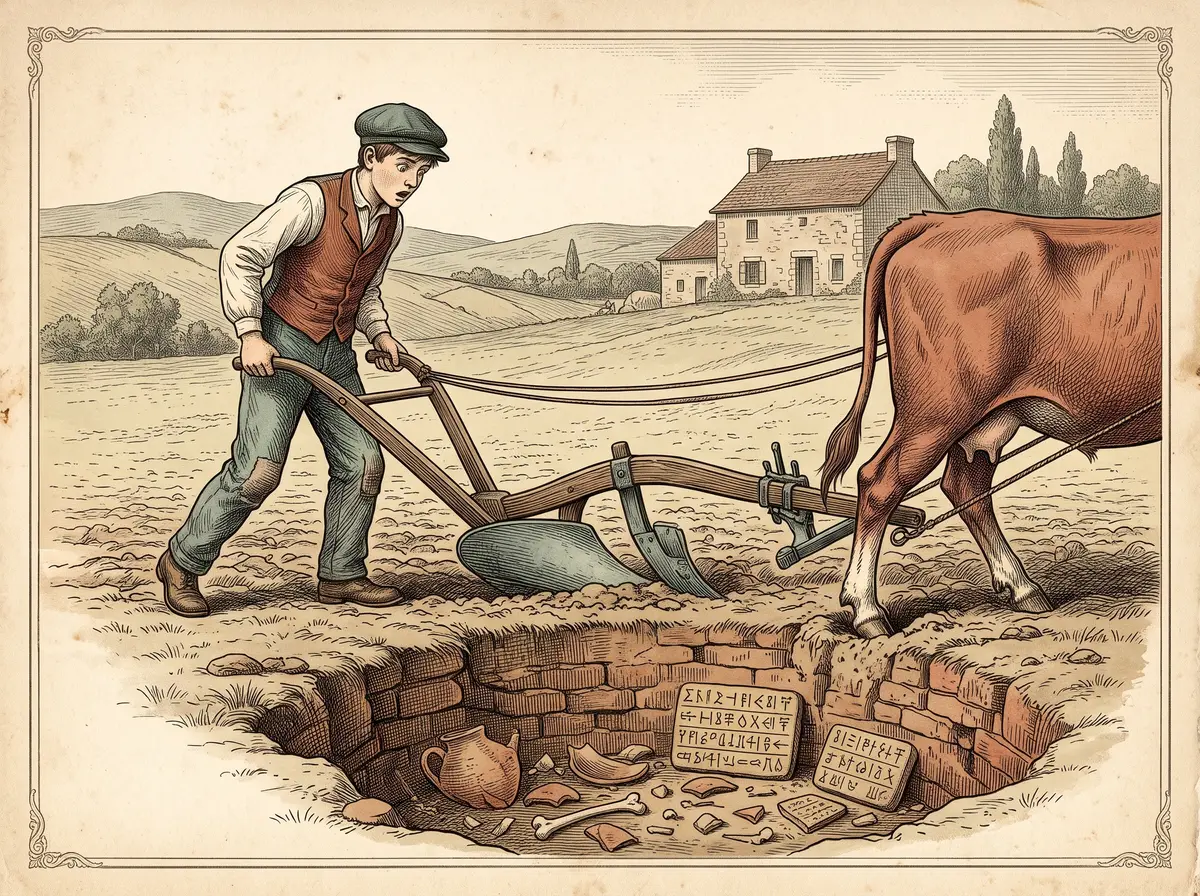
On March 1, 1924, near the hamlet of Glozel in central France, 17-year-old Émile Fradin was guiding a plow behind a cow when, by the usual telling, the animal's foot plunged into the ground. Underneath was a buried chamber lined with clay bricks, holding bones and broken pottery. Within a few years, that hole would bring in an international commission of experts, a police raid, two court cases, and a fight over clay tablets that still has not fully ended.
By the Curiosities Desk · · 5 min read · Filed under Archaeology · Today’s round
What happened: Glozel in 1924
Émile and his grandfather, Claude Fradin, cleared out the chamber. A local schoolteacher, Adrienne Picandet, came to look and passed word to the Ministry of Education. That July, another teacher visited with a companion; they broke down what was left of the walls with pickaxes and carried material away, judging the site to be Gallo-Roman, from roughly AD 100 to 400.
Then Antonin Morlet arrived. A physician from nearby Vichy and an enthusiastic amateur archaeologist, he paid the family 200 francs in April 1925 for the right to dig, and began in May. The field kept producing: engraved stones, bone and flint tools, small figurines, odd vessels, and above all clay tablets covered in rows of signs that looked a little like an alphabet. In September 1925, Morlet published a booklet calling Glozel a new Neolithic site, from the late Stone Age, and he listed the teenage Émile as co-author.
That date was the explosive part. Writing was supposed to have been invented far away, in the Middle East, thousands of years after the French Stone Age. If farmers in the Allier hills had been writing first, the textbooks were wrong. Some respected scholars were won over. Salomon Reinach, curator of France’s national archaeology museum, dug at the site and vouched for it. Others were sure it was fake. René Dussaud, a Louvre curator and expert in ancient scripts, said so publicly and named Émile as the forger.
In 1927, an international gathering of anthropologists in Amsterdam appointed a commission to settle the matter. Its members, including Denis Peyrony of France and a young British archaeologist named Dorothy Garrod, arrived on November 5 and dug for three days in front of journalists and onlookers. Worried that someone might slip fakes into the trench overnight, they dusted the dig face with plaster and then poked a secret pattern of holes into it, with Garrod writing the pattern down. The next morning, while she was checking it, Morlet saw her and accused her, in her later recollection, of making the holes herself to salt the site. Garrod said she was too embarrassed and confused to answer.
The commission’s December report declared nearly everything at Glozel fake, apart from a few flint axes and stones. In February 1928, Félix Regnault, president of the French Prehistoric Society, toured the small museum the Fradins had set up in their farmhouse and filed a fraud complaint, pointing out that the family charged visitors to see it. Police searched the farm the next day, smashed display cases, and took away three crates of objects. A police laboratory examined them and called them recent. Émile was charged with fraud in 1929, but an appeal court threw the case out in 1931. In 1932, the court ruled that Dussaud had defamed him.
Why it was strange: Glozel in 1924
The fight was never really about one farm. It was about who gets to decide what the past looked like: a country doctor and a teenage farmer, or professors from Paris and abroad. Both sides accused the other of planting evidence, and a test meant to prevent cheating ended up as one more accusation.
The objects were strange, too. People proposed that the tablets were written in Basque, Hebrew, Phoenician, Latin, Berber, Turkic, and several other languages. No decipherment has ever been confirmed. A script that seems to fit a dozen languages may not be a real language at all.
If you like fakes that fooled the experts, see Piltdown Man: The Fake Fossil That Fooled Science for 40 Years.
What scientists learned: Glozel in 1924
Glozel came back to life in 1974, when researchers used thermoluminescence on the pottery. That method dates fired clay by measuring the energy that builds up in its crystals from natural radiation after it was last heated. The first results said the objects were genuinely old, perhaps from around 700 BC to AD 100, though the authors called those dates preliminary.
Later testing made the picture messier, not neater. A 1979 round of 39 dates on 27 objects split them into three groups: Iron Age to Roman, medieval, and recent. Radiocarbon dating of charcoal and bone in the 1980s mostly pointed to the Middle Ages, with some bone as young as the 20th century. Neutron analysis of glass in Toronto placed it in the medieval period too.
France’s Ministry of Culture reopened excavations from 1983 to 1990. Its 1995 summary concluded that Glozel is probably a medieval site, possibly with a few earlier Iron Age pieces, that was very likely “enriched” with forgeries. That answers the Stone Age question, but not who made the fakes, when, or why.
The same pattern appears in The Fake Fossils Carved to Humiliate a Professor, where planted finds said more about the people around a dig than about the past.
How it reaches us today: Glozel in 1924
Glozel is a standard warning in archaeology classes. It shows why a find needs a recorded context, meaning exactly where and in which layer it lay, written down by more than one person before anything is moved. Once objects come out of the ground without that record, no lab test can fully sort the genuine from the planted. It also shows the limit of a single scientific date: thermoluminescence was a real advance, but one surprising result needed checking against other methods before anyone could trust it.
Émile Fradin never stopped saying the finds were real. He lived to 103, dying in 2010, and the museum at Glozel still displays the tablets.
For another dig that a joke turned into a scientific headline, read The Prank Skull California’s State Geologist Called the Oldest Human in America. The cow’s misstep belongs with the other finds that started on the wrong errand, in The Finds That Started on the Wrong Errand.
Fun fact: Glozel in 1924
At least one investigation reported that some of the engraved Glozel tablets dissolved when they were put in water, which suggests they had never been fired at all.
Sources: Glozel in 1924
- McKerrell, H., Mejdahl, V., François, H., and Portal, G. “Thermoluminescence and Glozel.” Antiquity 48, no. 192 (1974): 265ff.
- Garrod, Dorothy. “Recollections of Glozel.” Antiquity 42, no. 167 (1968): 172–177
- Daugas, J.-P., et al. “Résumé des recherches effectuées à Glozel entre 1983 et 1990.” Revue archéologique du Centre de la France 34 (1995): 251–259
- Vayson de Pradenne, A. “The Glozel Forgeries.” Antiquity 4, no. 14 (1930): 201–222
- “Glozel, site archéologique: Polémiques et procès,” Encyclopædia Universalis