Strange Animals Scientists Studied · Archaeology
The Hungry Badger That Left 90 Roman Coins Outside Its Front Door
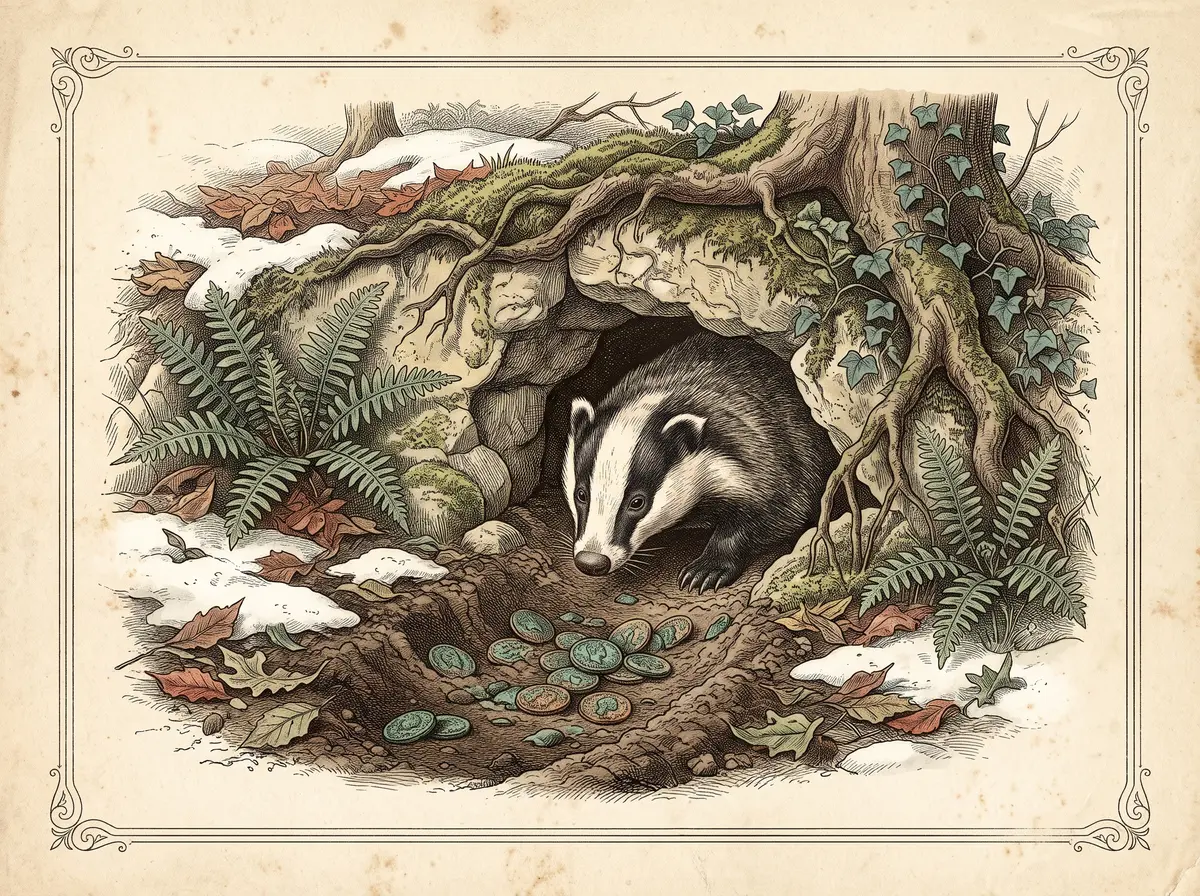
In January 2021, outside a badger's den near Grado in Asturias, the ground was glinting. Scattered across the dirt in front of the burrow lay about 90 small, green-crusted discs: Roman coins, some of them roughly 1,600 years old, kicked out like spare bedding by an animal that was only looking for something to eat.
By the Curiosities Desk · · 5 min read · Filed under Archaeology · Today’s round
What happened: The Grado Badger Sett
The place is La Cuesta, a small cave near the village of Berció in the municipality of Grado, in Asturias, on Spain’s rainy northern coast. In early 2021 a European badger (Meles meles) living in a sett — the network of tunnels badgers dig as a home — beside the cave did some serious excavating.
Researchers think timing explains the digging. In January 2021, Storm Filomena buried much of Spain under its heaviest snowfall in about 50 years. With food hard to reach, the badger may have dug deeper or wider than usual, either foraging or expanding its den. That link is the team’s best guess, not something anyone watched happen.
What came up with the soil was a pile of coins. Reports credit a local resident, named in Smithsonian Magazine’s coverage as Roberto García, with spotting them and calling in archaeologists. When the team arrived, dig director Alfonso Fanjul Peraza, an archaeologist then affiliated with the Autonomous University of Madrid, described the scene simply: they found the hole leading to the badger’s nest, “and the ground around it full of coins.”
The Asturias regional culture department authorized a proper excavation of the cave, which began in April 2021. Working the spot by hand, the archaeologists recovered roughly 119 more coins, bringing the total to 209.
The coins are mostly copper and bronze and date from the third to the early fifth century AD. They were struck at mints across the Roman world, from Constantinople and Thessaloniki in the east to Rome, Arles, and Lyon. The largest is a well-preserved coin from the mint at London — Londinium — weighing more than eight grams and containing about four percent silver.
In December 2021 the team published its first assessment in the journal Cuadernos de Prehistoria y Arqueología de la Universidad Autónoma de Madrid. The paper calls the hoard a “tesorillo” — literally a “little treasure,” the Spanish term for a modest stash of coins — and the authors described it as the largest Roman coin hoard ever found in a cave in northern Spain. It was not the area’s first: in the late 1930s, 14 Roman gold coins, known locally as the Chapipi treasure, turned up in the same woodlands.
Why it was strange: The Grado Badger Sett
Badgers are usually the villains of archaeology, not the heroes. Their tunnels are at least 25 centimeters wide, and a single sett can be used by generation after generation of badgers, sometimes for centuries. Every chamber they dig scrambles the soil layers archaeologists rely on to tell which object is older than which. Historic England publishes formal guidance on handling setts that threaten ancient monuments, and because badgers are protected by law in Britain, the usual fix requires a licence to close the problem tunnels.
At La Cuesta, that same destructive habit did the opposite. The badger did not ruin a site so much as announce one. Without the pile at its front door, a few hundred low-value coins in a small, unremarkable cave might have stayed hidden indefinitely.
There is a second, quieter oddity. People do not usually stash money in a cave unless they are frightened.
What scientists learned: The Grado Badger Sett
The coins are a time stamp. A hoard can only have been hidden after its youngest coin was made, so the latest pieces tell archaeologists roughly when someone tucked the money away: the first half of the fifth century AD.
That was a turbulent moment for the Iberian Peninsula. In 409, Germanic and other groups — the Suebi, Vandals, and Alans — crossed the Pyrenees into Roman Hispania, and in the decades that followed, Roman control of the northwest unraveled. Fanjul Peraza connected the hoard to “social and political instability which came along with the fall of Rome,” and suggested the coins may have belonged to people who fled into the hills and hid their savings, perhaps meaning to come back for them.
The mix of mints also says something about how far ordinary money traveled. Small bronze change from Constantinople and London ending up in the same Asturian cave shows how connected even a remote corner of the empire still was in its final years.
The team’s open question is whether La Cuesta was a one-time hiding spot or a place where displaced families actually lived for a while. Answering it means digging more of the cave — carefully, and with the badger’s tunnels in mind.
The Roman coins join a long line of hoards found by accident, like The Lost Hammer That Led to 14,865 Roman Coins — and Got Its Own Museum Number.
How it reaches us today: The Grado Badger Sett
The La Cuesta coins went to be cleaned and studied, with plans for them to be displayed at the Archaeological Museum of Asturias in Oviedo.
The story also captures a real tension in field archaeology. Burrowing animals — badgers, rabbits, moles, even earthworms — constantly churn buried layers, a process scientists call bioturbation, meaning soil mixing by living things. Archaeologists have to read their tunnels as part of the record, separating what an animal moved from what a person left. Sometimes, as in Spain, that churning is how a site gets noticed in the first place.
Animals reshaping the ground beneath ancient ruins is a story Darwin told too, in The Earthworms Darwin Caught Slowly Burying Stonehenge. And for animals who find the past on purpose rather than by accident, see The Cadaver Dogs That Found Graves 2,700 Years Cold. The coins belong with the other finds that started on the wrong errand, in The Finds That Started on the Wrong Errand.
Fun fact: The Grado Badger Sett
The Spanish badger has a German colleague. In 2013, near the town of Stolpe, two sculptors watched a badger digging its sett and noticed a human pelvic bone in the spoil. Their tip led archaeologists to a 12th-century cemetery of eight people — including two apparent Slavic warriors, one buried with a double-edged sword.
Sources: The Grado Badger Sett
- Fanjul Peraza, A., Juaneda Gavelas, A., García Flórez, R., Ceballos Hornero, A., Muñoz Fernández, E., & San Miguel Llamosas, C. “El tesorillo tardorromano de la cueva de La Cuesta de Berció (Grado, Asturias): primeras valoraciones en su contexto cantábrico.” Cuadernos de Prehistoria y Arqueología de la Universidad Autónoma de Madrid 47(2) (2021): 287–299: the excavation team’s first published assessment of the hoard
- Gershon, L. “Hungry Badger Digs Up a Trove of Roman Coins in Spain.” Smithsonian Magazine, January 11, 2022: the 209 coins, the London coin, the snowstorm hypothesis, and Fanjul Peraza’s quotes
- Baker, H. “Hungry badger accidentally unearths hundreds of ancient Roman coins in Spain.” Live Science, January 11, 2022: the mints, the date range, the Chapipi treasure, and the 409 invasion context
- Historic England, “Badgers and Archaeological Sites”: how setts damage monuments and how they are legally managed
- Lallanilla, M. “Dig This: Badger Unearths Medieval Treasure.” Live Science, August 15, 2013: the Stolpe burial ground found by a badger in Germany