The Five-Story Steel Ball Where Patients Checked In to Breathe Squeezed Air
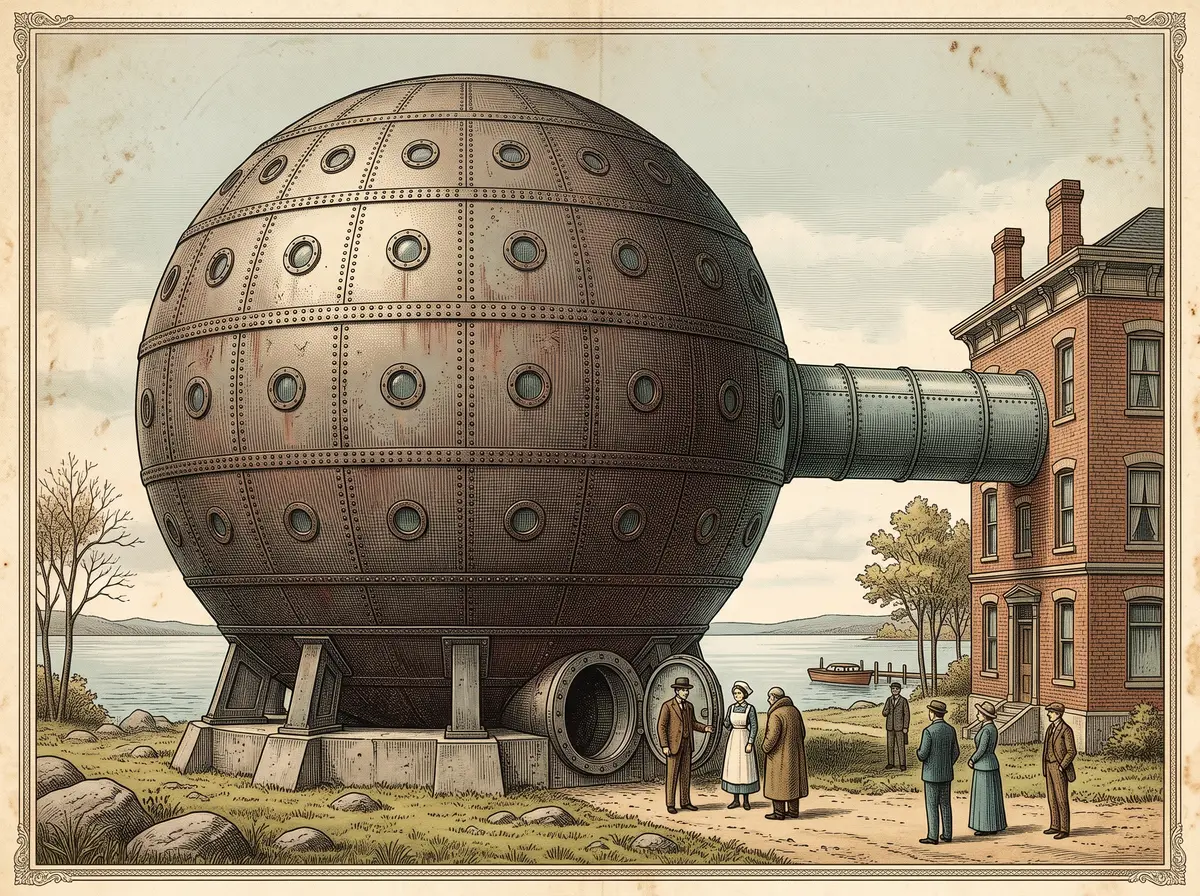
In December 1928, on the shore of Lake Erie in Cleveland, a giant steel ball opened its airlock doors to paying guests. It stood about 64 feet tall, weighed some 900 tons, and was dotted with roughly 350 portholes. Inside were bedrooms, a dining hall, and a recreation lounge, all sealed tight and pumped full of compressed air. The guests were patients, and the squeezed air was their medicine.
By the Curiosities Desk · · 5 min read · Filed under Medicine · Today’s round
What happened: The Five-Story Steel Ball Where Patients Checked In to Breathe Squeezed Air
The man behind the ball was Dr. Orval J. Cunningham, a Kansas physician who, in 1916, became the first chief anesthesiologist at the University of Kansas’s Bell Hospital. He had a reputation for being as good with machinery as he was with patients.
Cunningham had noticed something curious. People with lung disease seemed to do better when they moved from high-altitude Denver down to Kansas City, and the 1918 influenza pandemic appeared to hit high places harder. As an anesthesiologist, he knew that air at lower altitude is under more pressure, so every breath delivers more oxygen. What if you could create “extra-low altitude” on demand?
During the 1918 flu, he got his hands on a pressure tank and treated gravely ill patients inside it. He reported dramatic recoveries, including two pneumonia patients he credited the tank with saving. These were anecdotes, not controlled trials, but they set the course of his career.
By the early 1920s Cunningham had built a much bigger chamber in the side yard of a house on Harrison Street in Kansas City: a tank about 80 feet long and 10 feet across, laid out like a Pullman railroad sleeping car, with compartments, beds, and showers so patients could stay for hours or days. Air pressure inside ran from 5 to 30 pounds above normal, depending on the illness.
The neighbors were not charmed. They complained for months about the roar and rattle of the compressors, and worried that contagious patients were being housed next door. A judge even agreed to their request that patients not sit in the yard with canes or crutches. Then, in 1924, one of Dr. Cunningham’s monkeys escaped, and neighbors told the Kansas City Star it had terrorized the block.
What moved Cunningham on, though, was money. Henry H. Timken, the Canton, Ohio, roller-bearing magnate, became convinced the treatment had helped someone close to him (accounts differ on whether it was a friend or Timken himself). He bankrolled a dream facility reported to cost around $1 million. Timken’s chief engineer, Alois Hauser, designed the sphere; it had five stories, 38 rooms, room for about 40 patients, and was joined by steel tunnels to a three-story hotel-style building next door. Inside, the air was held at a steady 68°F and 65 percent humidity.
The Cunningham Sanitarium welcomed its first patient on December 1, 1928. It did not last long. Cunningham sold the site in 1934 to James Rand Jr., son of a Remington Rand founder, who rebranded it the Ohio Institute of Oxygen Therapy. It soon became an ordinary general hospital, then closed in 1937. In 1942, under War Production Board orders, the steel ball was cut apart and its metal went to the war effort.
Why it was strange: The Five-Story Steel Ball Where Patients Checked In to Breathe Squeezed Air
The building was strange, but the theory was stranger. Cunningham argued that diabetes, cancer, syphilis, and other diseases were caused by anaerobic organisms (microbes that cannot survive in the presence of oxygen). Flood the body with oxygen, he reasoned, and the invaders would die.
There was no evidence for this, and Cunningham never published the case reports that would let other doctors check. On May 5, 1928, the Journal of the American Medical Association ran a sharply skeptical piece on what it called the Cunningham “tank treatment,” noting the absence of published data and asking whether anyone could wonder that doctors “look askance” at it.
The timing adds an extra twist. By the time the sphere opened, insulin had been treating diabetes for six years, since its first human use in Toronto in January 1922. A proven therapy already existed for the main disease the sphere was built to cure.
Medicine has a long shelf of grand, expensive cures with thin evidence. One of its stranger neighbors is The Goat-Gland Surgery That Ended Up Rewriting American Radio Law.
What scientists learned: The Five-Story Steel Ball Where Patients Checked In to Breathe Squeezed Air
Cunningham’s first observation wasn’t foolish. It rests on real physics: Dalton’s law says each gas in a mixture contributes its own share, or “partial pressure,” of the total. Raise the total pressure and you raise the pressure of oxygen, which pushes more of it to dissolve into the blood. That is the principle behind hyperbaric medicine (treatment in air or oxygen at higher-than-normal pressure).
Where he went wrong was in the leap from a plausible mechanism to a cure-all, with no controlled testing in between. Diabetes is not an infection, and most cancers are not caused by oxygen-shy germs. Cunningham’s patients also breathed compressed ordinary air rather than pure oxygen, which limited how much extra oxygen they got.
The squeezing-the-body idea had its own earlier explorer: The Scientist Who Burst His Own Eardrums — and Said It Let Him Blow Smoke Out of His Ears.
How it reaches us today: The Five-Story Steel Ball Where Patients Checked In to Breathe Squeezed Air
Hyperbaric oxygen therapy is now a legitimate, if narrow, treatment. Patients breathe pure oxygen in a pressurized chamber for a specific list of conditions backed by research, including decompression sickness in divers, carbon monoxide poisoning, and some stubborn wounds, such as certain diabetic foot ulcers. The U.S. Food and Drug Administration, however, has not cleared it for many conditions it is still marketed for, including cancer, autism, and Alzheimer’s disease.
That is Cunningham’s legacy: a real idea, oversold. Some historians of hyperbaric medicine credit him as an early pioneer, while noting that the AMA’s criticism, and his cure-all claims, tarnished the field for years.
For another wealthy patron who backed an unproven cure, see The Radioactive Tonic That Dissolved a Millionaire’s Jaw.
Fun fact: The Five-Story Steel Ball Where Patients Checked In to Breathe Squeezed Air
A period photograph of the sphere shows a fifth-floor recreation room captioned “Smoking Allowed.” Modern hyperbaric chambers ban anything that can spark, because fire burns far more fiercely in pressurized, oxygen-rich air.
If you’re living with diabetes, cancer, or another serious illness, it’s worth talking with your doctor before trying any treatment sold as a cure-all, hyperbaric or otherwise.
Sources: The Five-Story Steel Ball Where Patients Checked In to Breathe Squeezed Air
- “Bureau of Investigation: The Cunningham ‘Tank Treatment,’” Journal of the American Medical Association, vol. 90, no. 18, May 5, 1928
- “Cunningham Sanitarium,” Encyclopedia of Cleveland History, Case Western Reserve University
- Morgan Choffin, “The Cunningham Sanitarium,” Cleveland Historical
- Mary Jo Draper, “Why Was There a Huge Steel Tank at 33rd and Harrison in the 1920s?,” Midtown KC Post, 2018
- “Hyperbaric oxygen therapy: Evidence-based uses and unproven claims,” Harvard Health Publishing