Accidental Discoveries · Space
The Knock on the Hatch That Solved John Glenn's Space 'Fireflies'
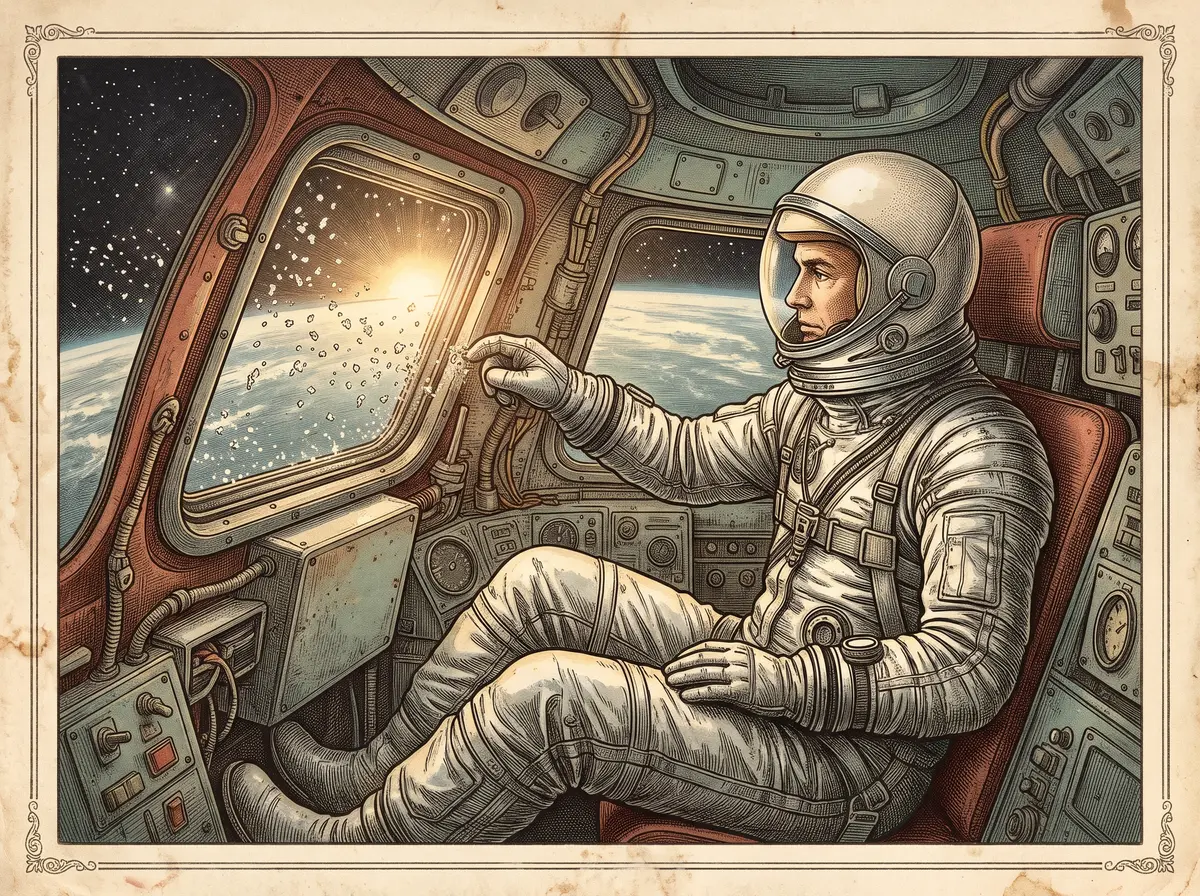
High over the Pacific, at the first sunrise of his first orbit, the first American to circle the Earth looked out his tiny window and found himself in a swarm of glowing specks. "I am in a big mass of some very small particles," John Glenn radioed, "that are brilliantly lit up like they're luminescent." Nobody on the ground knew what they were. Three months later, the answer turned up when another astronaut bumped his hand against the wall.
By the Curiosities Desk · · 5 min read · Filed under Space · Today’s round
What happened: The Knock on the Hatch That Solved John Glenn's Space 'Fireflies'
On February 20, 1962, John Glenn rode the Mercury capsule Friendship 7 into orbit and circled the Earth three times in just under five hours. It was the most closely watched flight NASA had yet flown, and almost every moment of it was planned. The particles were not part of the plan.
Shortly after his first orbital sunrise, Glenn began describing what he saw. According to the NASA air-to-ground transcript, he called them “little stars” and “a whole shower of them coming by.” He estimated they were spaced “maybe 7 or 8 feet apart,” drifted slowly at “maybe 3 or 4 miles per hour” relative to him, and were tiny — “on the order of 16th of an inch or smaller.” He told the ground there were “literally thousands” of them. In later accounts he gave them the name that stuck: fireflies.
Mission controllers took the report seriously. A capsule shedding pieces of itself in orbit could mean something was breaking. The tracking stations asked whether he could hear anything hitting the spacecraft (he couldn’t), and one relayed a request to “correlate the actions of the particles” with the firing of his attitude-control jets, the small thrusters that turned the capsule. Glenn saw the specks again at each sunrise, and they faded as the light grew stronger. He splashed down safely, but the fireflies came home as an open question.
The next American in orbit was Scott Carpenter, aboard Aurora 7, on May 24, 1962. Carpenter had a long list of observations to make, and the fireflies were on it. With each orbital sunrise he saw them too, though to him they looked less like glowing insects and more like snowflakes — some gray, some white, one shaped like what he described as “a helical shaving from a lathe.”
The breakthrough came by accident. NASA’s official history of Project Mercury, This New Ocean, puts it plainly: “Accidentally his gloved hand bumped against the capsule hatch, and suddenly a cloud of particles flew past the window.” Carpenter tried it on purpose. Another tap on the hatch sent off a second shower; a tap on the wall produced another. “I can rap the hatch and stir off hundreds of them,” he reported. The particles weren’t coming from space. They were coming off Aurora 7.
Why it was strange: The Knock on the Hatch That Solved John Glenn's Space 'Fireflies'
The fireflies landed at a moment when nobody knew what to expect in orbit. Only a handful of people had ever been there. Doctors were still gathering basic data on how the human body and senses held up in weightlessness. So when the first American orbiter described a glowing swarm that nobody could explain, the possibilities were wide open: a failing heat shield, debris from the rocket, some unknown space phenomenon, or simply a tired pilot’s eyes playing tricks.
The answer was humbling in the best way. The cutting-edge mystery of the early Space Age was solved not with an instrument but with a knuckle — and it turned out the spacecraft was carrying its own little weather system around the planet.
For another early NASA flight where a small, unplanned object stole the spotlight, see The Corned Beef Sandwich That Got NASA Hauled Before Congress.
What scientists learned: The Knock on the Hatch That Solved John Glenn's Space 'Fireflies'
The particles were ice. NASA’s postflight report on Carpenter’s mission traced them to the capsule’s own life-support system: steam from the system condensed between the spacecraft’s bulkhead and the heat shield, froze, and clung to the outside of the craft. In This New Ocean’s words, the exterior “evidently was covered with frost,” and so “Glenn’s ‘fireflies’ became Carpenter’s ‘frostflies.’”
Why did they glow? They didn’t, exactly. The flakes weren’t making light; they were catching it. At sunrise, the low sun lit up the drifting crystals against the black sky, the same way dust motes shine in a sunbeam in a dark room. Carpenter himself noted they did not appear truly luminous. And because the flakes had been knocked loose at roughly the capsule’s own speed, they hung beside it, drifting only a few miles per hour relative to the window.
Accounts of the exact source have varied over the years. Some later accounts pointed to the small hydrogen-peroxide thrusters, and Glenn later attributed the moisture to the spacecraft’s heat exchanger. What every version agrees on is the key point Carpenter proved: the fireflies were made by the spacecraft, not found by it.
Mercury’s cooling equipment had other surprises too; the program’s early approach to astronaut plumbing is covered in From a Wet Spacesuit to a $23 Million Toilet: A Short History of the Space Toilet.
How it reaches us today: The Knock on the Hatch That Solved John Glenn's Space 'Fireflies'
The fireflies were an early lesson in what engineers now call the “induced environment”: the cloud of gas, ice, and particles that a spacecraft creates around itself through venting, small leaks, outgassing from its surfaces, thruster firings, and waste dumps. Every crewed vehicle since has carried one.
That matters for more than curiosity. Telescopes, cameras, and sensitive instruments can be fooled or fogged by a spacecraft’s own debris, so mission planners account for venting and thruster plumes when they schedule observations. And when astronauts or cameras spot an odd glint outside a window, the first question ground teams ask is the one Carpenter answered with his hand: did it come from us?
For another accidental space discovery where the culprit turned out to be close to home, see The Pigeon Mess That Turned Out to Be the Echo of the Big Bang.
Fun fact: The Knock on the Hatch That Solved John Glenn's Space 'Fireflies'
Glenn’s mysterious “fireflies” were, by his own in-flight estimate, about a sixteenth of an inch across — tiny flakes of frost that briefly became one of the biggest puzzles of the Space Age.
Sources: The Knock on the Hatch That Solved John Glenn's Space 'Fireflies'
- Loyd S. Swenson Jr., James M. Grimwood, and Charles C. Alexander, “This New Ocean: A History of Project Mercury,” Chapter 13-9: Flight of Aurora 7 — NASA SP-4201 (1966), hosted by NASA Safety & Mission Assurance (primary NASA history)
- “Results of the Second U.S. Manned Orbital Space Flight, May 24, 1962” — NASA SP-6 (1962), NASA Technical Reports Server (primary source)
- Friendship 7 (Mercury-Atlas 6) air-to-ground transcript — NASA mission transcript, via Spacelog (primary source)
- “In Dire Peril: 55 Years Since the Troubled Mission of Aurora 7 (Part 2)” — AmericaSpace (2017)
- Nancy Atkinson, “The Mystery of John Glenn’s Fireflies Returns” — Universe Today (2011)