The Pocket 'Earthquake Machine' Tesla Smashed Before the Police Arrived
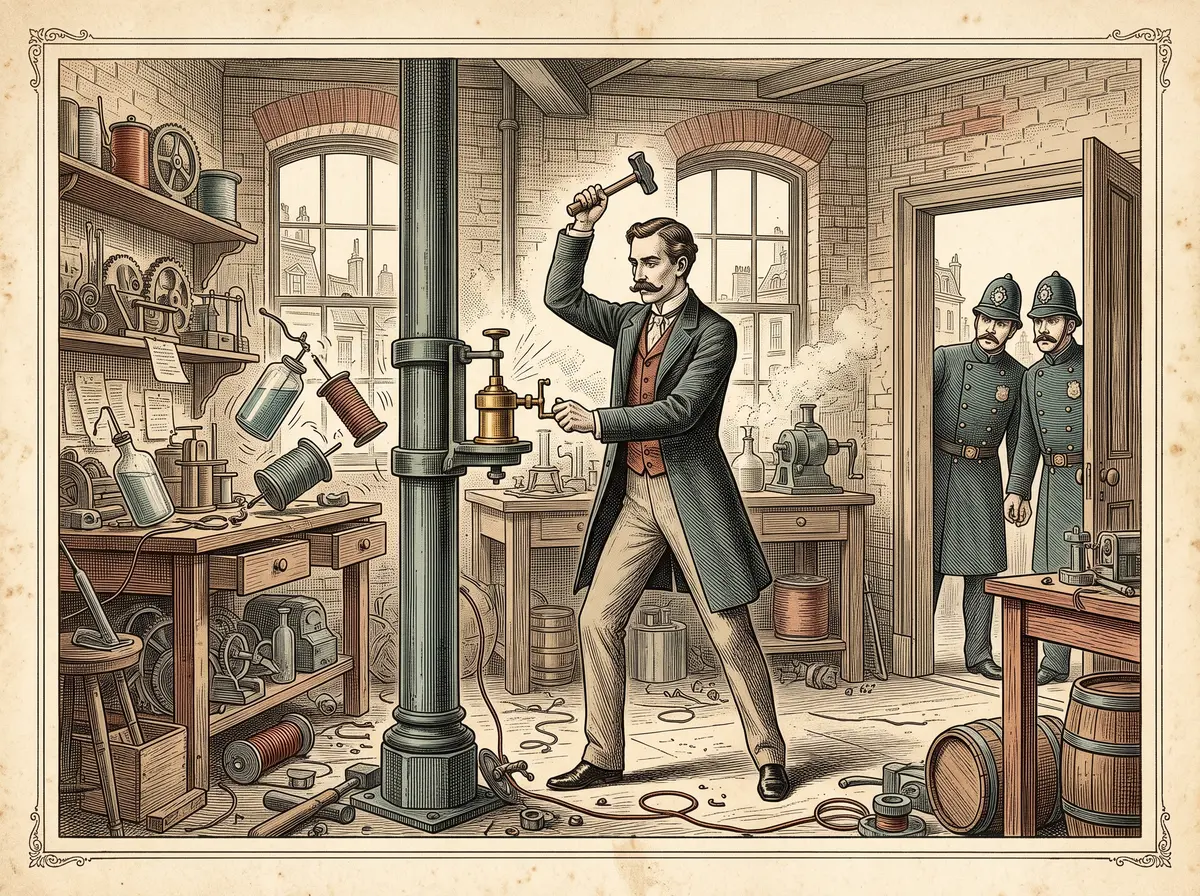
In July 1935, a day after his 79th birthday, Nikola Tesla told a newspaper reporter about the afternoon he nearly shook down his own laboratory. A little machine, small enough to "put in your overcoat pocket," had found the building's rhythm. Heavy equipment began "flying around." Tesla grabbed a hammer and smashed the machine. Then the police and ambulances showed up, and, as he told it, "We told the police it must have been an earthquake."
By the Curiosities Desk · · 5 min read · Filed under Engineering · Today’s round
What happened: The Pocket 'Earthquake Machine' Tesla Smashed Before the Police Arrived
The device at the center of this story was real. In the early 1890s, Tesla designed a steam-driven mechanical oscillator: a piston that shuttled back and forth at a very steady rate, attached to magnets and coils that turned that motion into electric current. On August 25, 1893, he lectured on it to the International Electrical Congress at the World’s Fair in Chicago. His goal was not destruction but precision. He wanted electric current with “a perfectly constant period,” steady enough that a motor run from it could serve as a clock. He received U.S. Patent 514,169, titled “Reciprocating Engine,” on February 6, 1894.
The earthquake part came later, and it came from Tesla himself.
In February 1912, journalist Allan L. Benson published a profile in The World To-Day titled “Nikola Tesla, Dreamer.” In it, Tesla described fastening an electric vibrator “no larger than an alarm-clock” to steel. He also told a story about clamping a vibrator to a beam of a ten-story steel building frame still under construction. “In a few minutes,” he said, “I could feel the beam trembling.” The structure began to “creak and weave,” and he said he stopped just in time: ten more minutes and he “could have laid that building flat in the street.” Then he went bigger. With the same vibrator, he said, he could drop the Brooklyn Bridge into the East River in under an hour, and with enough effort, “the earth would be split in two.”
The Houston Street version arrived in the New York World-Telegram on July 11, 1935, from Tesla’s annual birthday meeting with the press. This is the one with the overcoat-pocket machine, the shaking building, the hammer, the police, and the “earthquake” explanation. Tesla added that the right oscillator, attached to a girder of the Empire State Building, would need just “five pounds” of air pressure to bring it down.
Science writer John J. O’Neill retold the story in his 1944 biography Prodigal Genius, and later versions added new details: neighbors’ windows rattling, police bursting in, Tesla swinging a sledgehammer at the last second. That is the version most people know today.
Why it was strange: The Pocket 'Earthquake Machine' Tesla Smashed Before the Police Arrived
The story has a problem with its dates. The 1935 article placed the event at “48 E. Houston St.” in “1887 or 1888.” But Tesla’s Houston Street lab came after a fire destroyed his previous lab on South Fifth Avenue in March 1895. Retellings usually settle on 1898 instead. So a famous earthquake under Manhattan rests mainly on the inventor’s own memory, told decades after the fact, with details that shift between tellings.
That doesn’t mean Tesla was simply making things up. Something may well have rattled a building on Houston Street. A strong oscillator bolted to a frame really can set it humming. The leap from “the floor shook” to “I could split the planet” is where the physics stops following along.
Fittingly, the story belongs on the same shelf as Galloping Gertie: The Bridge That Taught Engineers to Fear the Wind, a real structure whose famous collapse also gets oversimplified as “resonance.”
What scientists learned: The Pocket 'Earthquake Machine' Tesla Smashed Before the Police Arrived
The core idea Tesla was playing with is resonance. Every structure has natural frequencies, rhythms at which it prefers to sway, like a playground swing. Push a swing at exactly the right moment each time, and small shoves build into big arcs. In principle, a small machine tapping a building at its natural frequency could do the same.
In practice, three things get in the way. First, damping: real buildings lose energy to friction in joints, walls, floors, and the ground, and the bigger they sway, the more energy they lose each cycle. Second, a skyscraper or bridge is enormous, so a pocket-sized machine has to pour in energy for a long time to move it noticeably. Third, an actual earthquake releases its energy from rock slipping along a fault, often many miles long, far beyond anything a steam piston could supply.
In 2006, the TV show MythBusters tested the idea in Episode 60, “Earthquake Machine.” After disappointing results with modified jackhammers, the team built a computer-controlled electromagnetic actuator, attached it to a large steel truss bridge, and tuned it to the bridge’s frequency. People felt the vibration about 100 feet away. Nobody would have mistaken it for an earthquake. Verdict: busted.
For a gentler side of Tesla, see Nikola Tesla and the Pigeon He Loved.
How it reaches us today: The Pocket 'Earthquake Machine' Tesla Smashed Before the Police Arrived
Resonance isn’t a myth, and engineers take it very seriously. When London’s Millennium Bridge opened on June 10, 2000, thousands of pedestrians unconsciously fell into step with its slight sideways sway, making it wobble more. It closed two days later and reopened in February 2002 after engineers installed 37 viscous dampers and 52 tuned mass dampers.
Taipei 101 goes further: a steel sphere of roughly 660 metric tons hangs near the top of the tower, swinging against the building’s motion to calm it in strong winds and earthquakes.
And Tesla’s dream of shaking the ground on purpose did come true, in a quieter form. “Vibroseis” trucks press heavy plates against the ground and vibrate them through a sweep of frequencies. Listening to the echoes helps geologists map rock layers below, including in the hunt for oil, gas, and water. No buildings fall down.
For the full story of that bridge, see The Wobbly Bridge That Closed Two Days After Opening — Because People Walked on It.
Fun fact: The Pocket 'Earthquake Machine' Tesla Smashed Before the Police Arrived
The headline on that 1935 interview didn’t even lead with the earthquake. It announced that Tesla, at 79, expected to have $100,000,000 within two years.
Sources: The Pocket 'Earthquake Machine' Tesla Smashed Before the Police Arrived
- U.S. Patent 514,169, “Reciprocating Engine,” Nikola Tesla, February 6, 1894 (Google Patents)
- “Tesla’s Mechanical and Electrical Oscillators,” report on his August 25, 1893 lecture to the Electrical Congress (Tesla Universe archive)
- Allan L. Benson, “Nikola Tesla, Dreamer,” The World To-Day, February 1912 (Tesla Universe archive)
- “Nikola Tesla, at 79, Uses Earth to Transmit Signals; Expects to Have $100,000,000 Within Two Years,” New York World-Telegram, July 11, 1935 (transcription)
- MythBusters Episode 60: “Earthquake Machine” (2006), episode results