The Roman 'Vomit Room' That Was Really Just the Way Out of the Stadium
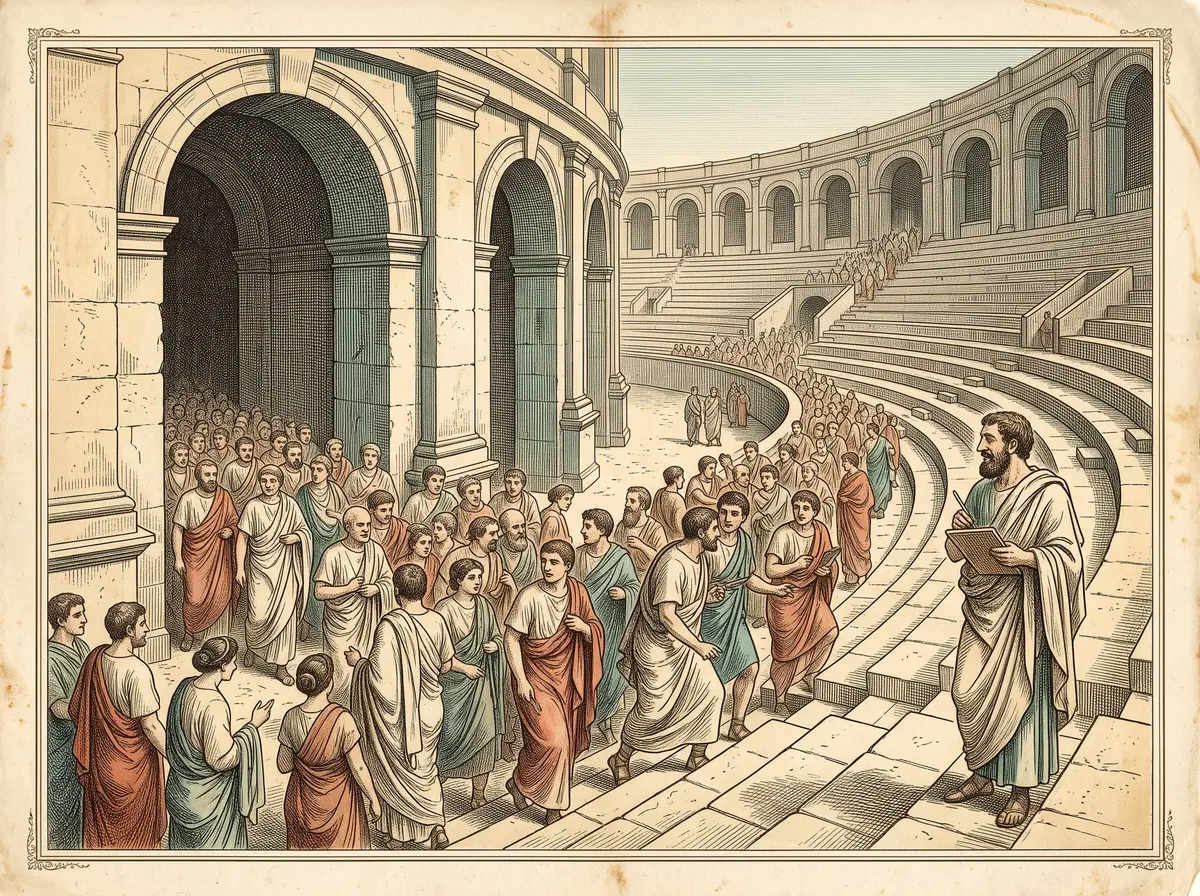
Around the fifth century AD, a Roman writer named Macrobius pictured crowds pouring through the arched passages of a public arena and reached for a vivid word. People did not simply walk into their seats, he wrote. The building spewed them out. He called those passages *vomitoria*. About fourteen centuries later, English readers met the word, put two and two together, and got five: a special room where stuffed Roman nobles went to throw up so they could keep on feasting.
By the Curiosities Desk · · 5 min read · Filed under Archaeology · Today’s round
Part of The Version Everyone Remembers
What happened: A Roman Vomitorium
The word turns up in Macrobius’s Saturnalia, a long, chatty book of imagined dinner-party conversations written in the fifth century AD. At one point (Book 6, chapter 4) the speakers are admiring how the poet Virgil used bold, earthy words. One example comes from Virgil’s Georgics, where a rich man’s mansion “vomits” a great wave of morning visitors out of its halls. Macrobius explains that this is the same image behind a word Romans still used: vomitoria, the passages at the public shows “from which people, coming in as a mass, pour themselves into the seats.”
In other words, a vomitorium was architecture. The big Roman theaters and amphitheaters were ringed with corridors, stairways, and openings that let tens of thousands of people enter and leave quickly. The verb vomere means “to spew forth,” and Latin added the ending -orium to make a word for a place, the way auditorium is a place for listening. A vomitorium was the place a crowd gushed out of. Nobody was being sick in it.
According to classicist Peter Gainsford, that passage in Macrobius is the only surviving ancient text that uses vomitoria this way, and even there it’s a figure of speech. The word carried its architectural meaning into English too. Gainsford notes that it appears by 1722 in an English translation of a French encyclopedia of antiquities.
The confusion seems to have crept in during the Victorian era. Historians Caillan Davenport and Shushma Malik of the University of Queensland point to an 1871 account by the French writer Félix Pyat describing a lavish Christmas dinner as “a Roman feast, in which the vomitorium is not wanting.” That same year, they report, the popular guidebook Walks in Rome by Augustus Hare identified a room in the Flavian Palace on the Palatine Hill as a vomitorium in the stomach-emptying sense. A critic in the Saturday Review later called this a “delightful blunder.”
The blunder stuck. In 1915 a humor book by William C. Hunter declared flatly, “They had a place called a vomitorium.” In his 1923 novel Antic Hay, Aldous Huxley had a character burst into a scene “like a Goth into the elegant marble vomitorium of Petronius Arbiter,” the Roman courtier credited with writing the Satyricon. By the 20th century, plenty of people “knew” that Roman banquets came with a purge room down the hall.
Why it was strange: A Roman Vomitorium
The myth survived because it felt true. Romans already had a reputation, much of it earned from their own writers, for spectacular overindulgence. The Satyricon, a first-century satire, features a freed slave named Trimalchio whose dinner party serves one absurd dish after another.
And some Romans really did vomit at the table. Suetonius, the imperial biographer, wrote that the emperor Claudius often ate and drank until he was stuffed and then slept on his back while “a feather was put down his throat to relieve his stomach.” The philosopher Seneca complained of people who “vomit so that they can eat, and they eat so that they can vomit.”
But look closely at those sources. Suetonius was describing individual emperors because their habits seemed shocking, not normal. Seneca was a moralist with, as classicist Sarah Bond put it in an interview republished by Scientific American, a “bad axe to grind about luxury.” Other ancient mentions of vomiting, Gainsford points out, are often about medicine: Roman doctors prescribed emetics, drugs that make a person throw up, for all sorts of complaints. Somewhere between a moralist’s jab, a gossipy biography, and a misread word for a stadium exit, an occasional excess became a dedicated room. Archaeologists have never found one.
For another tidy “fact” about antiquity that turned out to be a costume added later, see The Opera Costume Designer Who Put Horns on the Vikings.
What scientists learned: A Roman Vomitorium
The vomitorium is a lesson in how a single word can manufacture evidence. Once readers assumed what the word “obviously” meant, every Roman excess they read about seemed to confirm it, and nobody went back to check where the word came from.
Studying actual Roman food has also complicated the picture of nonstop gluttony. Anthropologist Kristina Killgrove, who analyzes chemical traces of diet preserved in ancient bones and teeth, said in the same piece that wealthy and poor Romans ate broadly similar grain-based diets. The rich ate more wheat and more meat, while poorer people ate more millet. The great banquets of literature were real enough for a small elite, but they were never everyday life for most Romans.
For another myth that grew from a too-good-to-check link to the Romans, see The Space Shuttle Boosters Supposedly Sized by the Rear Ends of Two Roman Horses.
How it reaches us today: A Roman Vomitorium
You have probably walked through a vomitorium yourself. Modern stadiums, arenas, and big theaters still use the word, often shortened to “vomitory,” for the tunnels that carry crowds between the concourse and the seats. In theaters built in the round, the “vom” is often the passage under the seating that actors use to make their entrances.
The Roman engineers who designed those passages were solving the same problem venue designers face now: how to move a huge crowd in and out quickly and safely. The name is the strangest part of the legacy. The idea was simply good crowd control.
For more Roman engineering that still shapes modern buildings, see The Roman Concrete That Heals Its Own Cracks. The passages belong with the other stories everyone remembers slightly wrong, in The Version Everyone Remembers.
Fun fact: A Roman Vomitorium
The word “vomitorium” owes its life to a poem about networking. Macrobius explained it using Virgil’s image of a grand house “vomiting” a crowd of morning callers, the clients who lined up each dawn to greet their wealthy patron.
Sources: A Roman Vomitorium
- Macrobius, Saturnalia 6.4.3, discussed with the Latin text by classicist Peter Gainsford, “Vomiting Romans, or: were Romans happy to throw up?”
- Caillan Davenport and Shushma Malik, “Mythbusting Ancient Rome – the truth about the vomitorium,” University of Queensland (originally published in The Conversation, 2017)
- Suetonius, Life of Claudius 33 (J. C. Rolfe translation)
- “Purging the Myth of the Vomitorium,” Scientific American (via Live Science, 2016)
- Michael Quinion, “Vomitorium,” World Wide Words