Failed Experiments · Engineering
The Tsunami Bomb New Zealand Tested 3,700 Times — Without Ever Making a Tsunami
In the second half of 1944, on a quiet peninsula north of Auckland, a team of engineers spent seven months setting off explosions in the sea, sometimes with charges weighing just a few grams. They were not clearing a harbor or testing mines. They were trying to build a weapon that could drown an enemy coastline under a wall of water. After roughly 3,700 blasts, they had learned a great deal about waves. They had not made a tsunami.
By the Curiosities Desk · · 5 min read · Filed under Engineering · Today’s round
What happened: Project Seal's Tsunami Bomb
The idea started with an observation in the Pacific. Commander E. A. Gibson, a United States Navy officer, noticed that the blasting used to clear coral reefs around Pacific islands sometimes threw up surprisingly large waves. If a small charge could do that by accident, could a big one do it on purpose?
Gibson passed the thought to New Zealand’s Chief of General Staff, Lieutenant General Sir Edward Puttick, who took it to the country’s War Cabinet. In February 1944 a joint American and New Zealand group ran preliminary tests off Nouméa, New Caledonia. Among them was Thomas Leech, professor of engineering at Auckland University College. Admiral William Halsey, the U.S. naval commander in the South Pacific, found the results encouraging enough to ask New Zealand to keep going in its own waters.
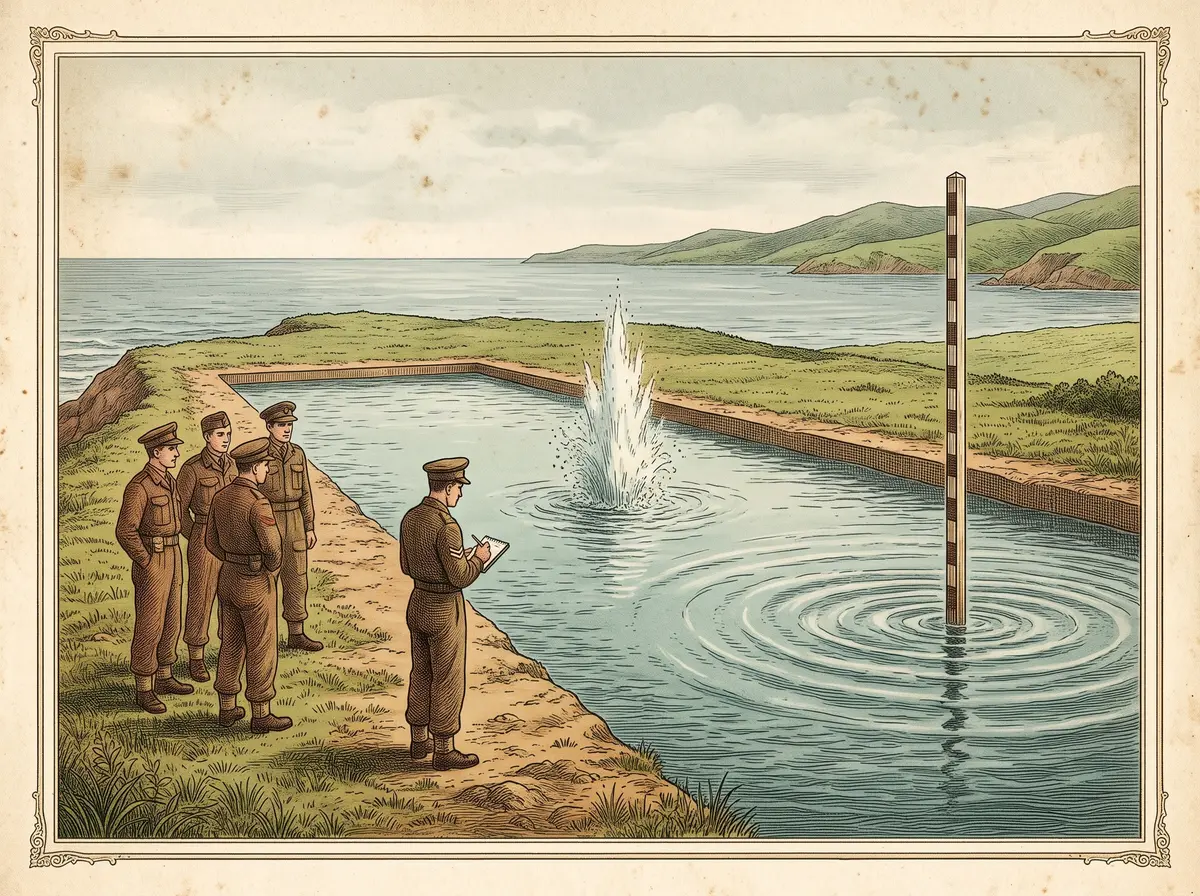
On 5 May 1944 the War Cabinet set up a research unit under Leech, and the project got a codename: Seal. About 150 people were assigned to it, working from a military site on the Whangaparaoa Peninsula. Engineers from the 24th Army Troops Company built an earth dam to create a testing pool about 365 meters long and 60 meters wide, and ran trials there and in nearby Shakespear Bay. The U.S. Navy supplied explosives. New Zealanders built the remote wave recorders and radio-controlled firing gear. According to the project’s later accounts, work began on 6 June 1944.
Over the next seven months the team set off about 3,700 explosions, using charges that ranged from a few grams to roughly 270 kilograms, mostly TNT. They varied the size, depth, and arrangement of the charges and measured the waves.
The results were not what anyone had hoped. A single explosion, however large, could not make a wave big enough to swamp a coastline. Leech concluded that it would take something on the order of 2,000 tons of TNT, split into about ten charges and set off together in a line several kilometers offshore, to raise a wave in the range of 30 to 40 feet (about 9 to 12 meters). Even then, the charges had to sit at just the right depth. Get it slightly wrong and most of the energy went somewhere other than the wave.
By early 1945 the war in the Pacific was turning, and Seal slid down the priority list. A planned full-scale ocean test at Taronui Bay, north of Kerikeri, was cancelled, and the unit closed on 8 January 1945. Leech’s formal report, Project Seal: The Generation of Waves by Means of Explosives, was not issued until December 1950. The files stayed secret for decades until New Zealand’s Ministry of Foreign Affairs and Trade released them in 1999.
Why it was strange: Project Seal's Tsunami Bomb
On paper, Project Seal sounds like a spy-thriller plot: a secret weapon made of the ocean itself. In practice it looked more like a very loud physics class, with a dammed-up pool, wave gauges, and thousands of small bangs.
The deeper surprise is how stubborn water turned out to be. An explosion releases a huge amount of energy in an instant, so it seems obvious that a big enough blast should push out a big enough wave. The Seal team found that most of that energy refused to cooperate. Earlier British studies had suggested that deep charges would work best, but the New Zealand tests found the best waves came from charges fired much nearer the surface. The window between “devastating” and “disappointing” was narrow.
Some modern writers have suggested Seal was partly a bluff aimed at the Soviet Union. That remains unsupported speculation.
For another wartime plan that ran into the plain stubbornness of nature, see The Government Expedition That Tried to Bomb Rain Out of the Texas Sky.
What scientists learned: Project Seal's Tsunami Bomb
Seal produced one of the earliest large, systematic data sets on explosion-generated waves, meaning waves created by a blast in or near water rather than by wind or earthquakes. Leech’s team showed that wave size depends heavily on charge depth and that one blast is far less effective than several timed together.
When the papers became public in 1999, Willem de Lange, an earth scientist at the University of Waikato, told the New Zealand Herald that a single explosion tends to send its energy upward rather than sideways. “You can’t confine the energy,” he said. Repeated blasts in the same spot could do much better, he explained, comparing it to sliding back and forth in a bath until the waves grow higher.
Later U.S. research pointed the same way. A 1968 handbook on explosion-generated water waves, prepared for the U.S. Office of Naval Research, concluded that such waves are relatively inefficient, because much of their energy is lost when they break over the shallow continental shelf before reaching the shore.
For another project that tried to bend nature into a weapon, see The Nuclear Landmine Britain Planned to Keep Warm With Live Chickens.
How it reaches us today: Project Seal's Tsunami Bomb
No tsunami bomb was ever built, but the physics Seal explored did not go to waste. In 1947 Leech was invited to help analyze wave data from the American nuclear tests at Bikini Atoll. Today, researchers who model tsunamis from underwater volcanic eruptions and landslides are working on a close cousin of Seal’s question: how does a sudden burst of energy under the sea turn into a wave, and how much of it reaches the coast?
New Zealand in particular has reasons to care. Scientists have studied whether future eruptions near Auckland could happen underwater, and the National Institute of Water and Atmospheric Research has modeled how an undersea landslide in the Kaikōura Canyon could raise a wave around 13 meters high. The goal now is warning and planning, not attack.
For a lighter wartime experiment with an equally ambitious premise, see The Jeep Britain Tried to Fly Like a Kite — and Got It Off the Ground Behind a Bentley. The bomb sits with the other experiments that did not come out, in The Experiment That Did Not Come Out.
Fun fact: Project Seal's Tsunami Bomb
By the accounts of the project’s own history, the Seal team began work on its secret wave weapon on 6 June 1944, the same day Allied troops landed on the beaches of Normandy.
Sources: Project Seal's Tsunami Bomb
- Thomas D. J. Leech, Project Seal: The Generation of Waves by Means of Explosives, Department of Scientific and Industrial Research, Wellington, 1950 (WorldCat record)
- “Making waves,” New Zealand Geographic
- “The best kept secret of World War Two: Project Seal, the tsunami bomb,” National Business Review
- Eugene Bingham, “Devastating tsunami bomb viable, say experts,” New Zealand Herald, 28 September 1999
- W. G. Van Dorn, B. LeMéhauté and L. Hwang, Handbook of Explosion-Generated Water Waves, Volume 1: State of the Art, Tetra Tech for the Office of Naval Research, 1968 (archived DTIC PDF)