The Two Rabbits a Retired Doctor Infected Behind His Estate Wall — and the Virus That Hopped It
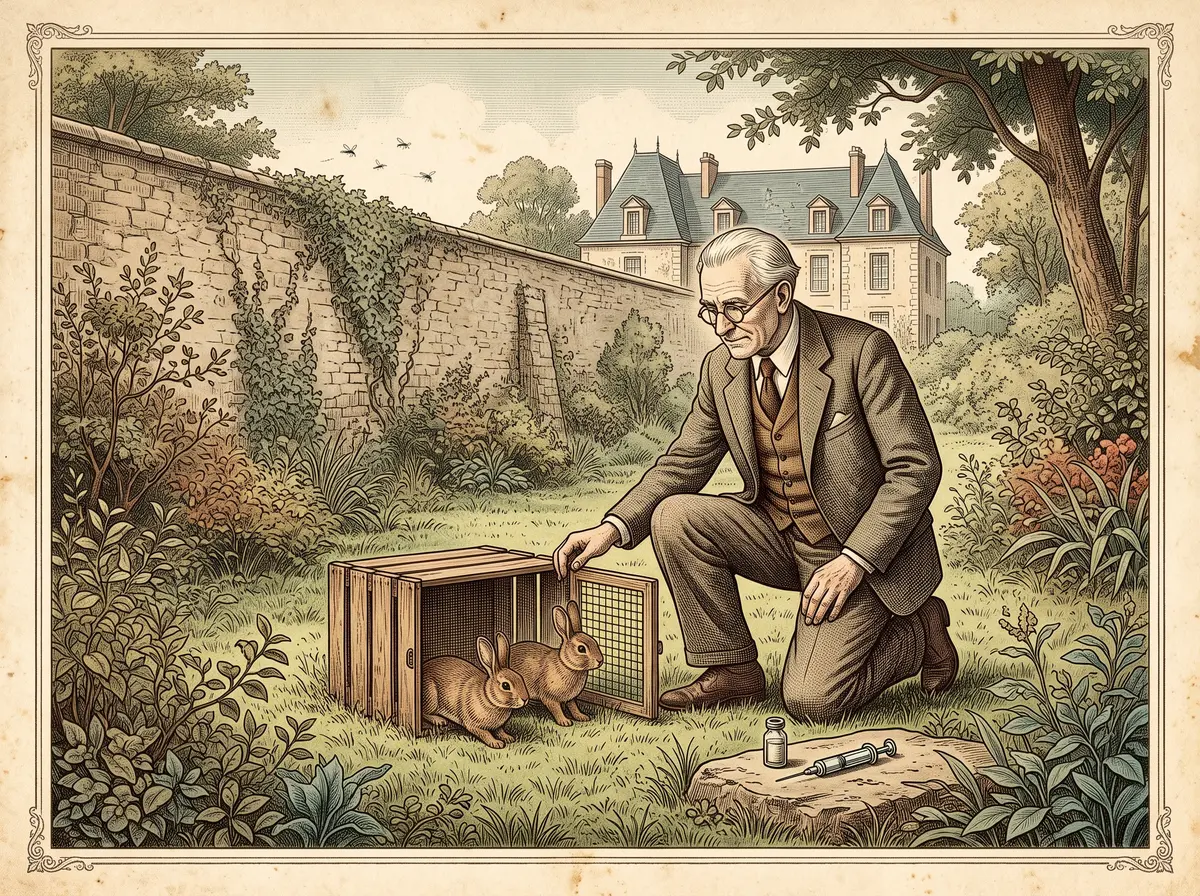
On 14 June 1952, at his walled country estate in Maillebois, France, a 77-year-old retired professor of medicine named Paul-Félix Armand-Delille inoculated two wild rabbits with a virus he had ordered from Switzerland. He only wanted the rabbits off his land. The wall, he figured, would take care of the rest. Within about eighteen months, the virus had reached every corner of France — and it was already crossing the Channel.
By the Curiosities Desk · · 5 min read · Filed under Biology · Today’s round
Part of When the Experiment Left the Lab
What happened: Myxomatosis in Rabbits
Armand-Delille was no amateur. Born in 1874, he had spent his career as a physician at the Paris Faculty of Medicine, specializing in infectious diseases in children, and he was a member of France’s Académie de médecine. In retirement he had a roughly 300-hectare property at Maillebois, in the Eure-et-Loir department northwest of Chartres — and a rabbit problem. The animals were eating his plants and crops.
He had been reading about Australia. In December 1950, Australian scientists had let myxoma virus loose among the country’s plague of European rabbits, and it had swept across the south-east of the continent in a single summer. Myxoma virus is a poxvirus that, in its natural host — a South American forest rabbit called the tapeti — causes little more than a skin lump. In European rabbits, which had never met it, it causes myxomatosis: swollen heads, eyes that puff shut, and death in most cases.
Through Switzerland, Armand-Delille obtained a sample of a laboratory strain known as the Lausanne strain. In June 1952 he infected two rabbits and released them. According to a 1988 review by French researchers C. P. Arthur and C. Louzis, he expected the outbreak to stay inside his property, which was enclosed by walls. Within two months, most of the rabbits on the estate were dead or sick.
The wall did not hold. Rabbits can dig, but the bigger problem was that myxoma virus does not need a rabbit to travel. It rides on the mouthparts of biting insects such as mosquitoes and fleas, which feed on one rabbit and then another. By autumn 1952, outbreaks had been recorded in several French departments. By the end of 1953, the entire country was declared contaminated. The virus turned up in England in October 1953, reached Italy and Spain by 1955–56, and had spread across most of Western Europe by the end of the decade.
The losses were staggering. Based on hunting records, Arthur and Louzis estimated that 90 to 98 percent of France’s wild rabbits died between 1952 and 1955. In Britain, the drop is estimated at 99 percent.
The reaction split France down the middle. Farmers and foresters, who had long battled rabbits gnawing crops and saplings, were delighted. Hunters, rabbit breeders, and furriers — rabbit fur was a real industry — were furious. Here the record gets murky. Several English-language accounts say Armand-Delille was prosecuted and fined in 1955; a French account in Slate says the opposite, that releasing the virus was not a crime at the time and he was never sanctioned. What is certain is that he made no secret of it: he described his release himself in a 1953 report to the French Académie d’agriculture.
Why it was strange: Myxomatosis in Rabbits
It’s rare that we can point to one person, one date, and two animals as the start of a continent-wide epidemic. Usually disease outbreaks have murky origins. This one has a street address.
It’s also strange because Armand-Delille was exactly the kind of person who should have seen it coming. He was an expert in infectious disease. But his expertise was in human patients, and the mistake was an ecological one: he treated a virus spread by flying, hopping insects as if it were a farm animal that a wall could pen in. Australia’s own release had already shown how fast and far the virus moved once it found mosquitoes.
He shares a shelf with the sugar planters in The Mongooses Hired to Hunt Rats — Who Worked the Day Shift, in When the Experiment Left the Lab.
What scientists learned: Myxomatosis in Rabbits
Myxomatosis became one of biology’s great natural experiments in evolution. In Australia, researchers tracking the virus found that, within a few years, slightly weaker field strains were taking over. A virus that killed its host very fast left less time for insects to pick it up and carry it on, so milder versions spread better. At the same time, the rabbits were evolving resistance. At one Australian study site, Lake Urana, the share of test rabbits killed by the field virus fell from 90 percent to 26 percent over about seven annual outbreaks.
Europe ran the same experiment in parallel, with the Lausanne strain from Maillebois. A 2015 review in the journal Viruses describes the two continents as a textbook case of a host and a pathogen evolving together in real time — a living model for how new diseases settle in after they jump to a fresh species.
For a very different deliberate release, see The Toad Australia Released to Fight a Pest.
How it reaches us today: Myxomatosis in Rabbits
The crash rippled up the food chain. On the Iberian Peninsula, the Iberian lynx depends on rabbits for more than 85 percent of its diet, and myxomatosis in the 1950s was the first of several rabbit crashes that have left the lynx short of food.
It also changed the law. Britain’s Pests Act 1954 made it an offense to knowingly use an infected rabbit to spread myxomatosis among healthy ones.
And the virus never left. Myxomatosis is still present in wild rabbits across Europe, which is why vets in many countries recommend vaccinating pet rabbits against it. (It does not infect people.) Today, any proposal to release a living biocontrol agent goes through years of testing, partly because of cases like this one.
Fun fact: Myxomatosis in Rabbits
According to widely repeated accounts, in June 1956 a former head of France’s forestry service presented Armand-Delille with a commemorative medal. One side shows his portrait. The other shows a dead rabbit.
Sources: Myxomatosis in Rabbits
- Arthur, C. P., & Louzis, C. (1988). “La myxomatose du lapin en France : une revue.” Revue scientifique et technique de l’Office International des Épizooties, 7(4), 937–957. https://laccreteil.fr/IMG/pdf/d8385pdf-626626e.pdf
- Kerr, P. J., Liu, J., Cattadori, I., Ghedin, E., Read, A. F., & Holmes, E. C. (2015). “Myxoma Virus and the Leporipoxviruses: An Evolutionary Paradigm.” Viruses, 7(3), 1020–1061. https://www.mdpi.com/1999-4915/7/3/1020
- Delibes-Mateos, M., Ferreira, C., Carro, F., Escudero, M. A., & Gortázar, C. (2014). “Ecosystem Effects of Variant Rabbit Hemorrhagic Disease Virus, Iberian Peninsula.” Emerging Infectious Diseases, 20(12). https://wwwnc.cdc.gov/eid/article/20/12/14-0517_article
- UK Parliament. Pests Act 1954, Part II, Section 12 (“Spreading of myxomatosis”). https://legislation.gov.uk/ukpga/Eliz2/2-3/68/part/II/enacted
- “C’est chaud pour les lapins.” Slate.fr. https://www.slate.fr/story/63093/lapins