Failed Experiments · Archaeology
Five Centuries of Trying to Raise Caligula's Lost Ships — Until Someone Drained the Lake
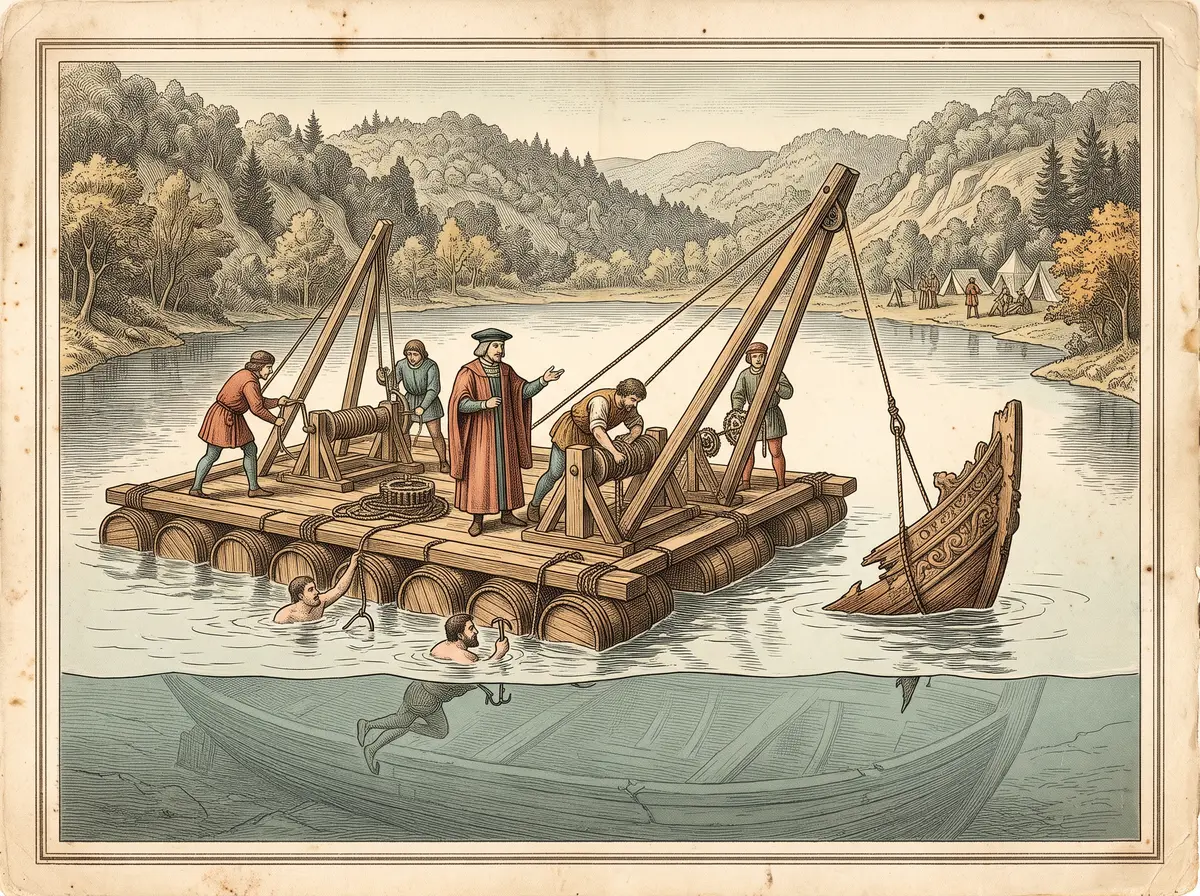
In 1446, on a small volcanic lake south of Rome, a floating raft of lashed-together wine casks bobbed above the most tantalizing wreck in Italy. Hired divers from Genoa, swimmers so skilled that the historian Flavio Biondo called them more like fish than men, went down to fix iron hooks into an ancient hull. The winches turned. The ropes strained. And what came up was a single splintered piece of the bow, while the rest of the ship stayed exactly where it had been for about 1,400 years.
By the Curiosities Desk · · 5 min read · Filed under Archaeology · Today’s round
What happened: Caligula's Ships
Lake Nemi sits in a volcanic crater in the Alban Hills, about 30 kilometers (19 miles) south of Rome. For centuries, local fishermen snagged their nets on something huge on the bottom, and they told stories of sunken palaces. The stories were true. Two enormous Roman ships lay in the mud. The larger was later measured at about 73 meters (240 feet) long and 24 meters (79 feet) wide, and the other at about 70 meters (230 feet) long. Neither was built for travel; there was nowhere to go on a lake covering less than 2 square kilometers (under a square mile). They were floating showpieces, decked out with marble, mosaics, and bronze fittings, and they were built in the first century AD for the emperor Caligula.
The first serious salvage attempt came in 1446. Cardinal Prospero Colonna, whose family controlled Nemi, recruited Leon Battista Alberti, the Renaissance architect and scholar, to bring a ship up. Alberti’s plan was sensible for its day: build a floating platform of empty barrels and beams, fit it with winches and cables, and have divers attach grappling hooks to the wreck. The ship would not budge from the mud. The cables kept snapping. The hooks tore off chunks of planking instead of lifting the hull. Alberti did learn something: the timber was high quality, and the hull was sheathed in lead. But the ship stayed down.
In 1535 a military engineer named Francesco De Marchi tried a new approach: going down there himself. He used a diving apparatus designed by a man called Guglielmo de Lorena, a wooden casing that fit over the diver’s head and shoulders, weighted with lead and fitted with a small glass viewing window. It is one of the earliest recorded dives with breathing equipment. De Marchi came back with bricks, bits of marble, bronze, lead, and timber beams. He also tried Alberti’s hook method and tore off still more of the hull.
Three centuries later, in 1827, a nobleman named Annesio Fusconi lowered a large diving bell from a floating platform and pumped air down to the men inside. Again the cables broke, again pieces of the wrecks came up without the wrecks themselves, and the project was abandoned. Later accounts add a memorable footnote: local people reportedly carried off the platform’s barrels to store their wine.
In 1895 an antiquities dealer named Eliseo Borghi sent divers in modern diving suits. They discovered there were two ships, not one, and brought up spectacular bronzes: lion and wolf heads that once held mooring rings, and a head of Medusa. They also pulled timbers off the hulls, and the Italian government stepped in to stop the stripping of the site.
Why it was strange: Caligula's Ships
For nearly 500 years, every attempt to recover the ships followed the same logic: get to the ship, grab it, and pull. And every attempt made the same mistake. The hulls were ancient, waterlogged, and stuck in mud. Pulling on them didn’t raise them; it took them apart. Each new expedition, however clever its equipment, left the ships a little more damaged than it found them.
The puzzle was finally solved by turning it upside down. Around the turn of the 20th century, naval engineer Vittorio Malfatti surveyed the wrecks and concluded they were too fragile to lift. His suggestion was to leave the ships where they were and take the lake away from them. It’s a story worth keeping next to The Bluestone Bound for Stonehenge That Sank 17 Miles Into a 240-Mile Trip, and it belongs on the shelf of The Experiment That Did Not Come Out.
What scientists learned: Caligula's Ships
Draining a crater lake sounds absurd, but the Romans had already provided the plumbing. An ancient drainage tunnel, an emissarium, ran about 1.65 kilometers (1 mile) through the crater wall to the valley below. Engineers under Guido Ucelli connected pumps to it, and on 20 October 1928 the pumps were switched on. By late March 1929 the first ship broke the surface. By the end of 1932 the second ship was clear of the water as well.
With the hulls finally out in the air, researchers could study Roman shipbuilding at a scale no one had seen before: the joinery of the planks, the lead sheathing that protected the hulls, bronze fittings and pumps. A lead pipe stamped with the name of Gaius Caesar Augustus Germanicus, the emperor better known as Caligula, settled whose ships they were. Earlier scholars, including Alberti, had guessed other emperors.
The ships were moved into a purpose-built museum on the lakeshore. Then, on the night of 31 May 1944, as the front line of World War II passed through the area, a fire destroyed both hulls. A commission at the time blamed retreating German soldiers. In 2023, archaeologist Flavio Altamura and historian Stefano Paolucci published research arguing that Allied artillery shells striking the museum were the more likely cause. The question is still debated. For another library of ancient material that survived disaster only to defeat its would-be rescuers for centuries, see The Library Burned by Vesuvius That AI Is Finally Reading.
How it reaches us today: Caligula's Ships
The bronzes recovered before the fire survive, and many are on display today, along with scale reconstructions of the ships at the Museum of the Roman Ships in Nemi. The Nemi saga also became an early cautionary tale for underwater archaeology. Its main lesson, that you can destroy a wreck by trying too hard to retrieve it, shapes how archaeologists work now. Many sites are recorded and left in place, and fragile hulls that are raised, like Sweden’s Vasa or England’s Mary Rose, are first given careful lifting cradles and long conservation treatment. The Nemi ships are also a reminder that a lost object sometimes waits for an idea rather than better equipment. Another story about prying too hard at an ancient monument is The Colonel Who Opened the Great Pyramid With Gunpowder — and Got His Drill Stuck in the Sphinx.
Fun fact: Caligula's Ships
The Nemi ships were identified not by a grand inscription but by plumbing: a lead water pipe stamped with Caligula’s name.
Sources: Caligula's Ships
- Flavio Altamura and Stefano Paolucci, “Una lente sull’incendio delle Navi romane di Nemi,” La Rivista di Engramma 203 (June 2023). engramma.it (PDF)
- National Maritime Museum of Ireland, “Roman wrecks of Lake Nemi.” mariner.ie
- James Grout, “The Nemi Ships,” Encyclopædia Romana (University of Chicago). penelope.uchicago.edu
- Direzione Regionale Musei Lazio (Italian Ministry of Culture), “L’incendio delle navi di Nemi” (2023). direzioneregionalemuseilazio.cultura.gov.it
- “Nemi ships,” Wikipedia (starting point; follow its citations to Ucelli’s Le navi di Nemi and Purtell 2001). wikipedia.org