Science Gone Wrong · Chemistry
The First Hydrogen Balloon Floated 13 Miles From Paris — and Villagers Attacked It With Pitchforks
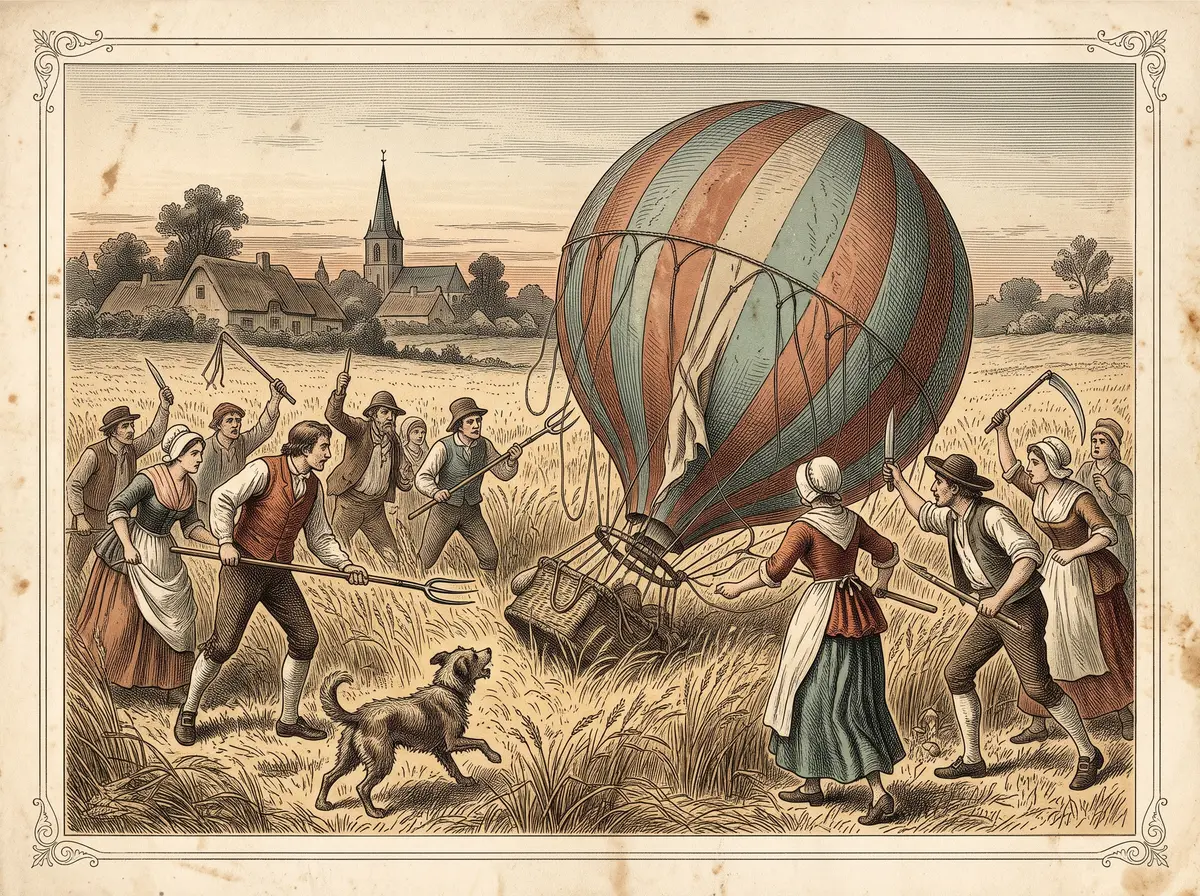
On a late August evening in 1783, a glistening sphere dropped out of the clouds into a field near Gonesse, a village north of Paris. When it touched the ground, it bounced. The people who ran out to meet it did what seemed sensible for a creature that had just fallen from the sky: they attacked it with stones and knives, and in later tellings pitchforks, until it lay in shreds. What they had killed was the world's first hydrogen balloon.
By the Curiosities Desk · · 5 min read · Filed under Chemistry · Today’s round
Part of When the Experiment Left the Lab
What happened: The First Hydrogen Balloon
The summer of 1783 was balloon summer in France. In June, the papermaking Montgolfier brothers had sent up a hot-air balloon in their hometown of Annonay, and Paris wanted a show of its own. The job went to Jacques-Alexandre-César Charles, a 36-year-old lecturer in physics and chemistry.
Charles skipped the Montgolfiers’ hot air and reached for “inflammable air,” which we now call hydrogen. The English chemist Henry Cavendish had described it in 1766. It weighs about a fourteenth as much as ordinary air, so a bag of it should float. The trouble is keeping it in the bag, because hydrogen leaks through almost anything.
For the bag, Charles teamed up with two brothers, Anne-Jean and Nicolas-Louis Robert, who had worked out how to dissolve rubber in turpentine. They varnished silk with it and stitched a sphere about 4 meters (13 feet) across. A public subscription paid for the project.
Making the gas was the hard part. Benjamin Franklin, then in Paris as the American envoy, described it as gas “produced by pouring Oil of Vitriol upon Filings of Iron,” oil of vitriol being an old name for sulfuric acid. Modern accounts put the quantities at roughly half a tonne of iron and a quarter tonne of acid. The reaction ran hot, the warm gas shrank as it cooled, and filling took days. It began on August 23 in the Roberts’ workshop, and the crowds that gathered grew so large that on the night of August 26 the balloon was moved in secret to the Champ de Mars, the military parade ground about 4 kilometers away.
The launch came on the afternoon of August 27, in the rain. Franklin estimated the crowd at “not less than 50,000 People.” Once released, the balloon climbed until, he wrote, it “seem’d to me scarce bigger than an Orange,” then disappeared into the clouds.
It flew for about 45 minutes and came down at Gonesse, roughly 21 kilometers (13 miles) away. In a letter to the Royal Society’s Joseph Banks that week, Franklin passed along the news: “It is said the Country People who saw it fall were frightned.” Because it bounced when it landed, he reported, they believed some living animal was inside, and they went at it with stones and knives until it was badly mangled. Prints of the scene show villagers with pitchforks, and the Metropolitan Museum of Art describes them dragging the remains across the countryside. The pitchforks may be artistic flourish, but the attack itself was reported by a witness to the launch within days.
The government soon issued a notice to the public, signed by two Paris officials, explaining the new discovery. A balloon in the sky, it said in translation, “is only a machine that cannot possibly cause any harm.”
Why it was strange: The First Hydrogen Balloon
Everyone in this story acted reasonably. The scientists had done something new: they made a gas in barrels and used it to lift an object into the clouds. The villagers, with no newspaper to warn them, saw a shiny, bouncing thing fall from the sky. Defending themselves was the logical move.
That gap is the strange part. One of the great leaps in the history of chemistry landed, literally, on people who had no way to know what it was, and the government had to explain to its own citizens that the sky was not attacking them. For another flight that went its own way, see The Balloon Built to Prove the Nazca Could Fly — Which Bounced Out Its Pilots and Flew On Without Them.
What scientists learned: The First Hydrogen Balloon
Franklin wrote that the globe was found “rent open,” and he suspected it had burst on its own. That makes sense. The bag was sealed with no way to vent gas. As it rose, the air pressure outside dropped, the hydrogen inside expanded, and the silk gave way.
Charles took the lesson. On December 1, 1783, he and Nicolas-Louis Robert rode a far larger hydrogen balloon up from the Tuileries Garden before a crowd of around 400,000. This one had a valve to release gas, a net to carry a basket, and sand ballast to drop for altitude. They flew about two hours and landed at Nesles-la-Vallée, 36 kilometers away. Charles then went up alone, rose to roughly 3,000 meters, and saw the sun again after it had set for the people below.
Charles also studied how gases swell as they warm. He never published it, but in 1802 the chemist Joseph Louis Gay-Lussac did and credited him. It’s still taught as Charles’s law: at steady pressure, a gas’s volume rises in step with its temperature. For a lighter take on homemade flight, see The Truck Driver Who Flew a Lawn Chair to 16,000 Feet on 42 Weather Balloons.
How it reaches us today: The First Hydrogen Balloon
Charles’s December balloon, with its envelope, valve, net, basket, and ballast, is essentially the layout of a modern gas balloon. Hydrogen went on to lift airships, and weather balloons today are still filled with hydrogen or helium and still burst high up as their gas expands, much as the first globe probably did. Franklin also turns up in The Turkey Benjamin Franklin Tried to Electrocute — and Shocked Himself Instead.
A popular story says Franklin, asked what use a balloon could be, replied, “What use is a newborn baby?” It’s a great line, but historians aren’t sure he said it. What he did write was that balloons might lead to discoveries “of which at present we have no Conception.” The landing belongs with the other experiments that left the lab, in When the Experiment Left the Lab.
Fun fact: The First Hydrogen Balloon
French still has two words honoring the summer of 1783: a hot-air balloon is a montgolfière, and a gas balloon is a charlière.
Sources: The First Hydrogen Balloon
- Benjamin Franklin to Joseph Banks, 30 August–2 September 1783, Founders Online, National Archives: https://founders.archives.gov/documents/Franklin/01-40-02-0342
- Science History Institute, “Artificial Clouds and Inflammable Air: The Science and Spectacle of the First Balloon Flights, 1783,” Distillations: https://sciencehistory.org/stories/magazine/artificial-clouds-and-inflammable-air-the-science-and-spectacle-of-the-first-balloon-flights-1783/
- Linda Hall Library, “Scientist of the Day: Jacques Alexandre Charles”: https://www.lindahall.org/about/news/scientist-of-the-day/jacques-alexandre-charles
- The Metropolitan Museum of Art, “The Villagers of Gonesse Alarmed by the Fall of J.-A.-C. Charles’s Balloon” (hand-colored etching, after 1783): https://www.metmuseum.org/art/collection/search/361967
- E. Charles Vivian, A History of Aeronautics (1921), Appendix C: “Proclamation published by the French Government on balloon ascents, 1783”: https://www.encyclopaedic.iovan.net/history-aeronautics/appendix-c