The Valentine's Day Particle That Showed Up Once — and Never Called Again
On Sunday, February 14, 1982, in an empty lab at Stanford University, the trace on a chart recorder suddenly jumped — and stayed jumped. Nobody was there to see it. When physicist Blas Cabrera came back the next morning, the paper showed a single, clean step of exactly the size he had spent months waiting for: the signature of a particle no human had ever detected. He had, it seemed, caught a magnetic monopole. He would spend years waiting for a second one.
By the Curiosities Desk · · 5 min read · Filed under Physics · Today’s round
What happened: Stanford on Valentine's Day
The idea Cabrera was chasing dated back to 1931, when the British physicist Paul Dirac published a paper asking a simple question: why do magnets always come with two ends? Cut a bar magnet in half and you don’t get a separate north and south — you get two smaller magnets, each with both poles. Dirac showed that the laws of quantum mechanics would allow a lone magnetic pole, a “monopole,” to exist. Better still, if even one existed anywhere in the universe, it would explain a long-standing puzzle: why every electric charge in nature comes in exact multiples of the electron’s charge.
By the 1970s, new “grand unified” theories, which try to describe several of nature’s forces as one, went further and predicted that monopoles were forged in the early universe. Physicists started building traps.
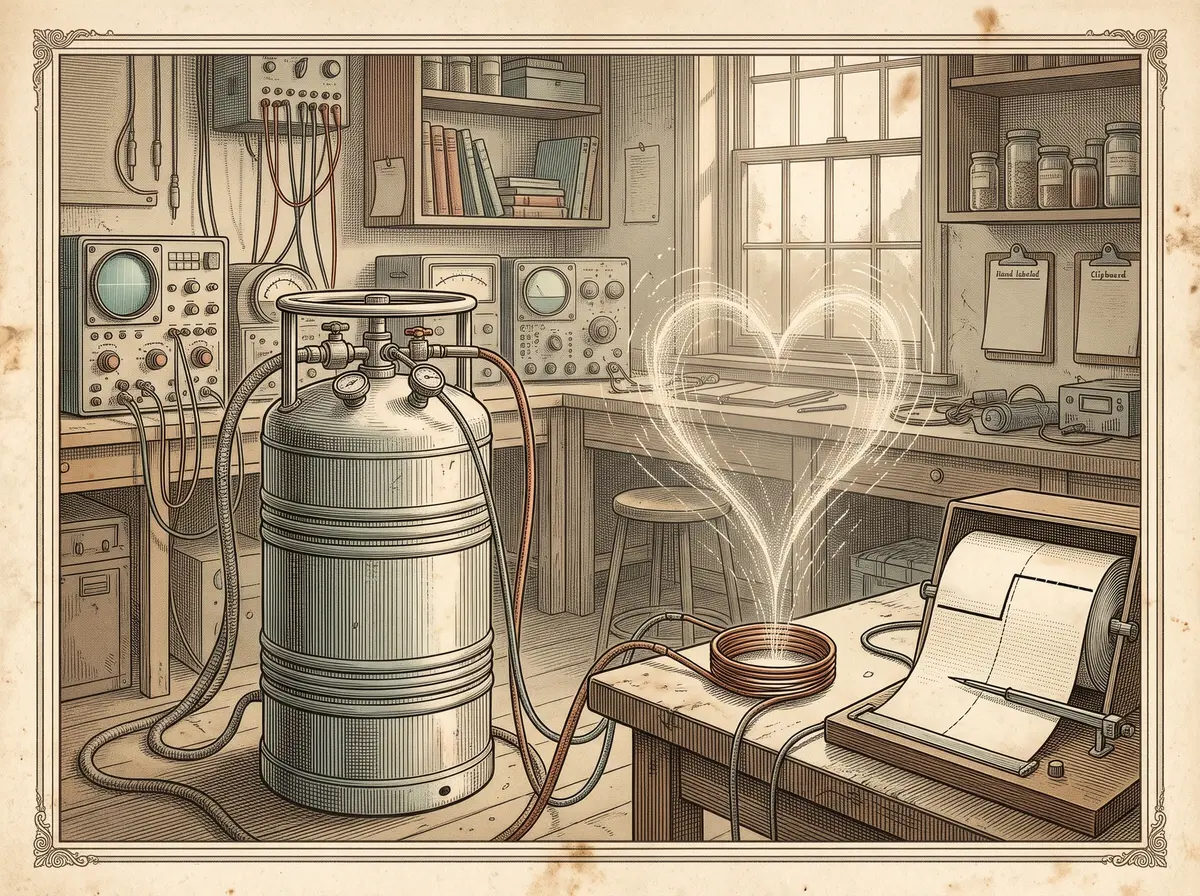
Cabrera, then a young Stanford physicist from a family of physicists (his father and grandfather were both Spanish scientists), designed one of the most elegant. It was a small loop of superconducting wire — wire cooled until it carries electricity with zero resistance — wound four times around and about 5 centimeters across, with its axis pointing straight up. The loop was wired to a SQUID, a superconducting device that can measure astonishingly tiny changes in magnetic field.
The beauty of the design was that it didn’t care how heavy or fast a monopole might be. An ordinary magnet passing near the loop would nudge the current up and then back down. A monopole passing through it would leave a permanent, one-way step in the current, and the size of that step was fixed by Dirac’s math. For a four-turn loop, one monopole should produce a jump of eight “flux quanta,” the smallest units in which magnetic flux comes inside a superconductor.
The detector ran for 151 days across five runs. Most of that time, it recorded the small background wobbles of any sensitive instrument. Then came Valentine’s Day. Early that Sunday afternoon, with the lab empty, the chart recorded a step of eight flux quanta — the right size, the right shape, in the right direction.
Cabrera did what careful scientists do. He looked for anything that could fake it: a stray tool, a mechanical jolt, a shift in the Earth’s field. He published the result in Physical Review Letters that spring under a deliberately modest title, “First Results from a Superconductive Detector for Moving Magnetic Monopoles.” He described one “candidate event” consistent with one Dirac unit of magnetic charge, and he openly noted that a mechanical disturbance could not be ruled out.
Then he — and soon labs around the world — waited for the second one. Bigger detectors went up, some more than a meter across, with extra loops to rule out false alarms. None ever saw anything like the Valentine’s Day event again.
Why it was strange: Stanford on Valentine's Day
Most failed experiments fail by finding nothing. This one failed by finding exactly one thing, perfectly, and then refusing to repeat it.
That is a cruel spot for a scientist. A single event can’t be thrown out just because it’s inconvenient, but it can’t be trusted either. Science runs on repetition, and one data point is a story, not a measurement. Even the timing worked against Cabrera: an unattended Sunday ruled out a careless colleague, but it also meant nobody had watched the moment happen.
There was a cosmic problem too. If monopoles were common enough for a 5-centimeter loop to catch one in five months, they would have drained the Milky Way’s magnetic field long ago. Astronomers had already worked out an upper limit on monopole numbers, now called the Parker bound, and Cabrera’s lone event implied far more. Other one-time sightings have dissolved under scrutiny, like the faster-than-light result in The Loose Cable That Made Neutrinos Outrun Light for Five Months.
What scientists learned: Stanford on Valentine's Day
To this day, no one knows what caused the event. Most physicists now suspect some rare mechanical or electrical glitch, but no specific culprit was ever found. Cabrera himself never claimed more than a candidate.
What the field learned was how to hunt properly. The follow-up detectors added multiple overlapping loops so that a real monopole would register in several places at once, while a jolt to the apparatus would look different. Every empty result tightened the limits on how many monopoles can be drifting through space. The Valentine’s Day event became a textbook lesson in why one extraordinary result needs an independent second look, a lesson physics had learned before in N-Rays: The Radiation 300 Scientists Saw That Was Never There.
The search also fed cosmology. One reason the leading theory of the early universe, cosmic inflation, caught on in the early 1980s is that it explains why monopoles are so rare: a burst of rapid expansion would have spread them out so thinly that we might never meet one.
How it reaches us today: Stanford on Valentine's Day
The hunt never fully stopped. The MoEDAL experiment at CERN’s Large Hadron Collider is built specifically to look for monopoles created in particle collisions, and the IceCube neutrino observatory in Antarctic ice sets some of the strictest limits on monopoles from space. Meanwhile, materials scientists have found “monopole-like” behavior inside exotic crystals called spin ices — not true free particles, but a nod to Dirac’s idea.
Cabrera’s sensitive superconducting know-how also found a new target. He went on to help lead the Cryogenic Dark Matter Search, which uses ultra-cold detectors to hunt for another particle nobody has yet confirmed: dark matter. Like the monopole hunters, those physicists know the value of waiting a very long time for nothing, as did the builders of The Ether-Hunting Machine That Found Nothing — and Broke Physics. The trace sits with the other experiments that did not come out, in The Experiment That Did Not Come Out.
Fun fact: Stanford on Valentine's Day
A year later, on Valentine’s Day 1983, Nobel laureate Steven Weinberg reportedly sent Cabrera a poem: “Roses are red, violets are blue, it’s time for monopole number TWO!” It still hasn’t arrived.
Sources: Stanford on Valentine's Day
- B. Cabrera, “First Results from a Superconductive Detector for Moving Magnetic Monopoles,” Physical Review Letters 48, 1378 (1982): https://doi.org/10.1103/PhysRevLett.48.1378
- P. A. M. Dirac, “Quantised Singularities in the Electromagnetic Field,” Proceedings of the Royal Society A 133, 60–72 (1931): https://doi.org/10.1098/rspa.1931.0130
- R. A. Carrigan Jr. and W. P. Trower, “Magnetic monopoles,” Nature 305, 673–678 (1983): https://www.nature.com/articles/305673a0
- “Magnetic Monopoles — From Dirac to the Large Hadron Collider” (review, arXiv, 2026): https://arxiv.org/abs/2605.02869
- Big Think, “The Valentine’s Day monopole”: https://bigthink.com/?p=152248